


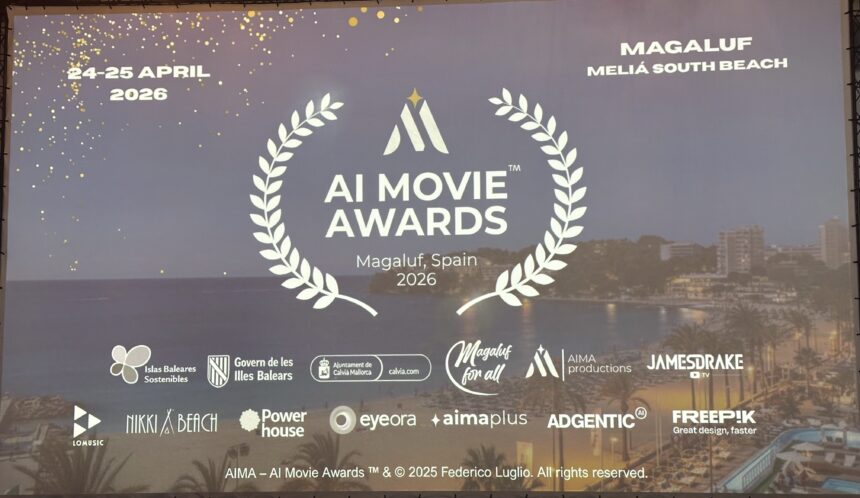
I spent two days at the world’s first AI film festival in Calvià. The films were not perfect. The potential was undeniable.
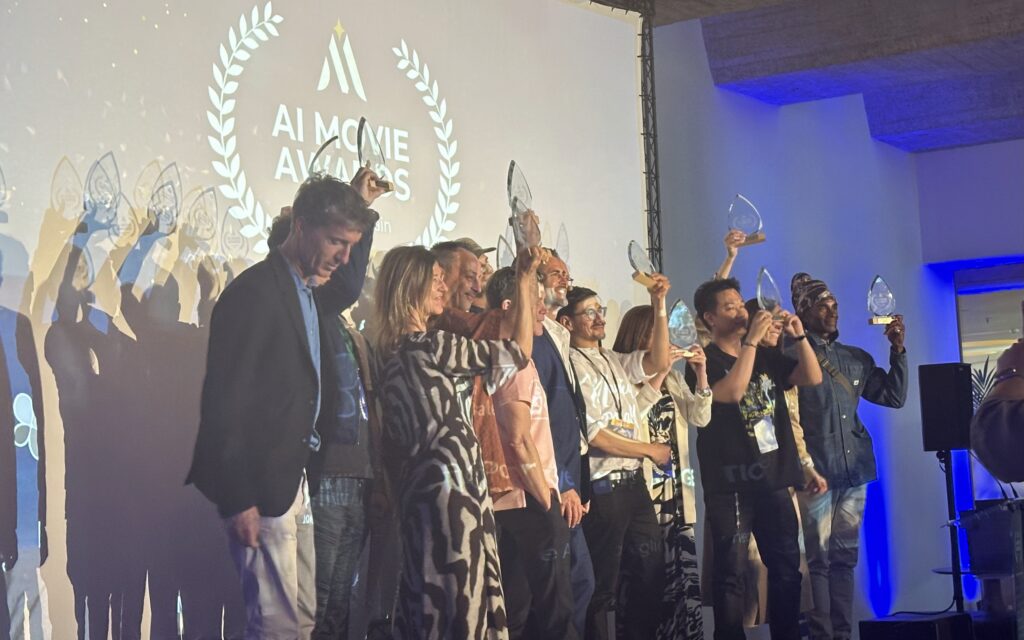
I walked into the Meliá Calviá Beach on 24 April 2026 as a VIP press guest. I left two days later as a genuine believer — not in AI replacing filmmakers, but in AI as a tool that is already changing what storytelling can be. The AI Movie Awards — known as AIMA — just completed its inaugural edition in Magaluf, Mallorca. It drew filmmakers, producers, researchers, and creators from South Korea, Colombia, Brazil, the United States, and across Europe. It received more than 300 submissions from directors, digital creators, and pioneers worldwide. By any honest measure, it exceeded expectations.
Federico Luglio — the festival’s founder and director — and Pedro Barbadillo — its executive producer — built something real here. That deserves to be said plainly, before anything else. This is not a vanity festival. It is a serious platform for a new kind of filmmaking that most of the entertainment industry has not yet figured out how to categorise. AIMA is doing that categorization work — and doing it on a Mediterranean island, in partnership with the Calvià municipality, with jury members who have produced Top Gun: Maverick and won at Cannes.
What’s Happening & Why It Matters
Day One: “Tomorrow Is Today”
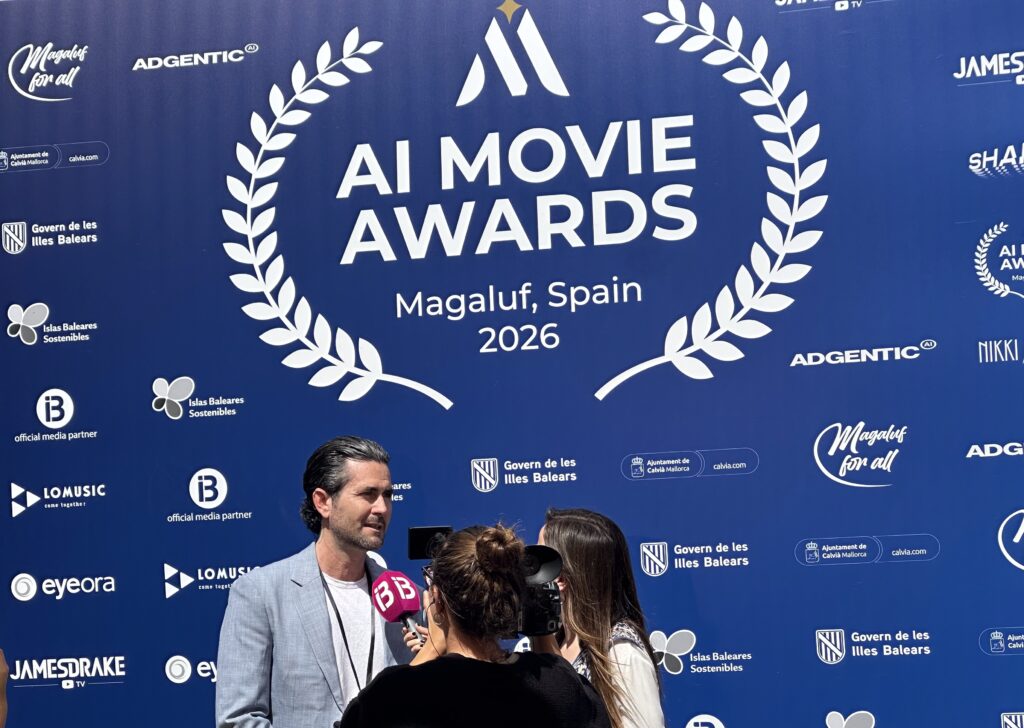
The opening keynote set the tone immediately. Luglio stepped to the front and articulated the festival’s founding principle directly. AI does not exist to stop storytelling. It exists to spread its limits. His phrase — “Tomorrow is Today. The time and the place is Calvià” — came with more weight than a promotional slogan. It was a statement. AIMA is not waiting for the industry to arrive at AI filmmaking. It is building the space where that arrival happens.
Barbadillo followed with context. Generative AI tools have progressed from Sora’s early video clips to full cinematic pipelines in under two years. The practical implication is startling. A person with a laptop and creative vision can produce work that would have required Disney’s 600-person engineering team when the first Avengers films were being made. That comparison is not hyperbole — it is the new arithmetic of production. The shift, as Barbadillo stated it, is not from budget to technology. It is from budget to vision. Tools are abundant. The differentiator is what you have to say.
The Films: Uneven, Astonishing, and Honest
The screenings were the heart of the festival. Over two days, the jury — including Fab Morvan and jury member Tommy Harper — watched more than 80 films. I watched a significant number of them alongside the audience.
Here is my honest assessment. The films are not uniformly polished. Some show the seams of AI generation — repetitive visual patterns, slightly uncanny human movement, occasional tonal inconsistency. Anyone expecting the narrative sophistication of a feature-length studio production will find moments of immaturity. That critique, however, misses the point entirely. The films were made by individuals. Many were made by people who have never had access to production infrastructure before. The best of what I saw was genuinely extraordinary — compositions, colour palettes, and emotional resonance that would hold their own in any short film festival, anywhere in the world.
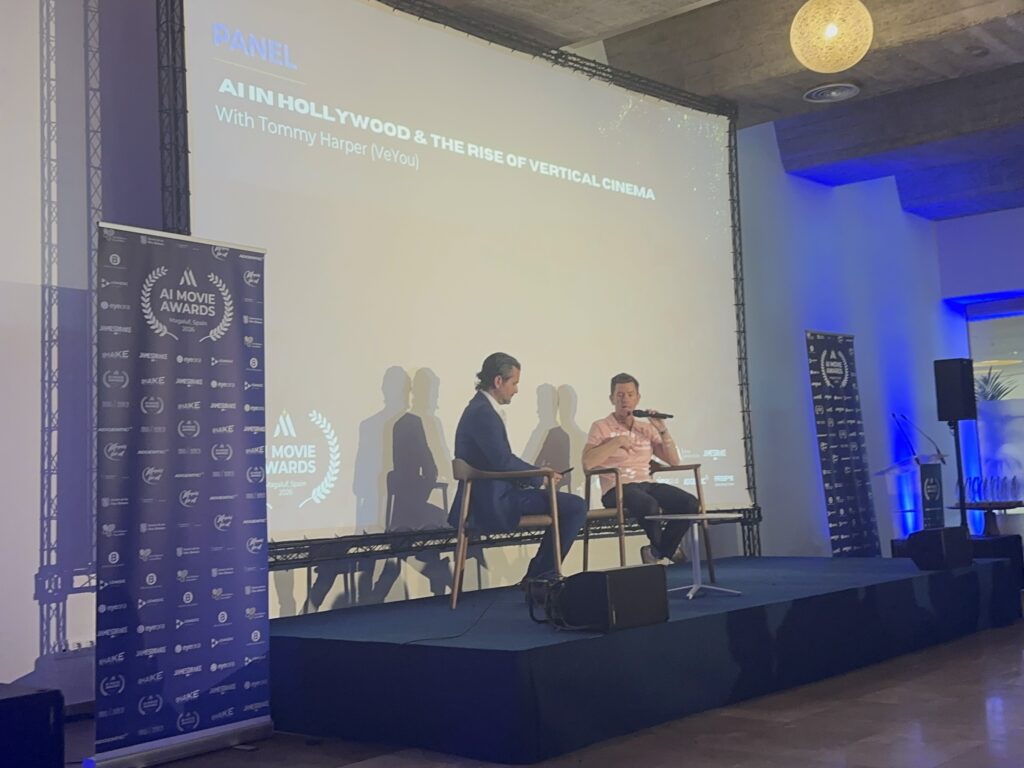
One of the most widely shared quotes from the festival captured it precisely. A jury member described certain AI-generated sequences as “quite mind-blowing… very hard to look at those images and believe they were done by an AI model.” I felt that too. There were moments in the screening room when the audience went quiet — not because the technology was impressive, but because the story was working.
The Roundtable: AI as Opportunity and Threat
Day One’s roundtable brought together Mike Day, CEO of Palma Pictures and Jeffrey Perlman, the branding strategist behind Zumba and Mindvalley. The conversation ranged across AI ethics, commercial applications, and the challenge of audience attention. Their central thesis: AI is both an opportunity and a threat. The distinction between those outcomes depends almost entirely on how creators use it.
Perlman’s contribution stayed with me. Building the next great entertainment property is about accepting the inspiration wherever it comes from — and then executing on it with genuine human intent. Brands, he argued, will eventually build entire universes in AI. Apple, BMW Films — the companies that understand storytelling as identity have always moved first. AI simply accelerates the surface on which that storytelling happens. The talent will raise the bar. The tools will not be the ceiling. In ten years, the question will not be whether AI helped make a film. The question will be whether the story was worth telling.
Day Two: History, Ethics, and a Hackathon
Day Two opened with a session from Emma Broussard of Freepik Studios, who walked through her practical workflow — cycling through the latest generative tools as fast as they release. Veo, Seedance, Kling, Sora. That flexibility is itself a skill. The AI filmmakers performing at the highest level are the ones who treat the toolkit as a living, updating resource — not a fixed software stack. The challenge she presented — “That Master That Walks into the Present” — tasked creators with depicting a historical figure appearing in our world for one minute. The results were remarkable. Historical immersion, rendered entirely through generative AI.

Vittoria Mascellaro — a PhD researcher in film and AI — delivered one of the most intellectually grounding presentations of the two days. She proposed dividing the history of AI and cinema into three phases. The first phase began in the 1970s with films like Metropolis — films that depicted robots as a concept. The second phase arrived in the 1990s with Toy Story and its peers — films that used technology to reduce production time and extend visual possibility. The third phase began in 2016 — when a film script was produced fully by AI, and AI became a co-agent and co-creator in the creative process. It places AIMA not at the beginning of a story, but at the start of a third distinct chapter.
One of the most energetic events was the Hackathon, run by Freepik and James Drake TV. Participants created complete short films in three hours. The quality of the winning entries was genuinely surprising. Under time pressure and competitive conditions, creators produced work of technical and narrative sophistication that would have taken weeks with traditional tools. That speed — and the creative density it enables — is the most important practical demonstration AIMA delivered.
AIMAPLUS.TV: The Netflix of AI Cinema
One announcement from Day One deserves specific attention. AIMAPLUS.TV launched at the festival. The platform positions itself as the first dedicated streaming service for AI-generated cinema. Think of it as the Netflix model applied to this new wave of AI storytelling — a curated destination where the best AI films find an audience beyond the festival circuit. The launch is early-stage, but the intent is clear. AIMA is not just an awards ceremony. It is building the distribution infrastructure that AI filmmaking needs to reach viewers at scale.
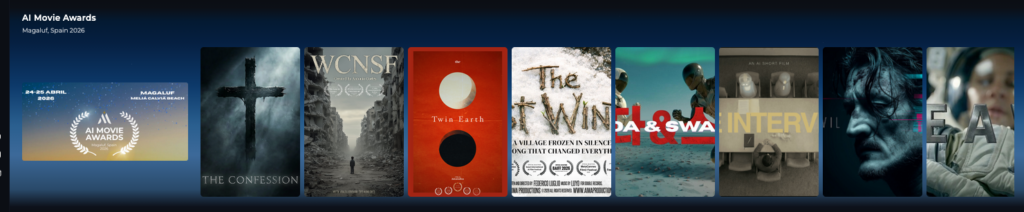
The infrastructure is influential for a specific reason. The films being made by AI filmmakers today are not finding their audience through traditional distribution channels. Studios and streaming platforms have not yet built acquisition frameworks for AI-generated content. AIMAPLUS.TV closes that gap — or at least begins to. It gives creators a home for their work and viewers a place to discover it.
What the Festival Did for Calvià — and for Mallorca
The Calvià municipality supported AIMA as part of its “Year of Cinema” initiative and the Magaluf for All responsible tourism campaign. That orienting — establishing a global AI film festival as a pillar of sustainable, culturally enriched tourism — is exactly the kind of lateral thinking that tourism-dependent destinations need right now. Calvià is not just hosting a beach holiday. It is positioning itself as an address for international creative innovation.
Local and regional press in the Balearic Islands covered the festival extensively. That coverage matters for the island’s self-image as much as for the event’s reputation. Mallorca has extraordinary natural beauty, a rich culinary culture, and a growing creative community. AIMA adds another dimension — one that is internationally legible, technologically forward, and genuinely original.
TF Summary: What’s Next
The AI Movie Awards first edition is over. The second edition is already being discussed. The rate of improvement in AI filmmaking tools is not linear — it is compounding. New model releases from Runway, Kling, Sora, and Veo arrive every few weeks, each one extending what a solo creator can produce. By the time the second annual AIMA arrives in 2027, the films on screen will be longer, more complex, and more emotionally sophisticated than anything shown this April. The gap between what the audience expects and what the technology can deliver is closing faster than anyone anticipated.
MY FORECAST: That trajectory is the real story from Calvià. AI filmmaking is not a finished product. It is a medium in rapid formation. The open questions are genuine — about authorship, about ethics, about how the entertainment industry will eventually integrate and value this work. AIMA does not pretend those questions are resolved. What it does instead is build the community and the platform to work through them together — in public, with creative rigor, on a beautiful island in the Mediterranean. Frederico built something worth coming back for. I will be there for the second edition. And TF will be covering it.