


Rivian’s retired EV battery packs are now powering Rivian’s own factory. That is not a recycling story. It is an energy strategy.
Electric vehicle batteries do not retire when a car does. Furthermore, they often retain significant usable capacity long after they are no longer suitable for vehicle power. Rivian and Redwood Materials are putting that insight to work in a landmark partnership. The two companies have deployed a second-life battery energy storage system at Rivian‘s manufacturing facility in Normal, Illinois. Furthermore, the system is described as the largest repurposed battery energy storage system ever installed by a US automotive manufacturer. The project gives retired Rivian battery packs a new job — keeping the factory running during peak demand periods, reducing electricity costs, and supporting local grid stability.
The initial deployment uses more than 100 retired Rivian battery packs to deliver 10 megawatt-hours (MWh) of dispatchable energy. Furthermore, the system is explicitly designed to scale. Consequently, what begins as a factory-floor energy project could become a model for how the entire automotive industry manages the growing mountain of spent EV batteries accumulating across North America.
What’s Happening & Why It Matters
The Partnership: Rivian Supplies, Redwood Integrates

The mechanics of the deal are straightforward. Rivian supplies its retired battery packs to Redwood Materials. Furthermore, Redwood integrates those packs into what it calls the Redwood Energy system. That system is managed through Redwood‘s proprietary Pack Manager technology. Pack Manager controls the safe operation, charging, and discharge of the second-life battery array. It dispatches stored electricity on-site when Rivian‘s factory needs it most.

The target moment is peak demand. During periods of intense electricity consumption — hot days, production surges, or grid stress events — Rivian can instantly draw on the stored energy from its own retired battery packs. Furthermore, this means the factory avoids purchasing more expensive electricity from the grid at precisely the moments when grid power costs the most. Additionally, by absorbing factory load during peak periods, the system reduces strain on the broader power network. Consequently, both Rivian and the regional grid benefit simultaneously.
Why Normal, Illinois? The Factory Context
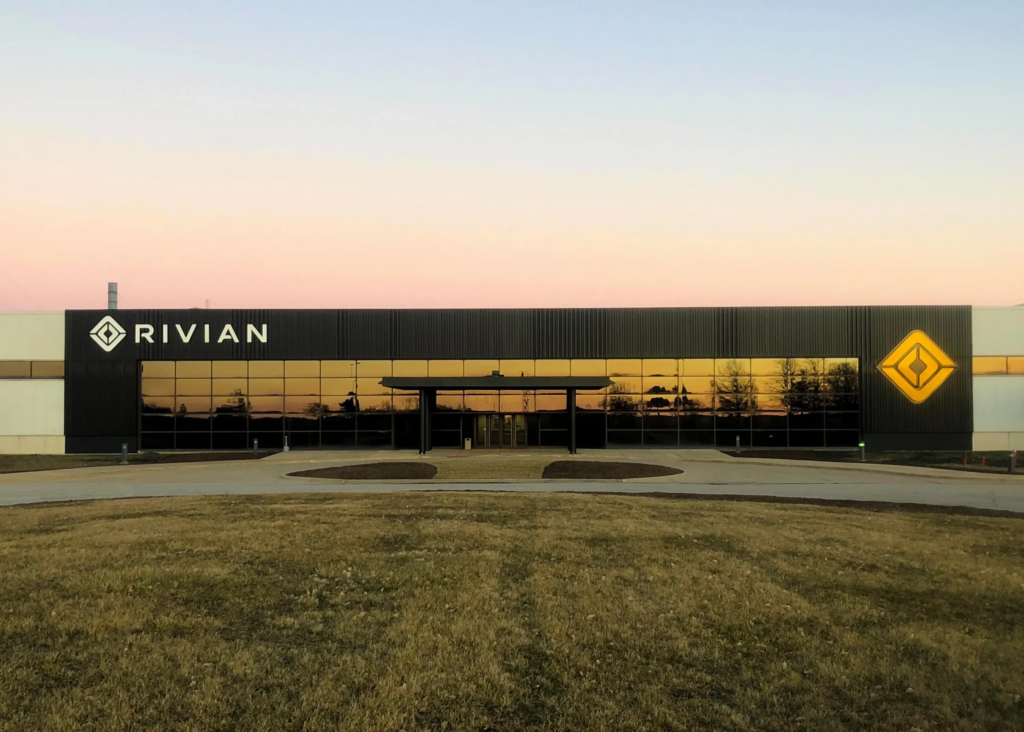
Rivian‘s Normal, Illinois facility is the company’s primary manufacturing plant. Furthermore, it has a maximum annual production capacity of 215,000 vehicles. The factory is already the birthplace of the Rivian R1T pickup truck and R1S SUV. Additionally, it manufactures the company’s commercial delivery vans. Consequently, the facility operates at significant scale — generating substantial electricity demand at all hours.
Large manufacturing sites face a structural energy cost problem. Electricity prices spike during peak demand windows. Furthermore, the factory cannot simply stop production to avoid high-cost periods. Therefore, on-site energy storage provides a genuine economic solution. The stored energy from second-life battery packs costs far less to deploy than purchasing and installing new stationary battery systems. Furthermore, those retired EV packs are already available in-house — no external procurement required.
What Makes This System Different
Several aspects of this project stand out from conventional energy storage installations. Furthermore, the most significant is the source of the batteries. Traditional stationary energy storage systems purchase newly manufactured battery cells. This project uses cells that have already completed a first life inside electric vehicles. Additionally, this approach addresses a growing supply-chain challenge for the energy storage industry — demand for new battery materials is intensifying while domestic supply chains remain constrained.
Second-life batteries offer a faster path to adding storage capacity. Redwood Materials CEO and Founder JB Straubel — former CTO of Tesla — explained the urgency. “Electricity demand is accelerating faster than the grid can expand, posing a constraint on industrial growth,” he said. Furthermore, Straubel noted that Redwood‘s approach “brings new capacity online quickly, supporting critical manufacturing, and reducing strain on the grid without waiting years for new infrastructure. This is a scalable model for how we add meaningful energy capacity in the near term.”
Additionally, Rivian Founder and CEO RJ Scaringe articulated the strategic logic from the vehicle maker’s perspective. “EVs represent a massive, distributed and highly competitive energy resource,” he said. “As energy needs grow, our grid needs to be flexible, secure, and affordable. Our partnership with Redwood enables us to utilise our vehicle’s batteries beyond the life of a vehicle and contribute to grid health and American competitiveness.”
The Technology: Pack Manager and Redwood Energy
Redwood Materials launched its Redwood Energy division in June 2025. Furthermore, the division was built on Redwood‘s existing position as North America’s leading lithium-ion battery recycler. The company recovers more than 70% of all used or discarded battery packs in North America. Over the 18 months preceding the Rivian partnership, Redwood observed that incoming EV battery packs retained better quality than anticipated. Consequently, immediate recycling was economically inefficient. A second-life deployment made more sense first.
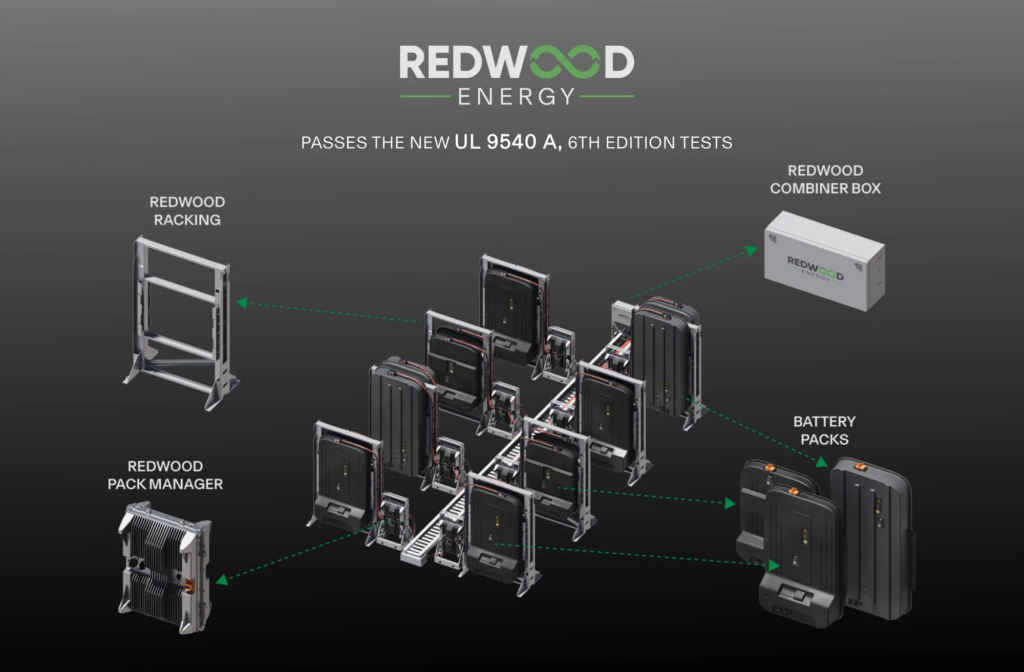
The Pack Manager technology is the core enabler. It monitors each individual battery pack’s state of health, charge level, and temperature in real time. Furthermore, it coordinates discharge and recharge cycles to maximise both performance and longevity. Additionally, the system manages the transition from second-life use to eventual recycling when battery capacity finally degrades below a useful threshold. Consequently, Redwood manages the complete battery lifecycle — from vehicle retirement through second-life storage and ultimately to material recovery.
Redwood’s Ambitions — and Its Investors
The Rivian project is one data point in a much larger strategy. Furthermore, Redwood Materials raised $425 million (€391 million) in a Series E funding round, with Google and Nvidia joining as strategic investors alongside Goldman Sachs and Capricorn. Additionally, Nvidia‘s investment reflects a direct connection between AI infrastructure and energy storage. AI data centres consume electricity at unprecedented rates. Some facilities require as much power as small cities. Consequently, fast-deployable, cost-effective energy storage is not just a clean energy priority — it is an AI infrastructure priority.
Redwood is targeting gigawatt-hour scale deployments across data centres, renewable energy projects, industrial applications, and utility-scale installations. Furthermore, the company has already completed a 63 MWh second-life battery microgrid powering two data centres. The Rivian project adds manufacturing to that portfolio. Additionally, Redwood‘s partnership with General Motors — which uses both new and end-of-life GM battery packs for stationary storage — demonstrates that the model is not exclusive to Rivian. The automotive industry as a whole is a potential supplier.
Furthermore, Porsche has deployed a comparable system at its plant in Leipzig, Germany — using second-life batteries from the Taycan electric sports car to power the production facility. The system there occupies roughly the space of two basketball courts. Consequently, precedent for large-scale second-life automotive battery storage already exists in Europe. Redwood and Rivian are establishing the first equivalent at this scale in the United States.
The Grid Problem This Addresses
The timing of the Rivian-Redwood project is not coincidental. Furthermore, US electricity demand is growing faster than grid infrastructure can expand. Data centre construction, EV charging networks, manufacturing reshoring, and electrification of buildings are all compounding simultaneously. Consequently, industrial users face higher peak energy costs and greater grid uncertainty. New transmission infrastructure typically takes years to permit and build. Second-life battery systems can be deployed in months. Therefore, repurposed EV batteries represent a near-term solution to a near-term crisis.
Additionally, the domestic supply chain dimension matters. Redwood Materials recovers critical materials — lithium, nickel, cobalt, and copper — from used batteries, feeding them back into new battery production. Consequently, every battery pack that completes a second life before recycling extends the useful value extracted from those materials. Furthermore, it reduces pressure on mining and refining operations that are already strained by global EV demand.
TF Summary: What’s Next
The 10 MWh Normal, Illinois deployment is the first phase. Furthermore, Redwood Materials has confirmed the system is designed to scale — meaning the Normal facility could expand its second-life battery storage well beyond the initial capacity. Additionally, the Redwood and Rivian agreement currently applies specifically to the Normal plant. It does not yet include the broader multi-year battery supply and recycling relationship that Redwood maintains with General Motors. Consequently, future expansion of the partnership to cover additional Rivian facilities — including the planned Georgia plant — is a natural next step.
Furthermore, the broader second-life battery storage market is at an early but rapidly accelerating point. Redwood‘s VP of Business Development Claire McConnell confirmed the company’s focus for 2026 is converting its backlog into operational deployments. “We’re talking about gigawatt-hours of deployments in the coming years, and we think we can play a really meaningful role in the overall battery energy storage market,” she said. Consequently, the Rivian project is not just a factory energy initiative — it is a proof-of-concept for an emerging industrial model. If it demonstrates the cost benefits and system performance Redwood projects, the model is likely to spread rapidly across US automotive manufacturing.