


Britain just bet £599 million on a factory-built nuclear future — and Rolls-Royce is building it.
Nuclear power just got a serious upgrade in Britain. On 13 April 2026, Rolls-Royce SMR and the UK government’s Great British Energy – Nuclear (GBE-N) signed a landmark contract to deliver the United Kingdom’s first Small Modular Reactors (SMRs). Furthermore, the National Wealth Fund committed up to £599 million ($754 million / €694 million) in loan financing to back the programme. As a result, Britain’s long-discussed nuclear renaissance has moved from policy paper to concrete construction plan.
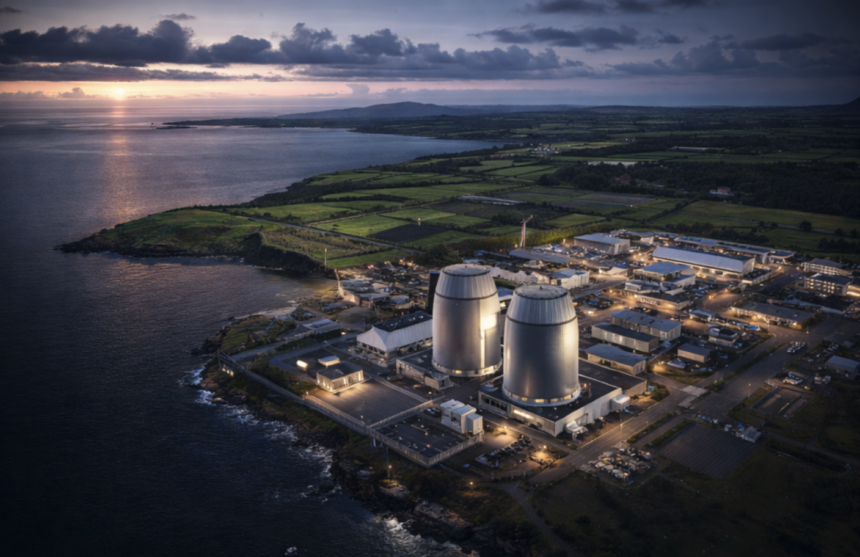
The reactors will be built at Wylfa, on the coast of Ynys Môn (Anglesey) in North Wales — a site with more than four decades of nuclear heritage. Three SMR units are planned initially. Additionally, the site has the potential to host up to eight units, subject to future decisions. Each unit will generate 470 megawatts (MW) of clean electricity. Together, the first three units will produce at least 1,400 MW — enough to power roughly three million homes for over 60 years. Consequently, this is not just an energy story. It is a defining moment for British industrial ambition.
What’s Happening & Why It Matters
What Exactly Is a Small Modular Reactor?
Traditional nuclear power stations are enormous, expensive, and slow to build. Hinkley Point C, for instance, is projected to cost around £35 billion ($44 billion / €40.5 billion). By contrast, each Rolls-Royce SMR unit is estimated to cost approximately £1.8 billion ($2.3 billion / €2.1 billion) at full production scale. Moreover, SMRs are built differently. Rather than constructing a bespoke plant from scratch at a single site, they use standardised, factory-built components that are transported and assembled on location. As a result, construction timelines are significantly shorter.
The Rolls-Royce design targets a 500-day construction window once on-site work begins. Furthermore, each reactor is on 10 acres (4 hectares) of land — a fraction of the footprint required by conventional nuclear stations. The target build time from start to commissioning is four years, split between two years of site preparation and two years of construction and commissioning. Consequently, this modular approach offers something traditional nuclear projects seldom provide: cost and schedule certainty. Rolls-Royce SMR Chief Executive Chris Cholerton described the contract as unlocking “a standardised, factory-built approach” that “transforms the way nuclear projects are delivered.”
The £599 Million Deal and What It Unlocks

The contract signed on 13 April 2026 is not just a handshake. It is a firm, contractual mandate. Therefore, Rolls-Royce SMR can begin site-specific design work, order critical components from the supply chain, and ramp up recruitment. Meanwhile, the National Wealth Fund loan of up to £599 million ($754 million / €694 million) is structured specifically to de-risk the programme for private investors. In other words, public money attracts private capital. The loan is repaid either when Rolls-Royce SMR begins deploying reactor units globally or through a future refinancing event.
The total government commitment to the SMR programme is considerably larger. In the 2025 Spending Review, the Chancellor allocated over £2.6 billion ($3.3 billion / €3.0 billion) for the programme. Additionally, more than £350 million ($441 million / €406 million) in contracts has already been awarded to British firms. These include Mace Consult, Turner & Townsend, and WSP. Furthermore, BAM Nuttall, Laing O’Rourke, and Atkins are part of the core design consortium.
Chancellor Rachel Reeves described the investment as one that will “strengthen our energy security, create skilled jobs and help to build a new generation of homegrown nuclear technology that will power our economy for decades to come.”
Jobs, Wales, and a Generational Opportunity
The economic case for Wylfa is compelling. At peak construction, the project will support around 3,000 jobs directly at the Anglesey site. Additionally, a further 5,000 jobs will be created across the national supply chain. Furthermore, the programme supports an average of nearly 8,000 highly skilled jobs per year across the UK during the full build phase. For North Wales — a region with significant industrial heritage but decades of economic underinvestment — this represents a once-in-a-generation opportunity.
Moreover, the Wylfa announcement arrived alongside confirmation of a new AI Growth Zone for North Wales. Data centres powering artificial intelligence workloads require vast, stable, and continuous electricity. Consequently, the co-location of clean nuclear power and AI infrastructure at the same site creates a powerful economic cluster. Prime Minister Sir Keir Starmer visited Anglesey on the day of the announcement, stating: “Putting that together — 6,500 jobs — I personally think it’ll be more than that, because I think these things have a magnet effect. They draw in other businesses. This is probably the biggest announcement for a generation here.”
Great British Energy – Nuclear Chair Simon Bowen described the deal as “an immense moment for the UK nuclear programme.” Tom Greatrex, Chief Executive of the Nuclear Industry Association, added: “This is a historic step for clean power, industrial growth and skilled jobs in Wales.”
The US Objection and Why Britain Chose Rolls-Royce Anyway

Not everyone welcomed the decision. US Ambassador to the UK Warren Stephens publicly stated that Washington was “extremely disappointed” by the choice of Rolls-Royce over a US company. Specifically, Westinghouse Electric had reportedly presented competing plans for a larger gigawatt-scale reactor at Wylfa. The US ambassador argued that American options were “cheaper, faster and already approved.”
Energy Secretary Ed Miliband pushed back directly. “The reason he doesn’t think it’s so great is that he wanted a US company at this site,” Miliband told Times Radio. “We chose a British company, Rolls-Royce, for this site, and I make no apologies for that. Our job is to stand up for the national interest.” Therefore, Britain’s choice of its own technology, funded by public capital and supported by a British supply chain, carries clear industrial policy intent. It is a deliberate statement that the UK intends to own and export next-generation nuclear technology rather than import it.
Europe’s First SMR Fleet — and Growing Global Ambitions
The contract at Wylfa makes Rolls-Royce SMR the only SMR company with multiple confirmed commitments in Europe. In addition to the three UK units, the company plans up to six further units in Czechia, working with the Czech utility CEZ Group. Furthermore, Rolls-Royce SMR is already 18 months ahead of all European competitors in the UK’s Generic Design Assessment — the independent regulatory process that validates reactor designs. Consequently, the company holds a genuine first-mover advantage in European SMR deployment.
The global context strengthens the case. Nations including the US, Canada, France, Japan, and Sweden have pledged to triple global nuclear capacity by 2050. As a result, the demand for proven, scalable SMR technology is accelerating sharply. A fleet of Rolls-Royce SMRs could contribute up to £54 billion ($68 billion / €62.7 billion) to the UK economy between 2025 and 2105. Moreover, Cloudflare, Yokogawa Electric, and Studsvik AB have already signed agreements to support the programme’s technology and systems.
TF Summary: What’s Next
The 13 April 2026 contract is not the finish line — it is the starting gun. Rolls-Royce SMR must now deliver against firm milestones: site-specific design, regulatory engagement, and planning processes, all ahead of a Final Investment Decision. Furthermore, Great British Energy – Nuclear has been tasked with identifying additional large-scale nuclear sites by Autumn 2026, including sites in Scotland. Consequently, the UK’s nuclear pipeline is expanding on multiple fronts simultaneously.
The picture is one of genuine momentum. Britain is backing homegrown technology with substantial public funding, creating high-skill jobs in communities that need them, and positioning itself as a global exporter of clean nuclear power. Moreover, the AI data centre connection at Wylfa signals that SMRs are not simply an energy solution — they are a foundation for the UK’s entire digital economy. If Rolls-Royce SMR delivers on its timeline and cost promises, Britain will not only secure its own energy future. It will have built something the rest of the world wants to buy.
— Text-to-Speech (TTS) provided by gspeech | TechFyle