


The countdown to Q-Day has accelerated. Google says 2029. The world’s encryption may not be ready.
Most people have never heard of Q-Day. However, it may be the most consequential moment in the history of digital security. Q-Day — short for Quantum Day — is the point when a quantum computer becomes powerful enough to break the encryption protecting nearly every digital system on earth. Furthermore, new research published in March 2026 has pulled that date dramatically closer. Consequently, the race to protect the internet is no longer a future problem. It is an urgent, present one.
For decades, quantum computing felt like a distant theoretical threat. Therefore, most organisations treated it accordingly. That assumption is now obsolete. Google, Cloudflare, and researchers at Caltech, Berkeley, and the startup Oratomic have each published breakthroughs in early 2026 that rewrite the threat timeline. Together, they represent the most significant shift in quantum risk assessment since mathematician Peter Shor published his landmark factoring algorithm in 1994.
What’s Happening & Why It Matters
First, What Exactly Is Quantum Computing?
To understand Q-Day, you first need to understand what makes quantum computers different. Traditional computers process information in binary — each bit is either a 0 or a 1. Quantum computers, by contrast, use quantum bits or qubits, which can exist in multiple states simultaneously. This property, called superposition, allows quantum machines to explore many computational possibilities at once rather than sequentially. As a result, problems that would take classical computers thousands of years can potentially be solved in minutes.
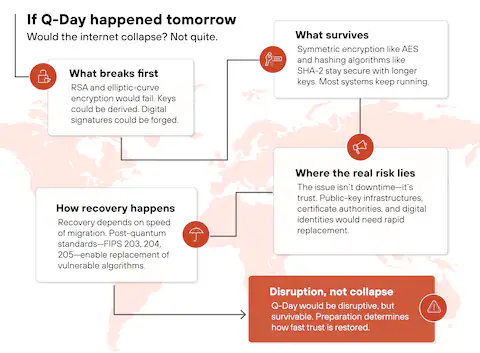
Today’s encryption depends entirely on mathematical problems that are easy to compute one way but nearly impossible to reverse. RSA encryption, for instance, relies on the difficulty of factoring enormous prime numbers. Elliptic Curve Cryptography (ECC) — which protects Bitcoin, Ethereum, and most digital signatures — depends on a related mathematical puzzle. Both of these problems are trivial for a sufficiently powerful quantum computer running Shor’s algorithm. However, no such computer exists yet. The key question, therefore, is: how long until it does?
Google Moves Q-Day to 2029
In March 2026, Google made a striking announcement. The company set 2029 as its internal deadline for completing a full migration to post-quantum cryptography (PQC). This was not a gradual adjustment. Previously, most experts had placed Q-Day somewhere in the mid-2030s. The US National Security Agency had set 2031 as its implementation target. The broader US government pointed to 2035 for full readiness. Google’s 2029 deadline blows past all of these.
The reason for the acceleration is a cascade of new research. Three major papers landed within months of each other. First, Craig Gidney of Google Quantum AI published a paper showing that a quantum computer with fewer than one million noisy physical qubits could crack a 2,048-bit RSA key — the encryption standard underpinning most internet banking, email, and digital certificates. Previous estimates had required 20 million qubits. That is a twenty-fold reduction in the barrier to a catastrophic attack.
Heather Adkins, VP of Security Engineering at Google, and Sophie Schmieg, Senior Staff Cryptography Engineer, stated plainly: “Quantum computers will pose a significant threat to current cryptographic standards, and specifically to encryption and digital signatures. That’s why we’ve adjusted our threat model to prioritise PQC migration for authentication services. We recommend that other engineering teams follow suit.”
Elliptic Curves Are Now Easier to Break Than We Thought
The second major development targets ECC specifically. Google Quantum AI published a whitepaper in March 2026 showing that the ECDLP-256 logarithm underpinning ECC could be cracked in a few minutes using approximately 20 times fewer physical quantum bits than previously estimated. Furthermore, the attack requires fewer Toffoli gates — the expensive computational steps that determine how long an algorithm takes to run.
ECC is everywhere. Moreover, it is particularly critical for cryptocurrency. Additionally, it underpins most digital signatures across the broader internet. Therefore, this research carries enormous implications far beyond blockchain. The threat to Bitcoin alone is striking. Under idealised conditions, Google estimates a roughly 41% probability that a primed quantum computer could derive a private key before a Bitcoin transaction is confirmed.
Crucially, however, Google chose not to publish the actual attack circuits. Instead, the team released a zero-knowledge proof — a cryptographic technique that allows anyone to verify the resource estimates without gaining access to the attack method itself. Additionally, the team engaged with the US government prior to publication. This level of responsible disclosure is unprecedented in quantum cryptanalysis and signals how seriously researchers are taking the risk of misuse.
Neutral Atoms Change the Hardware Picture
The third breakthrough came from a collaboration between Caltech, Berkeley, and Oratomic. Their preprint, published alongside Google’s research, explored neutral-atom quantum computers — a different hardware architecture that has recently proved more scalable than expected. Their findings are striking. Consequently, they estimate that Shor’s algorithm could run on as few as 10,000 to 20,000 atomic qubits. Furthermore, a system with around 26,000 qubits could crack Bitcoin’s encryption in a matter of days.
For comparison, today’s leading quantum computers operate in the hundreds of qubits. Nevertheless, the direction of travel is unmistakable. Each algorithmic improvement lowers the hardware bar for a cryptographically relevant attack. In addition, neutral-atom architectures are advancing faster than the superconducting qubit systems that have dominated the field. Cloudflare principal research engineer Bas Westerbaan noted: “We are starting to see some details of the three breakthroughs that scared Google, but crucial elements are being withheld due to their perceived risk as an aid for adversaries.”
The “Harvest Now, Decrypt Later” Threat
Here is the most unsettling part: the threat to encrypted data does not wait for Q-Day. Currently, adversaries — including nation-state actors — are systematically collecting encrypted data. They store it today. Then they plan to decrypt it once a cryptographically relevant quantum computer exists. This strategy is known as “harvest now, decrypt later” (HNDL).
Therefore, any data that must remain confidential into the 2030s is already at risk today. Healthcare records, financial transactions, classified government communications, private messages — all of these are potentially in cold storage with malicious actors right now. Consequently, organisations cannot simply wait until quantum computers arrive before acting. As Certes CTO Simon Pamplin stated: “The most dangerous window isn’t when quantum computers arrive — it’s right now. Adversaries are already running harvest-now, decrypt-later campaigns.”
Research from Bain & Company found that 90% of organisations do not yet have systems in place to defend against quantum security threats. Furthermore, only one in ten reported having a roadmap to address the risk. Most are simply waiting to see what happens. That approach, however, is no longer viable.
What Is Post-Quantum Cryptography, and Who Is Building It?
The good news is that solutions already exist. The US National Institute of Standards and Technology (NIST) finalised several post-quantum cryptographic standards in 2024, after nearly a decade of global collaboration with independent cryptographers. These algorithms are designed to resist attacks from both classical and quantum computers. Consequently, they represent the most credible path to long-term digital security.
The key new standards include ML-KEM (formerly CRYSTALS-Kyber) for encryption, and ML-DSA (formerly CRYSTALS-Dilithium) for digital signatures. Both are already moving into real-world deployment. Google is integrating ML-DSA into Android 17, due for release in June 2026. Additionally, Google Chrome already supports PQC for web connections. Cloudflare has also moved its internal Q-Day readiness deadline to 2029, aligning with Google’s timeline. Meanwhile, IBM has adopted a new quantum error-correction blueprint to pursue fault-tolerant quantum computing by the same year.
However, migration is not simple. Transitioning to PQC involves larger data packet sizes, higher latency, and potential incompatibility with older hardware. For large enterprises, retrofitting encryption embedded in legacy systems could cost over £100 million ($126 million). Moreover, migrating to quantum-safe authentication requires rotating all credentials previously exposed in quantum-vulnerable systems. Unlike encryption, which can be switched in one large update, authentication migration has a long dependency chain. It will take years, not months.
TF Summary: What’s Next
Q-Day is no longer a theoretical countdown. Furthermore, three concurrent breakthroughs in early 2026 have compressed what was once a 10-year buffer into a much shorter period. Google and Cloudflare have each committed to 2029 as their PQC migration deadline. Additionally, NIST has finalised the standards organisations need to begin this transition right now. The tools, therefore, exist. What is missing in most organisations is urgency.
The world’s digital infrastructure — banking, healthcare, government, communications, and cryptocurrency — was built on encryption assumptions that quantum computers will eventually invalidate. Consequently, the organisations that begin their post-quantum cryptography migration today will be ready when Q-Day arrives. Those who wait will face a scramble no budget or timeline can fix. As 2026 has made clear, the question is no longer whether Q-Day is coming. The question is whether the world will be ready when it does.
— Text-to-Speech (TTS) provided by gspeech | TechFyle