



China’s Tsinghua University solved the battery that works at 302°F without catching fire. Israel’s Esh-Tech built a laser that kills drones in under two seconds for 25% of the cost of existing systems. South Korea plans to train 500,000 soldiers as drone operators. Three separate stories. One direction of travel.
Three warfare technology developments occurred in the week — each advancing a different component of the drone-dominated battlefield that Ukraine established as the new normal. A Tsinghua University research team published an all-ceramic solid-state battery that operates at 150°C (302°F) and survives brief shocks of 300°C without combustion — published in the peer-reviewed journal Matter on 5 June. Israeli startup Esh-Tech debuted its DroneLight pulsed laser weapon at Eurosatory 2026 in Paris — a counter-drone system that neutralises threats in one to two seconds at 25% of the cost of conventional laser systems. And South Korea’s Defence Minister Ahn Gyu-back announced on 26 June that the military will train 500,000 drone warriors — effectively every active-duty soldier — while deploying 11,000 Korean-made drones by year-end and 60,000 by 2029. Taken individually, each story is significant. Taken together, they describe the three simultaneous technological investment tracks — power, counter-drone, and operator scale — that every serious military is running in parallel.
What’s Happening & Why It Matters
The Tsinghua Ceramic Battery — Why “Non-Flammable” Changes the Calculus
Three warfare technology developments begin at the most fundamental layer: power. Standard lithium-ion batteries use volatile liquid electrolytes that pose severe flammability and explosion risks under high heat or physical damage. That safety hazard limits their use in military applications — a drone battery that ignites when punctured by shrapnel is a liability rather than an asset. The Tsinghua University team solved the core engineering obstacle blocking all-ceramic battery development. Traditional ceramic solid-state batteries face a “thickness-strength trade-off” — making ceramic layers thin enough for miniaturised electronics compromises their structural strength. The team’s solution is elegant and manufacturable. They stacked multiple ceramic layers — a multilayer stacking approach that maintains thinness at each individual layer while achieving the combined structural strength required for a robust battery.
The result operates stably up to 150°C (302°F) and survives brief thermal shocks of up to 300°C (572°F). By contrast, conventional lithium-ion batteries fail dangerously below those temperatures. Additionally, the battery is non-flammable — a critical property for military applications where impact and puncture are operational realities, not edge cases. Applications include aerospace equipment, military IoT sensors, and small drone systems operating in high-heat environments where a burning battery is a mission-ending failure.
DroneLight: Drilling Holes in Drones With Light
Israel’s Esh-Tech introduced DroneLight at Eurosatory 2026 — a pulsed laser counter-drone system built around a specific and distinctive architecture. Most fielded laser weapons use continuous-wave systems — holding a sustained beam on a target for 10 to 15 seconds to generate enough heat to cause structural damage. DroneLight instead fires 10-millisecond pulses at 5 pulses per second (5Hz), physically removing material from the target through a drilling effect. Each pulse acts like a high-precision projectile. The system neutralises a drone in one to two seconds, compared to 15 seconds or more for legacy systems.
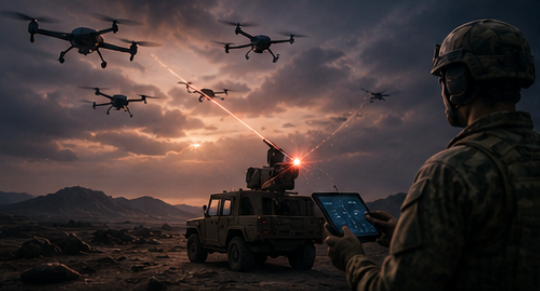
The power consumption figure is the commercial breakthrough. Conventional high-energy laser systems require 20 kW or more — demanding dedicated generator infrastructure that restricts deployment to fixed strategic sites. DroneLight consumes approximately 4 kW, drawing directly from a standard military vehicle’s electrical system. That power profile makes the system genuinely mobile — deployable on a standard tactical vehicle or jeep without modification. The system provides 1 kilometre (0.6 mile) of defensive coverage with 360-degree engagement capability, operated by a single person. Esh-Tech CEO Erez Riahi confirmed pricing at approximately 25% of legacy continuous-wave laser systems. First operational systems target September to October 2026. The company reported destroying approximately 20 drones in Israeli field trials. The system is at Technology Readiness Level 8 — one step below full production readiness. Customer evaluations are underway across multiple markets. Orders have reportedly been secured.
South Korea’s 500,000 Drone Warriors
South Korea’s announcement on 26 June is the most ambitious single military drone programme announced by any NATO-adjacent nation in 2026. Defence Minister Ahn Gyu-back said the goal is to transform drones from specialist equipment into universal battlefield tools, and make them a “second personal weapon” for every soldier. The plan calls for training 500,000 drone warriors across the army, navy, air force, and marine corps. Additionally, the military will procure 11,000 Korean-made training drones by the end of 2026 and approximately 60,000 by 2029.
The political context is specific and important. The Korean Drone Operations Command was dismantled following former President Yoon Suk Yeol‘s conviction — Yoon was sentenced to 30 years in prison after prosecutors found he had ordered drone incursions into North Korea to justify his 2024 martial law declaration. Current President Lee Jae Myung‘s government replaced the old command structure with a new National Defense Drone Headquarters focused on policy and capability development, while leaving operations to individual military units.
South Korea’s Model Versus Ukraine’s
Three warfare technology developments include South Korea’s programme — but Ukraine’s experience provides the relevant benchmark. South Korea plans to train every active soldier as a drone operator. By contrast, Ukraine’s battlefield success came not from universal training but from deeply specialised drone units — “ace pilots” with high operational tempo, backed by a domestic drone industry producing millions of systems annually. Yang Uk, a defence expert at Seoul‘s Asan Institute, challenged South Korea’s doctrine directly. “[The] concept of 500,000 drone warriors is full of [critical problems] — they don’t know what is really happening!” South Korea’s NCO and officer shortage makes the training target operationally difficult regardless of the target number. The plan faces demographic pressure. South Korea‘s active-duty personnel total is only 450,000 — and that number is declining due to demographic change.
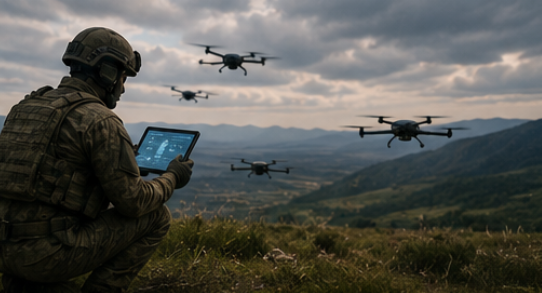
The ministry plans to field directed-energy weapons — including laser and high-power microwave systems — alongside the drone expansion. That parallel investment in counter-drone capability is a lesson all conflict observers have absorbed from Ukraine: the side that wins the drone war will need to defend against the adversary’s drone war simultaneously.
The Three Capability Gaps
The three warfare technology developments align almost perfectly against the three most documented capability gaps revealed by two years of large-scale drone warfare in Ukraine. The first gap is power endurance — batteries that survive heat, impact, and high-discharge rates without flammable failure modes. The Tsinghua ceramic battery addresses the trouble. The second gap is affordable counter-drone response at scale — the ability to neutralise drone swarms without depleting expensive interceptor magazines. DroneLight addresses expense at one-quarter the cost of existing systems. The third gap is operator mass — enough trained personnel to operate, maintain, and respond to drone threats across every tactical unit. South Korea’s 500,000-warrior programme addresses scale, even if the doctrine is contested.
TF Summary: What’s Next
The Tsinghua ceramic battery findings are published in Matter and available for peer review. Commercialisation timelines have not been specified for military applications. DroneLight targets first operational systems at September to October 2026 — just weeks away. South Korea’s drone procurement begins immediately: 11,000 systems by end-2026, 60,000 by 2029. The new National Defense Drone Headquarters replaces the disbanded Drone Operations Command under President Lee’s government.
MY FORECAST: Three warfare technology developments will each reach operational inflection points within 18 months — but on different timelines. DroneLight arrives first and faces the most immediate scrutiny: it must demonstrate that its 5Hz engagement rate holds against coordinated multi-target swarms, not just sequential single engagements. A single sustained swarm attack — 40 drones from three directions simultaneously — will test whether DroneLight’s one-minute maximum engagement endurance at full rate is a tactical limitation or an engineering ceiling to fix. By contrast, the Tsinghua ceramic battery’s timeline is longer but its strategic impact is more durable. Non-flammable military batteries will eventually be the standard — the question is whether Chinese manufacturers or Western labs commercialise the technology first. South Korea’s 500,000-warrior programme will prove harder to execute than announced. Ukraine spent three years building a specialised drone force of tens of thousands. Training half a million soldiers to an operationally relevant standard is a decade-long commitment, not a budget cycle. The announcement signals intent. The doctrine and the operational results will take longer.
Related Stories
- US Navy Drone Boat Completes World’s First Autonomous Combat Rescue
- Russian EKS Satellites Have Tested Continental-Scale GPS Jamming
- SpaceX Starfall — FAA Approves Orbital Manufacturing Platform