


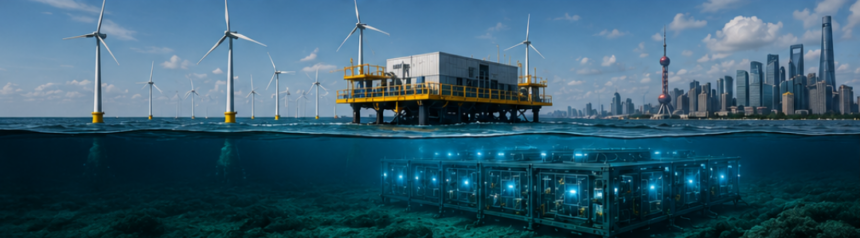
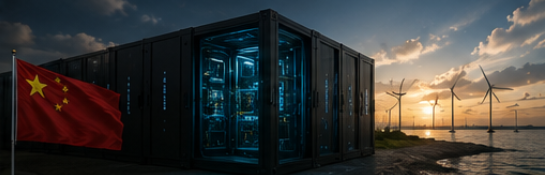
China’s LineShine supercomputer just dethroned America’s El Capitan for the first time since 2017 — using no Nvidia GPUs. Off the coast of Shanghai, China’s first underwater data centre operates 35 metres below sea level, powered by offshore wind, and runs 90% cooler than land-based alternatives. Two stories. One country. One message.
China’s dual AI infrastructure breakthrough is really two distinct announcements. China has clinched the top spot on a list of the world’s most powerful supercomputers, overtaking the United States for the first time since 2017 with a model powered by homegrown chips amid an intense race for tech supremacy between the two superpowers. The machine — named LineShine — is housed at the National Supercomputing Center in China’s tech hub of Shenzhen and replaced the American titleholder El Capitan in the latest biannual TOP500 ranking, which tracks the world’s most powerful supercomputers. The ranking showed LineShine achieved a computing speed 20% faster than El Capitan. Meanwhile, off the coast of Shanghai, Shanghai Hailanyun Technology (HiCloud) operates the world’s first wind-powered underwater data centre — a facility that cuts cooling energy consumption by 90% compared to conventional alternatives, submerged 35 metres (115 feet) below sea level. Together, the two stories describe a China that is not catching up with American AI infrastructure. It is building a different version of it.
What’s Happening & Why It Matters
LineShine: No NVIDIA GPUs, Still the World’s Fastest
China’s dual AI infrastructure breakthrough includes a supercomputer that challenges a core assumption of the global AI race. Notably, the LineShine relies entirely on CPUs — conventional computing chips often found in consumer electronics — instead of specialised GPUs, the highly sought-after chips that power most of the supercomputers today and are dominated by American suppliers like Nvidia. Through a series of measures starting in 2022, Washington has cut off China’s access to the cutting-edge GPUs, throttling Chinese companies’ efforts in competing for the top AI models with US tech giants.
That context transforms the LineShine achievement from a technical milestone into a geopolitical statement. The US export control regime was designed specifically to prevent China from accessing the GPU capability that powers frontier AI. China responded by building an alternative architecture around CPUs — and produced the fastest computer on the planet. The moves forced Chinese companies to innovate around the restrictions. Last year, China-based AI startup DeepSeek released a model that delivered near industry-leading performance with far fewer advanced chips, surprising Silicon Valley and the wider industry. LineShine follows the same trajectory: constrained access producing engineering ingenuity.
The TOP500 Ranking — and Its Limits
The TOP500 ranking carries a specific methodological caveat that warrants acknowledgement. Rohl explained the TOP500 ranking is based on a decades-old benchmark designed to measure traditional scientific computing workloads instead of modern AI. Additionally, many of the most powerful AI systems built by US giants such as xAI and Google or supercomputers run by top defence facilities do not enter the ranking, either for sensitivity or economic reasons.
By contrast, El Capitan — which ranks second — is at Lawrence Livermore National Laboratory in California. Following El Capitan are two other American machines in national libraries in Tennessee and Illinois, as well as one in Germany. The US retains the second, third, and fourth spots. The AI systems that power ChatGPT, Claude, and Gemini are not in the TOP500 — their scale and configuration differ from traditional supercomputer architectures. LineShine is genuinely the world’s fastest ranked supercomputer. It is not necessarily the world’s most capable AI training system.
The Underwater Data Centre: 35 Metres Below Shanghai
The second element of China’s dual AI infrastructure breakthrough addresses a different constraint entirely. The Shanghai facility is located off the coast of Shanghai’s Lin-gang Special Area, submerged roughly 35 metres (115 feet) below the sea surface and powered directly by a nearby offshore wind farm while using seawater for natural cooling.
With a total investment of $226 million (¥1.6 billion), an installed capacity of 24 MW, and nearly 2,000 deep-sea sealed servers deployed 35 metres below sea level, the facility cuts cooling energy consumption by 90% compared with conventional onshore alternatives. It maintains a Power Usage Effectiveness (PUE) below 1.15, well outperforming the global industry average of 1.5. Powered predominantly by an adjacent offshore wind farm, the centre achieves a green energy penetration rate exceeding 95%, saving 61 million kilowatt-hours of electricity annually.
90% Cooling Savings
The cooling efficiency figure is significant in the global data centre context. As TF covered in its C40 Cities mayors pact article, conventional data centres use cooling systems consuming 40–50% of their total power budget. The HiCloud facility eliminates that burden almost entirely. By contrast, the tradeoffs are real. Introducing anything to an underwater ecosystem can have unexpected effects on wildlife. When seawater cools servers, it carries waste heat into the surrounding water. Related studies show thermal discharge from power plants can alter oxygen and pH levels and sediment composition, ultimately reducing the number and variety of creatures that live nearby. HiCloud is monitoring the water at the Hainan data centre.
Additionally, Microsoft’s precedent is worth noting directly. Microsoft’s earlier Natick project had already verified the reliability of underwater server operations, recording a hardware failure rate of merely 0.7%, far lower than the 5.9% of onshore facilities. Nevertheless, Microsoft officially terminated the project in 2024, citing exorbitant maintenance costs, severe scalability bottlenecks and unstable commercial returns, and concluded that large-scale industrial promotion of underwater data centres was not commercially feasible at the current stage. China is proceeding where Microsoft retreated.
The Scale China Is Planning
The HiCloud facility is explicitly a first phase. China is currently planning a 500 MW deep-sea underwater data centre cluster to drive industrial upgrading from pilot operation to large-scale systematic deployment. At 500 MW, the cluster would represent a 20-fold expansion from the current 24 MW capacity. By contrast, the current 24 MW facility is equivalent to the electricity consumption of approximately 20,000 US homes annually. A 500 MW cluster would supply the equivalent of 400,000 homes. That is no longer a pilot. That is infrastructure at national scale.
TF Summary: What’s Next
LineShine’s TOP500 ranking stands until the next biannual list in June 2027. The HiCloud facility operates in Phase 1 at 2.3 MW, with full 24 MW capacity planned as the facility scales. The 500 MW cluster is a planning document rather than an approved project. US export controls on advanced chips are in place — and the LineShine result will intensify Congressional debate about whether those controls are achieving their stated strategic objectives.
MY FORECAST: China’s dual AI infrastructure breakthrough will accelerate two specific US policy debates simultaneously. The LineShine result will prompt calls to extend GPU export controls to CPU architectures — a response that underestimates how long the next generation of Chinese CPU-based supercomputers would take to develop. By contrast, the more consequential policy question is whether the US government should fund competitive supercomputer development at a pace that maintains a TOP500 lead. LineShine was built specifically because GPU access was denied. The US responded to the DeepSeek moment with surprise. The LineShine moment should produce strategic planning, not surprise. The underwater data centre story will travel more slowly — but its 500 MW planning ambition, combined with China’s mature offshore wind infrastructure, positions it to become commercially viable before any Western competitor reaches the same technical maturity.
Related Stories
- 40 Mayors Demand Standards for AI Data Centres — the UN Wants Transparency Too
- Amazon Data Centres Used 2.5 Billion Gallons of Water in 2025
- Spain Launches Floating Solar Platform That Uses the Sea to Boost Output