


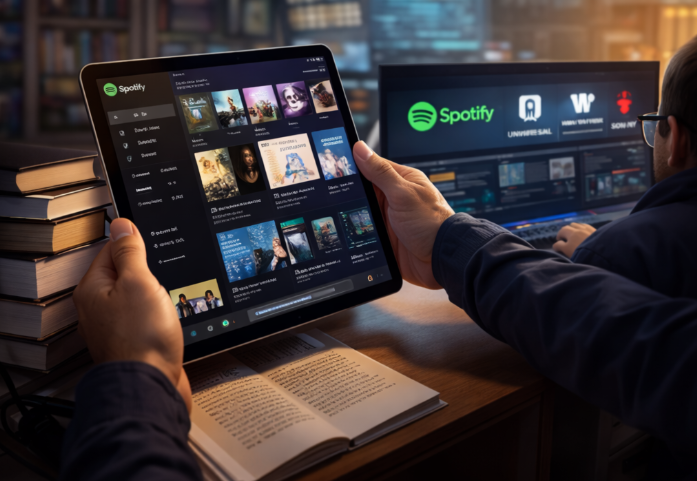
Spotify redesigned its tablet app, started selling physical books, and won a $322 million piracy judgment — all in one week. Let’s unpack all three.
Spotify does not stand still. In the space of a few days in mid-April 2026, the world’s largest audio streaming platform launched a ground-up redesign of its tablet apps, began selling physical books through a partnership with independent booksellers, and secured a landmark $322 million (€296 million) default judgment against a piracy group that had scraped 86 million songs from its platform. The three stories are distinct. Together, however, they paint a clear picture of where Spotify is heading — deeper into media, in commercial ambition, and increasingly assertive in protecting what it has built.
Each development is influential on its own. The tablet redesign speaks to product maturity. The bookshop partnership speaks to diversification. The court ruling speaks to the systemic challenge of protecting intellectual property in an era of anonymous digital piracy. Furthermore, all three illustrate a company that is no longer content to be just a music streaming service.
What’s Happening & Why It Matters
The Tablet App: Finally Built for Tablets
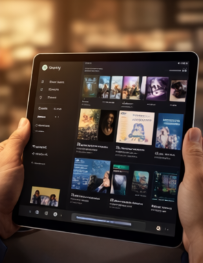
On 16 April 2026, Spotify launched a redesigned app experience for iPad and Android tablets. This is notable because, for years, the tablet version of Spotify was essentially a stretched phone app. It wasted the larger screen and felt awkward to use. That era is over.
The new design is built specifically for larger screens. Spotify called it explicitly: “Rather than simply scaling up mobile components, we designed the tablet experience to take advantage of the extra space.” The result is a genuinely different experience from the phone app. Users can browse and discover new content in parallel with playback — a so-called “parallel browsing” mode that keeps music or video playing on one side of the screen. In contrast, the other side shows the library, recommendations, or charts.
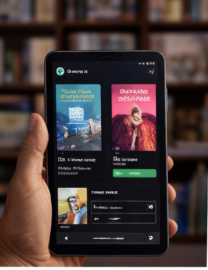
Four features define the redesign. Adaptive orientation means the interface reconfigures — not just resizes — when a device rotates. Switching between portrait and landscape produces a balanced, intentional layout in both modes, not a stretched version of the same screen. A collapsible sidebar gives users a browse-and-discover panel that sits alongside playback. The sidebar can collapse for a minimal view or expand for deeper browsing. It contains interactive, scrollable content. An enhanced video experience brings the “Switch to Video” toggle front and centre. That reflects Spotify‘s video initiative. The company rolled out new video controls globally on 9 April 2026, and the tablet redesign builds directly on that momentum. Finally, parallel browsing itself is the feature that makes the whole design worthwhile. Watching a music video on one side of the screen while exploring your library on the other is genuinely new behaviour for Spotify.
Spotify Head of Design for Consumer Experience Nicole Burrow summarised the intent: “We’ve been designing Spotify to feel native to each screen.” The bottom navigation bar is unchanged for familiarity. The update is available on iOS and Android tablets.
Selling Physical Books — With a Conscience
On 15 April 2026, Spotify made official something it had announced in February: users can buy physical books directly through the Spotify app. The feature is live on Android in the United States and the United Kingdom. iOS support was set to follow within a week.
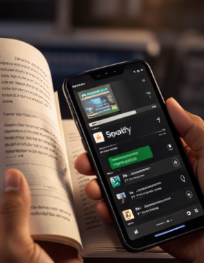
The mechanism is simple. On audiobook pages within the app, users see a button labelled “Get a copy for your bookshelf.” Clicking it redirects to Bookshop.org, which handles pricing, inventory, and shipping. Bookshop.org exists specifically to support independent bookstores. The organisation returns over 80% of its profit to indie bookshops. Furthermore, buyers can choose to support a local bookstore by making a purchase.
That partnership choice is enormous. Spotify could have kept the full transaction in-app, built its own retail infrastructure, and captured the margin. Instead, it directed purchase traffic to an organisation specifically designed to route money back to independent booksellers. Bookshop.org Founder and CEO Andy Hunter responded directly: “We are excited to see the impact Spotify’s scale will have for local bookstores. By meeting readers where they are and linking to Bookshop.org, Spotify is financially supporting indie booksellers with each purchase.”
This launch coincided with significant new audiobook features. Spotify‘s audiobook catalogue exceeds 700,000 titles, up from 150,000 at launch in 2022 — nearly a fivefold increase. The company’s Page Match feature, which launched in February, uses a phone camera to scan a page in a physical book and sync the user to the corresponding point in the audiobook. It supports 30 additional languages — including French, German, and Swedish. Furthermore, Page Match usage data tells a compelling story. Users who engage with Page Match stream an average of 55% more audiobook hours per week than non-users. Additionally, 62% of Page Matched titles are books users had never previously streamed. That means the feature is actively driving discovery and expanding reading habits, not just helping existing listeners.
Audiobook Recaps — short audio summaries tuned to a user’s most recent listening point — are available on Android. Audiobook Charts have expanded to Germany. A dedicated Kids & Family Audiobook Chart has launched in the United States, the United Kingdom, and Germany. Spotify Global Head of Audiobooks Owen Smith described the goal: “These updates demonstrate our continued ambition to make reading fit into modern life.”
The Piracy Judgment: $322 Million and an Anonymous Adversary

On 15 April 2026, Judge Jed Rakoff of the Southern District of New York issued a default judgment of $322.2 million (€296.2 million) against Anna’s Archive — a shadow library and piracy activist group that scraped 86 million songs from Spotify and planned to release them publicly via BitTorrent.
Spotify, Universal Music Group, Warner Music Group, and Sony Music Entertainment filed the lawsuit on 2 January 2026. In December 2025, Anna’s Archive announced it had scraped metadata for 256 million audio tracks and 86 million music files from Spotify, totalling over 300 terabytes (TB) of data. The group described it as a “preservation archive.” Spotify and the labels described it as “brazen theft of millions of files containing nearly all of the world’s commercial sound recordings.”
Judge Rakoff immediately issued a temporary restraining order. Anna’s Archive never responded to the lawsuit. Instead, in February 2026, the group escalated deliberately. Despite the court order, it released over 2.8 million audio files — totalling 6.4 TB of data — via 47 separate BitTorrent torrents. The judge later cited this release as a “blatant disregard” of his authority. Spotify‘s lawyers downloaded 120,000 files as part of their investigation.
The damage calculation reflects two separate legal claims. Spotify pursued damages under the Digital Millennium Copyright Act (DMCA) for circumvention of its digital rights management technology — calculated at $2,500 per circumvention instance multiplied by 120,000 test downloads. That produced Spotify‘s $300 million (€275.8 million) award. The three major labels pursued standard copyright infringement damages — calculated at $150,000 per infringement multiplied by 148 identified recordings. That produced the labels’ combined $22.2 million (€20.4 million) award. Recordings identified in the Anna’s Archive collection included songs by Beyoncé, Ariana Grande, Bruno Mars, Cardi B, Justin Bieber, Lady Gaga, Michael Jackson, Rihanna, and U2.

However, there is a significant complication. The identities of Anna’s Archive’s operators are unknown. Furthermore, the group continues to operate. Collecting the $322 million judgment is, at present, effectively impossible. Nevertheless, the ruling carries immediate practical value. The permanent injunction requires internet service providers to block the Anna’s Archive website permanently. It also orders the destruction of all copies of works scraped from Spotify. That injunction gives Spotify and the labels a legal tool to force ISP-level blocking of future piracy infrastructure — a precedent with long-term significance for digital copyright enforcement.
TF Summary: What’s Next
Spotify‘s tablet redesign is available and will reach all iOS and Android tablet users in the coming weeks. The physical book purchase feature will go live on iOS shortly. The audiobook catalogue, Page Match language support, Recaps, and Charts continue to expand. Collectively, the moves signal that Spotify is building a media ecosystem — not just a music service. Physical books, audiobooks, video, podcasts, and music coexist in one app. That ambition is genuine. Furthermore, it comes with real product craft — as the tablet redesign demonstrates.
The piracy judgment, meanwhile, sets a legal precedent even if the money is uncollectible today. ISP blocking injunctions and DMCA circumvention damages at this scale are new territory. Spotify and the major labels are likely to use this ruling as a template for future enforcement actions against shadow libraries and piracy networks. The anonymous operators of Anna’s Archive remain at large. However, the court’s finding of liability, the permanent injunction, and the damages framework give rights holders a stronger position in every future case. Spotify’s week was productive. Its fight to protect that catalogue is not over.
— Text-to-Speech (TTS) provided by gspeech | TechFyle