


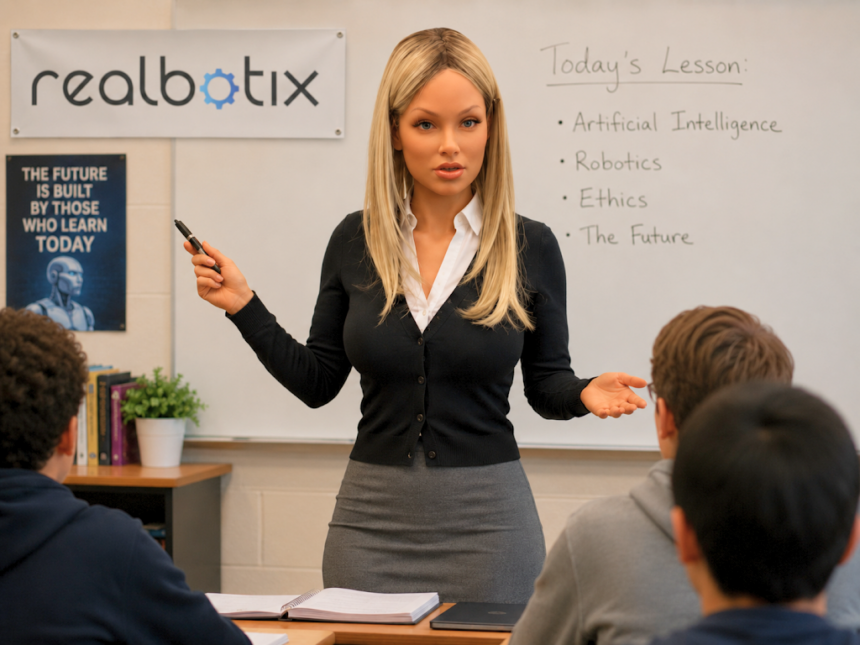
It is 24/7 and speaks multiple languages. It has curriculum-specific safety guardrails. The robot answers questions, reinforces lessons, and supports neurodiverse learners. Optio is a robot with a face. Realbotix launched Optio at a New York school on the Seneca Nation Reservation on 24 June. Five hundred students will use it by fall.
Optio’s New York school deployment launched — and it is the first time a humanoid robot has been deployed as an active AI teaching assistant in a US public school district. Realbotix Corp. launched Optio alongside its M-Series humanoid robot at Salamanca City Central School District — located on the Seneca Nation Reservation in New York state.
The district is a recognised Woz ED STEM Pathway school — founded by Apple co-founder Steve Wozniak to prepare students for STEM careers. The initial deployment supports high school students in Woz ED AI and Robotics courses.
The programme expands to approximately 500 high school students in fall 2026. Optio is simultaneously a classroom AI assistant and an at-home tutor — available 24 hours a day, seven days a week, trained specifically on the district’s own approved curriculum.
By contrast, the humanoid robot deployed alongside it is the physical element — the face, the conversation, the classroom presence that pure software cannot provide.
What’s Happening & Why It Matters
What Optio Does — In and Out of the Classroom
Optio’s New York school deployment covers two distinct use cases simultaneously. In school, Optio serves as a teacher’s assistant — answering student questions, reinforcing lesson content, and participating in classroom discussions through the M-Series humanoid robot‘s natural language processing and expressive facial movements. At home, Optio functions as a 24/7 personal tutor — offering one-on-one concept reinforcement, multilingual homework help, and personalised learning pathways.
Students interact with Optio through personalised digital avatars trained specifically on the district’s curriculum — not general web data. That specificity is the important safety choice. A curriculum-trained AI tutor produces responses grounded in what students are actually studying, rather than generating plausible but off-curriculum content. Additionally, Optio is designed to support neurodiverse learners — offering always-available reinforcement and personalised pathways that a single teacher serving a class of 30 cannot individually provide. The district maintains full oversight, including protection against inappropriate responses and unreliable outputs.
The Humanoid Robot in the Room — Embodied AI
Optio’s New York school deployment pairs the digital AI system with a physical robot — and that combination is deliberate. The Realbotix M-Series uses natural conversation, expressive facial movements, and real-time interaction to create hands-on learning experiences. Students do not talk to a screen. They talk to a robot with a face that responds in kind.
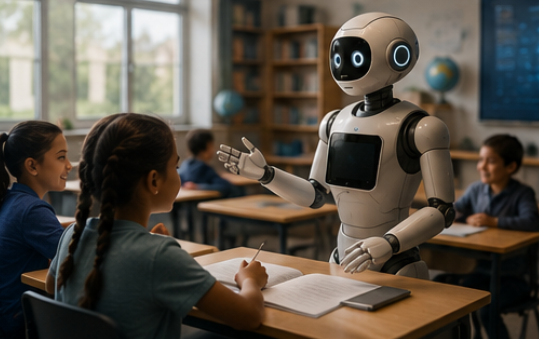
That embodied dimension influences learning engagement in a way that software alone cannot replicate. Research on children’s learning consistently shows that social interaction — even with a non-human agent — activates engagement patterns that text-on-screen does not. By contrast, a robot that engages and interacts like a person in a classroom. Optio triggers the same critical questions about appropriate boundaries and over-dependence that every AI education product must address. Realbotix CEO Andrew Kiguel framed the deployment’s purpose directly. “We are moving beyond lab demonstrations and pilots to deliver real, embodied AI directly into classrooms — supporting teachers, engaging students, and proving that advanced robotics can thrive in live educational environments.”
Choosing The District — and What Woz ED Means
Optio’s New York school deployment chose Salamanca specifically and intentionally. Salamanca is a Woz ED STEM Pathway district — part of the education initiative launched by Apple co-founder Steve Wozniak to build STEM career pathways in underserved communities. Salamanca is also a small district serving the Seneca Nation community in upstate New York — not a wealthy suburban school.
That context is significant. AI tutoring pilots typically begin in well-resourced districts with strong technology infrastructure and parent populations comfortable with new tools. Realbotix is starting in an Indigenous community school on a STEM pathway programme. Superintendent Dr. Mark Beehler described the reasoning directly. The district wanted “a safe, Salamanca-specific AI tutor and customized AI tools for educators” — not a generic off-the-shelf product. The district’s students needed equitable access to AI learning tools while the district maintained full control over content and safety. Beehler noted that schools have faced challenges from rapid AI adoption and student misuse of general AI tools. Optio‘s district-specific guardrails are the specific answer to that challenge.
Realbotix’s Business Structure
Optio’s New York school deployment carries a specific financial structure that deserves transparency. Realbotix Corp. is a Canadian company listed on the TSX Venture Exchange under ticker XBOT. On 12 February 2026, Onconetix Inc. — a US Nasdaq-listed biotechnology company — entered a definitive all-stock share exchange agreement to acquire 100% of Realbotix LLC, the operating subsidiary. The combined company is expected to trade on Nasdaq following closing, anticipated in the second half of 2026.
That acquisition structure means Optio‘s Salamanca pilot is also a business development event — establishing a commercial reference customer at the moment Realbotix‘s parent company prepares to go public on Nasdaq. By contrast, the educational objectives are genuine regardless of the commercial timing. Dr. Beehler’s comments are a superintendent who evaluated the product on its merits for his students, not simply a school that agreed to be a test case.
Contrasting With Norway — Two Countries, Two Responses to AI in Schools
Optio’s New York school deployment is in the same week that Norway banned AI tools from primary school classrooms for ages 6–13. As TF covered in its Norway AI ban article, Norwegian Prime Minister Jonas Gahr Støre cited declining PISA scores and the risk that AI removes the productive cognitive difficulty that enables genuine learning. The US and Norway are responding to the same technology — AI in education — with opposite policy frameworks in the same week.
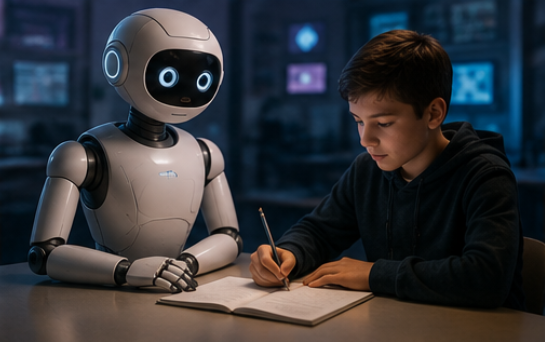
The contrast is not simply regulatory. It is a fundamental disagreement about what education is for and how learning works. Norway is betting that foundational skills require struggle, and AI removes that struggle. Realbotix is betting that AI can support teachers and reach students who traditional classroom formats underserve — particularly neurodiverse learners and students in under-resourced communities. Both positions are defensible. The Salamanca pilot will generate data that helps resolve which interventions actually work.
TF Summary: What’s Next
Optio is live at Salamanca City Central School District from 24 June 2026. The programme expands to approximately 500 students in fall 2026. Realbotix will measure outcomes in student engagement, concept mastery, and teacher workload reduction. The Onconetix acquisition is expected to close in the second half of 2026, pending shareholder and regulatory approval. Additional district deployments will follow the Salamanca pilot results.
MY FORECAST: Optio’s New York school deployment will produce compelling engagement data by the end of fall 2026 — and those results will determine Realbotix‘s commercial trajectory. The Salamanca district’s STEM pathway focus and its Indigenous community context make it a genuinely meaningful test environment, not a cherry-picked performance showcase. By contrast, the most important metric will not be student engagement. It will be teacher workload. If Optio measurably reduces the preparation time and individual attention burden on Salamanca’s teachers — in a district that almost certainly faces resource constraints — it is defensible to scale. If it adds complexity without reducing burden, it is an interesting technology demonstration that districts cannot operationally sustain. The Norway-US policy contrast will also produce its own evidence by 2028. One country is running the ban experiment. The other is running the deployment experiment. Education researchers will have the data to compare them.
Related Stories
- Norway Bans AI in Primary Schools — Effective This August
- Estonia Gives AI Agents Their Own Legal Identity Codes — a World First
- Snap Specs Cost $2,195 — and Beat Meta, Apple, and Google to Consumer AR