


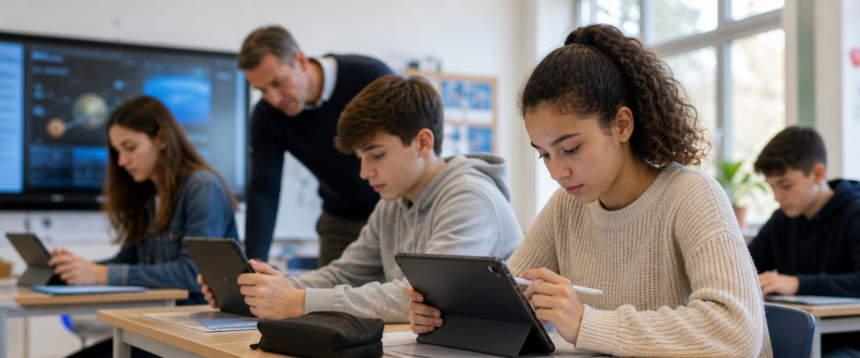
London schools are trialling VR headsets to calm anxious pupils. At the same time, teachers and parents across the UK are asking whether screens have already gone too far in the classroom.
Two education stories landed in the same week in early May 2026 — and they pulled in opposite directions. The Guardian reported that London secondary schools are trialling virtual reality headsets to help anxious and overwhelmed pupils manage exam stress. A day earlier, a separate investigation asked a harder question: why are so many UK schools teaching children almost entirely on screens — and what is that doing to their development?
Together, the two stories capture the genuine tension at the heart of technology in education right now. Screen time in classrooms has grown dramatically since the COVID-19 pandemic. Parents and teachers are pushing back. Researchers are raising evidence of real harm. At the same time, specific, targeted applications of technology — like VR for mental health — are showing genuine promise. The debate is no longer simply “technology, yes or no.” It is more specific than that. Which technology, at what age, for what purpose, and who decides?
What’s Happening & Why It Matters
London Schools Try VR for Exam Stress and ADHD
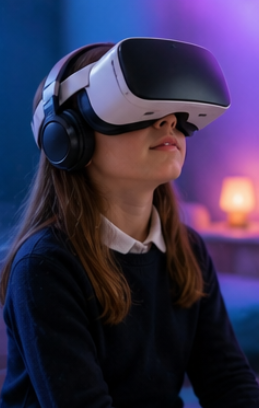
A programme called Phase Space is currently being trialled in several London secondary schools. The programme uses virtual reality headsets to help pupils manage stress, anxiety, and emotional dysregulation. Ark Academy in north London is among the schools participating. The school uses the headsets primarily with pupils experiencing social, emotional, or mental health difficulties — including those with ADHD and anxiety disorders.
Aelisha Needham, Vice Principal for Ethics at Ark Academy, described the students the programme targets. “We use them mainly with pupils with social, emotional or mental health problems who had ADHD or issues with anxiety.” The headsets place pupils inside a calm, immersive virtual environment. The experience typically lasts around 15 minutes. Staff report that young people who engage with the headsets come out calmer, more regulated, and ready to return to lessons. Phase Space was co-designed with input from young people and school staff. Zillah Watson — co-creator of Phase Space and former Head of VR at the BBC — described the programme’s target group as “overwhelmed and anxious students.” Her framing is deliberate. This is not a technology programme designed for academic enrichment. It is a well-being intervention for pupils who are struggling to function in a conventional school environment.
What Early Evidence Shows About VR for Young People
The research base is still developing. A co-design and proof-of-concept study published in the journal Computers in Human Behavior Reports examined VR’s potential to support adolescent well-being in UK secondary schools. Researchers worked with both young people and school staff to design and field-test a VR-based mindfulness programme for stress reduction. The findings were cautiously positive. At one school, a care-experienced 14-year-old described as “borderline ADHD” asked to remain in the headset for 30 minutes at a time and appeared noticeably more regulated after each session. At another school, a pupil who arrived in school in crisis was helped to regulate within a single 15-minute VR session. The researchers described several “breakthrough moments” across participating schools.
The underlying logic is sound. Mindfulness delivered in a fully immersive environment can produce a genuine emotional shift. VR creates physical separation from the stressors present in a school corridor or classroom. For a teenager with ADHD who cannot sit through a conventional lesson, the ability to “sit through the whole thing” inside a headset represents a meaningful clinical outcome. That said, researchers noted that some pupils resisted the 15-minute weekly commitment. One school reported students wanting a “quick fix” rather than a sustained programme. The technology’s effectiveness depends significantly on the quality of implementation and student buy-in.
The Bigger Debate: Why Are Schools Still Teaching Mostly on Screens?

The VR story sits within a much broader and more contested debate. The question The Guardian’s 3 May investigation asked is uncomfortable: why, five years after the pandemic, are UK schools still relying on screens as the dominant classroom medium — even for tasks that paper and pencil do more effectively? The investigation gathered accounts from teachers, parents, and researchers across the country. The picture that emerged was consistent.
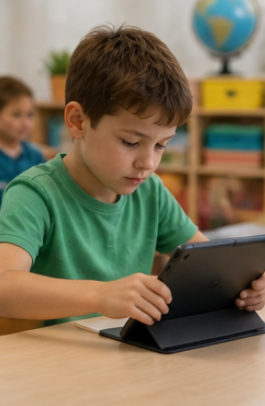
Children in many UK primary schools are expected to complete reading, writing, and even maths tasks on Chromebooks or tablets — sometimes from as young as Year 2 (age 6–7). Teachers describe situations where children learning to write for the first time are doing so primarily on keyboards, without any typing instruction. One parent described their child’s bewilderment at a keyboard that was not laid out in alphabetical order — a detail that resonated with similar accounts from the LAUSD screen time debate that erupted in the United States in April 2026. That vote — which made Los Angeles Unified the first major US district to cap classroom screen time — is now cited by UK teachers and parents as a model worth examining.
What Teachers Are Seeing in the Classroom
The Guardian’s call for teacher and parent experiences generated a significant response. The accounts shared reflect a profession increasingly uncertain about the technology it has been asked to deploy. Many teachers reported that the shift to digital classroom tools was not driven by pedagogical evidence. It was driven by pandemic-era remote learning, post-pandemic inertia, and edtech procurement decisions made at the school and district levels — often without meaningful teacher input.
Specific concerns appear repeatedly. Writing development in younger children is slowing as handwriting practice declines. Reading comprehension drops when children read primarily on screens rather than in print. Attention spans shorten. Children who struggle with focus in conventional lessons find device-based learning more distracting, not less. At the same time, teachers are not uniformly opposed to technology. Many describe interactive whiteboards, specific educational software, and coding tools as genuinely valuable. The concern is not technology itself. It is the default assumption that more screen time is always better, and there is no systematic evidence to justify it.
What the Research Actually Says

The evidence landscape is mixed but directional. Educational psychologist John Horvath — who testified before the US Senate on screen-based learning earlier this year — stated plainly: “Most general-use educational technologies perform below the effectiveness of ordinary classroom instruction. We are much closer to proving that it’s harmful than we are to proving it’s helping.”
A 2024 systematic review published in the journal Campbell Systematic Reviews examined the impact of mobile devices on literacy and numeracy in primary classrooms. The review, conducted by researchers at Queen’s University Belfast, found no consistent evidence that tablet and smartphone use in mainstream primary classrooms improves literacy or numeracy outcomes. Gains were found only in specific, well-designed programmes — not in general device deployment. The OECD‘s own education data has shown that countries with higher rates of classroom digital technology use do not systematically outperform countries with lower rates on measures of reading, mathematics, or science. Sweden, Finland, and other high-performing education systems have, in recent years, reduced classroom technology use — not expanded it.
The Screen Time Paradox
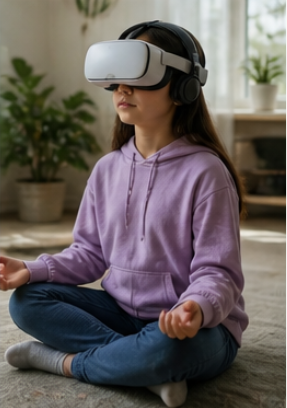
The co-existence of the VR well-being trial and the screen time debate illustrates a paradox that education policy has not yet resolved. Technology can be genuinely beneficial in highly specific, well-designed, targeted interventions — like Phase Space for anxious pupils. The evidence for that is growing. At the same time, technology used as a default classroom medium — replacing books, handwriting, and face-to-face instruction as the primary learning channel — shows limited academic benefit and growing evidence of real harm.
The distinction matters enormously. A VR headset used for 15 minutes to help a pupil with ADHD regulate their emotions is categorically different from a Chromebook used as the primary writing tool for a six-year-old learning letter formation. Both are “technology in schools.” Only the second category is driving the current backlash. The problem is that policymakers, procurement teams, and school leaders have not been making that distinction clear — and the young people in classrooms bear the cost of that blurring.
TF Summary: What’s Next

The Phase Space VR trial will continue to collect data across participating London schools. Larger evidence bases will emerge from this and similar programmes over the next academic year. The mindfulness-based VR model appears promising for specific well-being applications — but researchers emphasise that it complements, rather than replaces, trained pastoral support.
On the broader question of screen time, the UK has no equivalent of LAUSD’s formal caps on classroom device use. The Department for Education has not committed to reviewing its guidance on technology in the curriculum. Teacher and parent pressure, however, is building — and the political visibility of the issue is growing. School leaders across England and Wales are increasingly being asked to justify their technology choices not just to inspectors but to the parents in their communities. The question of where the line sits — between technology as a powerful tool and technology as a lazy default — is one that education systems in the UK, the US, and beyond are all struggling to answer simultaneously. Getting it right will require listening to teachers, reading the research, and having the honesty to admit that not every screen in every classroom is serving the child sitting in front of it.