


New Glenn stuck its historic booster landing. Then the upper stage botched the job — and a $200 million satellite paid the price.
On 19 April 2026, Blue Origin launched its New Glenn rocket for the third time. The mission started beautifully. The first-stage booster — nicknamed “Never Tell Me the Odds” — flew its second flight and landed cleanly on a recovery ship in the Atlantic Ocean. Consequently, Blue Origin became only the second Western company to successfully reuse an orbital-class rocket booster. Only SpaceX had done it before. That achievement alone would have made NG-3 a headline.
Unfortunately, the celebration was short-lived. Hours after liftoff, the upper stage of New Glenn failed its second engine burn. The payload — AST SpaceMobile‘s BlueBird 7 satellite — ended up stranded in an orbit far too low to sustain operations. Furthermore, the satellite’s onboard propulsion could not compensate for the altitude shortfall. Consequently, AST SpaceMobile confirmed BlueBird 7 would be de-orbited and burn up in Earth’s atmosphere. NG-3 produced a historic milestone and Blue Origin‘s first commercial mission failure — simultaneously.
What’s Happening & Why It Matters
The Launch: A Strong Start on a Sunday Morning

New Glenn lifted off from Launch Complex 36 at Cape Canaveral Space Force Station in Florida at 7:25 a.m. Eastern Time on 19 April 2026. The countdown had experienced a brief hold for an unspecified technical issue. However, the rocket successfully cleared the pad and climbed away cleanly. Seven BE-4 engines powered the first stage. The booster reached supersonic speed in under two minutes. Furthermore, engine throttle performance was nominal throughout the ascent phase.
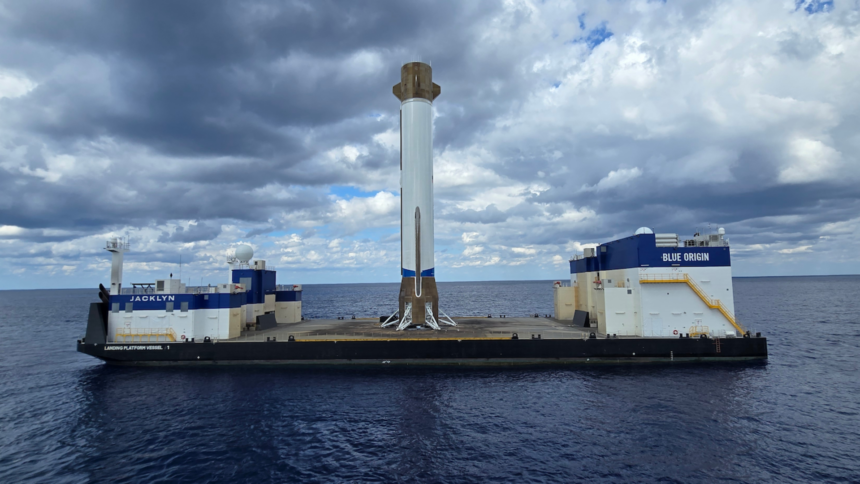
Three minutes after liftoff, the first stage separated from the upper stage. The booster then executed a controlled descent toward Blue Origin‘s floating recovery ship, Jacklyn, positioned approximately 400 miles (644 kilometres) southeast of Cape Canaveral in the Atlantic Ocean. Just under 9.5 minutes after liftoff, “Never Tell Me the Odds” touched down cleanly on Jacklyn. The Blue Origin launch commentator Tabitha Lipkin captured the moment perfectly: “Welcome back once again, Never Tell Me the Odds. It’s good to say that twice.”
Additionally, Jeff Bezos posted a video of the landing on social media within minutes of touchdown. The mood inside the Blue Origin team was clearly celebratory. The booster reuse had worked. Furthermore, it had worked on just the third New Glenn mission ever — a remarkable pace compared to SpaceX‘s Falcon 9, which took 32 flights before its first successful booster reflight.
The Booster Reuse: What Made It Historic
The booster’s reuse was not entirely straightforward. Blue Origin CEO Dave Limp explained the details in a 13 April social media post. The company replaced all seven BE-4 engines on “Never Tell Me the Odds” before its second flight. Additionally, engineers tested several upgrades, including a new thermal protection system on one of the engine nozzles. Limp confirmed that the NG-2 engines are preserved for future missions. “With our first refurbished booster we elected to replace all seven engines and test out a few upgrades,” he said. “We plan to use the engines we flew for NG-2 on future flights.”
Therefore, the reuse was technically partial — the structural airframe flew again, but the engines were new. Nevertheless, the achievement stands. Blue Origin is only the second Western company to recover and re-fly an orbital-class first stage. That counts enormously for the economics of launch. Every reuse reduces the per-launch cost. Furthermore, it validates the core business case for reusability at orbital velocities.
The Upper Stage Failure: Where Everything Went Wrong
The upper stage’s job was to complete two engine burns using its BE-3U engines, which run on liquid hydrogen and liquid oxygen. The first burn established an initial parking orbit. The second burn — lasting 68 seconds — was supposed to circularise the orbit at 285 miles (460 kilometres) altitude at an inclination of 49.4 degrees. That target orbit would have placed BlueBird 7 where it needed to be to join AST SpaceMobile‘s growing constellation.
However, the second burn failed. Blue Origin ended its launch webcast after the booster’s successful landing — before the second upper-stage burn even occurred. That decision attracted immediate criticism. Approximately one hour after the scheduled payload separation, Blue Origin acknowledged via social media that BlueBird 7 had reached an “off-nominal orbit.” US Space Force tracking data confirmed the situation. The upper stage and satellite were sitting in an initial parking orbit of just 154 by 494 kilometres (96 by 307 miles) — far below the planned circular orbit.
Furthermore, the satellite’s electric propulsion system could not overcome the altitude deficit. BlueBird 7 separated from the upper stage and powered on successfully. However, at that altitude, the satellite would have experienced destructive atmospheric reentry within hours or days. Consequently, AST SpaceMobile confirmed de-orbit. “While the satellite separated from the launch vehicle and powered on, the altitude is too low to sustain operations with its onboard thruster technology and will be de-orbited,” the company stated. Moreover, the cost of the lost satellite is covered by insurance.
BlueBird 7: What Was Lost
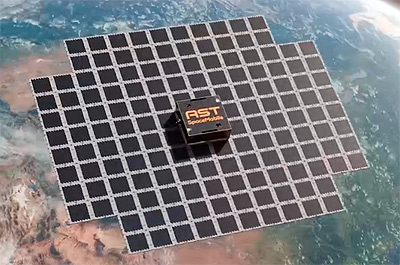
BlueBird 7 was no small hardware investment. The satellite weighed approximately 6,100 kilograms (13,400 pounds). When fully deployed, its phased-array antenna would have stretched more than 2,400 square feet (223 square metres) — roughly the size of a large apartment. Furthermore, AST SpaceMobile designed BlueBird 7 to deliver high-speed, direct-to-device (D2D) broadband connectivity to standard smartphones without any special equipment. That technology would have linked with six other BlueBird satellites to test the full D2D network in orbit.
The D2D market is moving fast. SpaceX‘s Starlink already operates an extensive D2D agreement with T-Mobile. Additionally, Amazon recently announced its acquisition of satellite operator Globalstar to accelerate its own D2D services through Apple. Therefore, every month AST SpaceMobile loses to delays is a month its competitors add more satellites and more customers.
The Deployment Pressure Facing AST SpaceMobile

Before the launch, AST SpaceMobile CEO Abel Avellan had committed publicly to having 45 satellites in orbit by the end of 2026. Furthermore, the company planned to accelerate its launch pace by stacking multiple satellites per mission — in batches of three, four, six, or even eight at a time. Avellan expected New Glenn to turn its booster around every 30 days or less after NG-3. That schedule was already aggressive. After this failure, it is under severe strain.
Blue Origin‘s New Glenn will likely be grounded for months pending an investigation into a failure. The cause of the upper stage BE-3U anomaly has not yet been publicly identified. Consequently, AST SpaceMobile will need to rely on its other launch agreements to maintain momentum. The company confirmed it still targets one to two orbital launches per month on average through the rest of 2026. It has contracts with multiple launch providers. However, to reach 45 satellites by December, the company needs to launch roughly 40 more spacecraft in under eight months — using a rocket that has flown just three times, failed on its most recent attempt, and has never carried more than one satellite at a time.
What Blue Origin Does Next
Blue Origin faces a demanding calendar beyond just the NG-3 investigation. The company’s next major New Glenn mission is the first launch of Amazon Leo satellites — formerly known as Project Kuiper — which will form Amazon’s own LEO broadband constellation. Furthermore, Blue Origin plans an unpiloted test flight of its Blue Moon lunar lander prototype as early as late summer or early autumn 2026. Potentially one or two Amazon Leo launches are also planned before the year ends.
Blue Origin Vice President of New Glenn Mission Management Laura Maginnis described the company’s ambition at the Satellite 2026 conference in March. “The market demand, as everyone has said, is significant, and we’re excited to meet it,” she said. Additionally, she confirmed the company is “increasing our resources, our tooling, our processes” to scale launch frequency. Consequently, the pressure to resolve the upper stage issue quickly is intense. However, resolving it correctly is more important than resolving it fast.
TF Summary: What’s Next
Blue Origin will conduct a full investigation into the NG-3 upper-stage anomaly. Until that investigation concludes and corrective actions are implemented, New Glenn is almost certainly grounded. Furthermore, the timeline for returning to flight is unknown. The investigation will likely take several months. Consequently, both Amazon Leo‘s satellite deployment schedule and AST SpaceMobile‘s 45-satellite target face genuine pressure. Insurance covers BlueBird 7’s loss. However, time and constellation deployment delays cannot be insured away.
MY FORECAST: Nevertheless, the booster reuse milestone from NG-3 is real and permanent. Blue Origin proved that “Never Tell Me the Odds” can fly twice. Furthermore, the speed at which it achieved booster reuse — on just its third mission — demonstrates genuine engineering progress. Moreover, the company’s stated goal is to reuse each booster up to 25 times. Therefore, once the upper stage issue is resolved, New Glenn’s economics and cadence should improve substantially. The programme is young. Three flights are not a large sample. However, the commercial stakes are now undeniably high — and the next launch will carry enormous weight.
— Text-to-Speech (TTS) provided by gspeech | TechFyle