


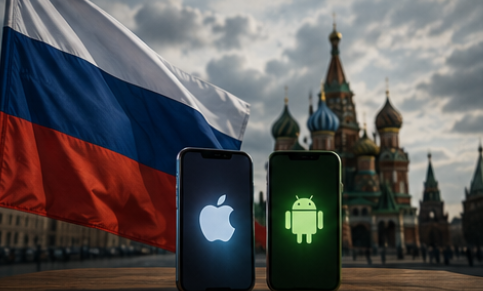
Apple removed Russia’s state-mandated messaging app MAX on 3 June. Then it removed VKontakte and all VK apps on 25 June. The Kremlin’s response: “Switch to Android. Switch to our national systems.” Twenty million Russian iPhone users are caught between an American tech giant and a government they didn’t ask to be in a conflict with.
Apple’s removal of Russian apps from the App Store escalated sharply — when VKontakte (VK) and every affiliated application disappeared from the App Store. That removal followed Apple‘s earlier deletion of MAX — Russia’s state-mandated messaging application — on 3 June. Kremlin spokesperson Dmitry Peskov responded on 25 June with instructions that Russian users will remember. “Switch to Android, switch to our national systems, switch to our equivalent service,” Peskov said. He added that the Russian government would seek an explanation from Apple before drawing final conclusions. Apple confirmed to multiple outlets that both removals comply with sanctions requirements, without specifying which sanctions applied to each app. The combined effect has left more than 20 million Russian iPhone users without notifications for their two most-used domestic communication platforms — and facing a government recommendation to abandon the iPhone entirely.
What’s Happening & Why It Matters
The MAX App — State-Mandated, App Store-Banned
Apple’s removal of Russian apps from the App Store began on 3 June with MAX — an app most people outside Russia have never heard of and Russians could not avoid. MAX was developed by VK, Russia’s largest technology company, and modelled explicitly on China’s WeChat. President Vladimir Putin signed a law in June 2025 establishing MAX as a “national multi-functional messenger.” By September 2025, the app became a mandatory pre-install on every smartphone and tablet sold in Russia. Civil servants, teachers, and students are required to use it. The State Duma publishes official communications exclusively through MAX. Authorities claim MAX’s daily audience exceeds 60 million users. At the time of its App Store removal, MAX was the ninth most-downloaded app in Russia’s App Store.
Cloudflare briefly classified MAX as spyware in April 2026 — a designation the developer attributed to a misunderstanding of web analytics. Digital rights experts have consistently described MAX’s surveillance integration as “enormous.” Apple told BBC News Russian it deleted MAX “in order to comply with sanctions.” The specific sanctions cited have not been publicly identified.
VKontakte Removed 22 Days Later
Apple’s removal of Russian apps from the App Store reached its largest impact on 25 June. VKontakte — Russia’s dominant social network and closest equivalent to Facebook — disappeared from the App Store along with all affiliated applications: VK Messenger, VK Video, VK Music, VK Dating, Odnoklassniki, Dzen, and Mail.ru. All previously downloaded apps continue to function. By contrast, they can no longer receive updates — meaning security patches, feature improvements, and, critically, compatibility maintenance with new iOS versions will not reach existing installations.
The Russian Ministry of Digital Development accused Apple of “unfair competition.” One aspect of the VK removal is technically notable. The apps remained on Google Play after Apple‘s action. That divergence supports the argument that Apple‘s removals follow specific sanctions compliance triggers — not a general tech company alignment with Western policy — since the same apps appear fine on Google‘s platform.
The Kremlin’s Android Recommendation
Apple’s removal of Russian apps from the App Store produced the most revealing government response in the entire episode. Peskov’s recommendation was public and unambiguous: switch from iPhone to Android and use “national systems.” That advice tells Russian citizens something the Kremlin may not have intended to communicate directly. Russian-made alternatives to global apps are on Android — on Google Play, RuStore (Russia’s domestic app store), and Huawei‘s AppGallery. MAX and VK both are fully available on Android. The problem is the hardware. Every new iPhone purchase is a commitment to an App Store ecosystem that the Russian government cannot fully control. Every new Android device is a platform where Roskomnadzor — Russia’s internet regulator — has more leverage over available software.
Additionally, switching from **iPhone to Android is not seamless for Russian users heavily invested in VK. Even when buying a new Android phone, VK apps will not automatically restore from an iCloud backup. Manual transfers are unreliable. For users with years of VK history, photos, and contacts — the switch carries genuine friction.
State of Apple in Russia?
Apple’s removal of Russian apps from the App Store is not Apple‘s first significant Russia-related action. Since February 2022, Apple has removed Apple Pay, restricted iCloud functionality, ended product sales, and removed Apple Maps routing across Russia. Each action followed Western sanctions escalations. By contrast, Apple has not exited Russia entirely — existing devices still function, developer accounts still operate, and some services are available. The MAX and VK removals are the most recent in a sustained series of compliance-driven App Store actions that have progressively reduced the iPhone‘s utility as a Russian platform. Blogger Wylsacom (Valentin Petukhov) summarised the user consequence directly: after the VK removal, “users will find it difficult to switch to a new iPhone.”
TF Summary: What’s Next
The Russian government is negotiating with Apple for the return of both MAX and VK to the App Store. No timeline or terms have been confirmed. Existing iOS installations of both apps continue to function without push notifications. New iPhone buyers in Russia will not receive either app through the App Store. The Kremlin’s “switch to Android” recommendation is public government policy as of 25 June 2026.
MY FORECAST: Apple’s removal of Russian apps from the App Store will not be reversed without a sanctions policy change that neither the US government nor Apple controls unilaterally. The Kremlin’s negotiation request is a diplomatic gesture rather than a commercially viable path. By contrast, the longer-term consequence is a slow structural shift in Russian consumer technology. Each month that iPhone users cannot receive updates for their most-used apps increases the incentive to switch at upgrade time. The Android ecosystem — with RuStore increasingly prominent and Huawei hardware available — is the Kremlin’s preferred platform for exactly the reasons digital rights advocates have warned about. Apple‘s walled garden is a privacy feature in the West. In Russia, it is an obstacle — for citizens trying to use government-mandated apps and for a government that wants to reach those citizens directly.
Related Stories
- WWDC 2026: Siri Gets a Brain, macOS Drops Intel, Tim Cook Takes a Bow
- VivaTech 2026: Bezos Wants the Moon, Europe Wants AI Sovereignty
- Russian EKS Satellites Have Tested Continental-Scale GPS Jamming