


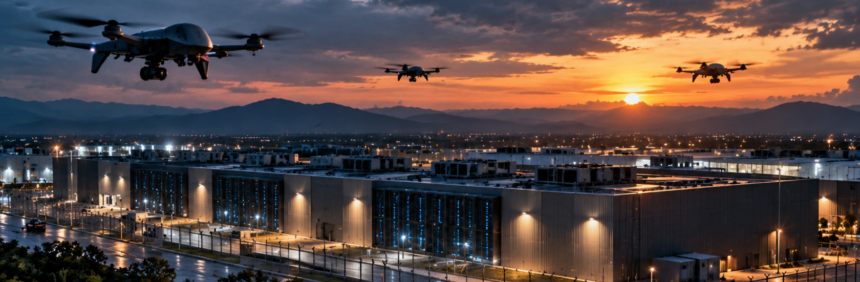
Drones have struck three Yandex sites in October after Iranian strikes on Amazon sites in March.
Data centres are war targets in two conflicts, with Ukrainian drones striking three Yandex sites in October 2026 after Iranian drones struck Amazon sites in March. Drones hit facilities serving ordinary users and soldiers. Here is the TF breakdown of the strikes, the legal test, and the operators’ response.
What’s Happening & Why It Matters
Ukraine Strike Yandex
Ukrainian drones struck a Yandex data centre near Ryazan on 8 October. Al Jazeera says the Sasovo hub houses two of the three supercomputers Yandex uses to develop its AI models. Internal systems failed at several major Russian companies, and some media websites stopped loading.
On 9 October, drones disabled part of a Yandex data centre in Kaluga. Overnight on 11 October, drones struck a third site in Vladimir. Yandex said the infrastructure was damaged and operations were halted. Preliminary reports say a supercomputer in Vladimir took damage. The count reaches three Yandex data centres struck in four days.
Civilians felt the effects. Users could not order taxis in Moscow, St. Petersburg, Perm, Yekaterinburg and other cities. Similar problems appeared in Serbia, Kazakhstan, Belarus and Armenia. Al Jazeera reports that an attack left about 100,000 households without internet service.
Ukraine calls the strikes a response. President Volodymyr Zelenskyy said Ukraine is responding in a mirror-like fashion. Russia has struck several Ukrainian data centres and telecenters over the past month, including targets in central Kyiv.
The Gulf Precedent
Iranian drones struck Amazon Web Services sites in the United Arab Emirates and Bahrain on 1 March 2026, according to Data Centre Dynamics. Three facilities took damage. Two of the three availability zones failed in the UAE, and one failed in Bahrain. AWS confirmed structural damage, power loss and fire.
Customers included Abu Dhabi Commercial Bank, Emirates NBD, First Abu Dhabi Bank, Snowflake and Careem. Iran’s Revolutionary Guard said US military users ran AI systems on the sites. Microsoft denied any strike on its striking data. Centre Dynamics calls them the first confirmed military attacks on a hyperscale cloud provider.
The Legal Line

Article 52(2) of Additional Protocol I to the Geneva Conventions sets the test. An object is a military objective if the object makes an effective contribution to military action and its destruction offers a definite military advantage. Tech Policy Press and Data Centre Dynamics both say that one military function on shared hardware can expose a facility.
Physical colocation decides the question. Separate virtual machines, availability zones, or encrypted partitions don’t stop a drone. Russia’s Defence Ministry and Kremlin say they strike military targets. A taxi app and a search engine fall outside the description, but both ran on the struck sites.
What Operators Do
Sam Winter-Levy of the Carnegie Endowment for International Peace says physical attacks will grow as AI gains weight. Ashish Nadkarni of IDC expects Gulf governments to offer tighter security to win clients. IDC expects providers to spread data across separate buildings.
Some operators already build underground. Bunkers in the UK and Sweden house servers, and Tencent stores data in caverns in Guizhou province. My take: insurers will force the issue. Standard property policies often exclude war, and war-risk cover costs more. A National Interest analyst, quoted by Semafor, wrote: “Modern warfare no longer discriminates between military targets and commercial infrastructure.”

TF Summary: What’s Next
Yandex is working to restore service, but repair times for Vladimir are unknown. Gulf cloud providers are weighing multi-building designs and war-risk cover. Governments are weighing which data centres count as critical national infrastructure. The 5-gigawatt Stargate UAE campus in Abu Dhabi faces new security questions.
MY FORECAST: More strikes on data centres will follow against Ukraine and Russia within weeks. Cloud providers will publish war-risk terms in their contracts. Governments will name hyperscale sites as critical national security infrastructure. Operators will separate military and civilian workloads in different buildings.
Related Stories
- AI Chip Rally Lifts Wall Street as Chinese Labs Eye IPOs
- Samsung Posts Record $80 Billion Profit on AI Memory Boom
- TSMC and Sony Are Investing Billions in a New Chip and Sensor Plant
- Sour Sentiment Triggers AI, Chip Stocks Sell Off
- Chinese Memory Chipmaker CXMT Surges on Stock Market Debut