


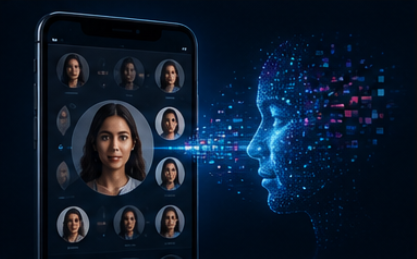
Anyone can @-mention your public Instagram account and generate AI images using your face as a reference. You won’t be notified. The opt-out exists — but it’s buried in a menu most people will never find, under a setting that isn’t labelled privacy at all.
Meta’s Muse Image consent backlash erupted within days of the tool’s July launch — after users discovered that Meta‘s new AI image generator lets anyone create pictures using other people’s public profile photos without notifying them. Muse Image is available through the Meta AI app and web browser, as well as on WhatsApp and in Instagram Stories for US users. With this feature, users can @-mention any public Instagram account inside a Muse Image prompt, and the AI will access the person’s public photos as visual references to generate new images. Donald Campbell, advocacy director at tech justice non-profit Foxglove, told the BBC it was “an obvious recipe for disaster.” “We’ve already seen a catalogue of harms from non-consensual AI-altered images on social platforms just in the past year,” he said. “It is hard to see why Mark Zuckerberg thinks facilitating yet more of this creepy image manipulation is a good idea,” Meta said, a dedicated setting allows users to opt out — even with a public account.
What’s Happening & Why It Matters
The Opt-Out That Almost No One Will Find
Meta’s Muse Image consent backlash centres on a specific and consequential design choice: the feature is default-on, and the opt-out is buried. To deactivate it, users must go to Instagram’s settings menu, select “Sharing and Reuse,” and switch off “Allow people to reuse your content on Instagram and with AI features at Meta” for both posts and reels. Crucially, this setting only appears if the account is public — private accounts are already excluded from reuse.
The default-on setting is the major part of the controversy — a consent problem that goes beyond typical privacy concerns. Users with public Instagram accounts have no control over how their photos are used as references for AI-generated images unless they actively locate and disable a setting most users will never know exists. Additionally, they receive no notification if someone actually uses their public profile in an AI prompt — meaning a person could be the subject of dozens of AI-generated images without ever becoming aware of it.
Privacy International and the “Raw Material” Critique
Meta’s Muse Image consent backlash drew a second, more structurally focused criticism from Privacy International, which told the BBC that the feature was “the latest sign AI companies see people’s images and data as raw material to be exploited.” The choice situates Muse Image within a widespread movement. TF has documented throughout 2026 — from Meta‘s own employee-monitoring Model Capability Initiative, which was suspended after an internal data leak, to the general industry’s treatment of user-generated content as free AI training input.
By contrast, Meta is entering an already crowded text-to-image market — there are many similar tools available, so Meta is not introducing a fundamentally new capability. What has drawn specific criticism is the combination of default-on public-profile access with a named-mention mechanism that makes targeting a specific real individual trivially easy, rather than the general act of AI image generation itself.
The Regulatory Picture — Ofcom’s Grok Investigation
Meta’s Muse Image consent backlash arrives as the UK media regulator Ofcom is already investigating Elon Musk-owned platform X over concerns about AI chatbot Grok’s role in creating and sharing non-consensual AI-altered images of real individuals. That parallel investigation is a significant precedent — it confirms that UK regulators are actively scrutinising exactly the category of harm, and Muse Image’s launch timing places it directly within that regulatory attention window.
The international regulatory response is already beyond the UK alone. In February 2026, India amended its IT Rules to create its first legal framework for synthetically generated information (SGI) content — requiring online platforms to label AI-generated content, remove unlawful material, and comply with strict takedown timelines. The rules were specifically developed following the Indian government’s investigation into X‘s Grok chatbot. As TF covered in its UN AI Child Safety Pledge article, the global regulatory conversation around AI-generated imagery and consent has been accelerating throughout 2026 — Muse Image’s launch gives every regulator currently watching a fresh and specific case study.
TF Summary: What’s Next
Meta has not announced any changes to Muse Image’s default-on public-profile access following the backlash. The opt-out mechanism remains available but unchanged in its current buried location within Instagram’s settings menu. Ofcom‘s investigation into X‘s Grok continues independently. India’s IT Rules synthetic content framework applies to any platform operating in the country, including Meta.
MY FORECAST: Meta’s Muse Image consent backlash will force Meta to change the feature’s default settings within 60 to 90 days — the combination of Foxglove and Privacy International’s public criticism, active parallel regulatory scrutiny of comparable Grok functionality, and the sheer scale of Instagram’s public-account user base makes the current default-on configuration commercially and legally untenable to maintain unchanged. By contrast, Meta will likely resist making the change opt-in by default globally, instead rolling out region-specific defaults that comply with the strictest applicable regulation — the EU and UK first, given active Ofcom scrutiny, with the US changing only if Congress or the FTC intervenes directly. Expect Meta to establish any eventual change as a “user experience improvement” rather than a concession to the backlash — precisely the pattern TF has documented across Meta‘s other 2026 privacy controversies.
Related Stories
- Meta Suspended Its AI Employee Monitoring Programme After an Internal Data Leak
- UN’s AI Child Safety Pledge — Guterres Calls for Accountability in Geneva
- Meta Wants Legal Immunity Written Into the Kids Online Safety Act