


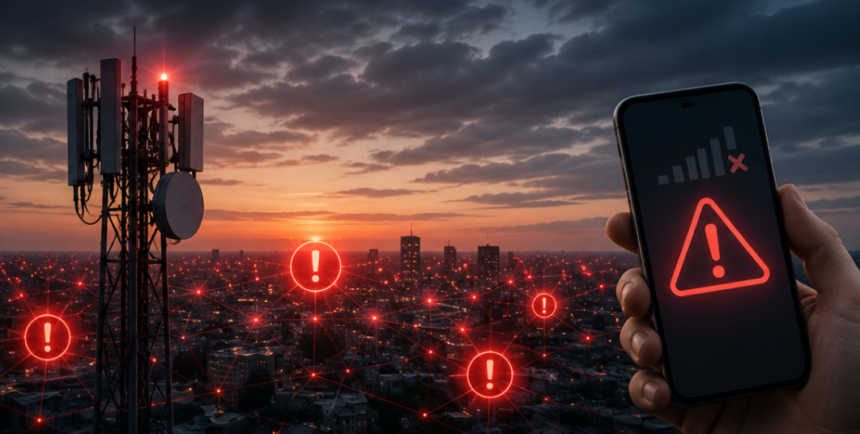
A software defect nobody can yet explain. Time synchronisation failed inside servers in Sydney and Melbourne. Trains stopped across Victoria and New South Wales. Police carried out 333 welfare checks on people whose emergency calls dropped. Telstra says it’s fixed. The regulator says it wants answers.
Telstra’s national network outage struck Australia — knocking out mobile and internet services for tens of thousands of customers nationwide. It disrupted transport networks and cut off Triple Zero emergency calls for an unknown number of people. Telstra experienced a major national service crash on Wednesday morning, with issues reported from around 4am. Notably, the reports peaked just before 7am, according to Downdetector. Communications Minister Anika Wells confirmed some Telstra users were unable to contact Triple Zero. Telstra chief financial officer Michael Ackland said the company had completed 333 welfare checks by Wednesday afternoon. These were done for customers whose emergency calls went unsuccessful or dropped. “The volume of these welfare checks was higher than we expected and it has prompted us to investigate further,” Ackland said. Telstra said its network issues had been fully resolved by 4pm. This was roughly 12 hours after the disruption began.
What’s Happening & Why It Matters
The Cause: Time-Synchronisation Failure
Telstra’s national network outage stemmed from a specific and, by the company’s own admission, poorly understood technical fault. Telstra said the issue is a node problem affecting timekeeping across its network, resulting in intermittent outages. The source of the issue lies in servers held in data centres in Sydney and Melbourne, Ackland said. “Time synchronisation in those nodes wasn’t working as it should. We don’t know why,” he said. Additionally, Telstra said the fault stemmed from a software defect rather than external interference. Prime Minister-level speculation around a potential malicious attack was addressed directly by Ackland. “At this stage we have nothing to indicate malicious activity,” he told reporters.

By contrast, that admission of uncertainty is significant on its own. A telecommunications provider serving 24.9 million retail mobile services — according to its own 2025 annual report — experienced a nationwide outage. The root cause was one its own engineers could not immediately diagnose. “The fact that it occurred means that there is something in our process that we need to fix and to change — we are working through that,” Ackland said.
The Emergency Services Failure
Telstra’s national network outage produced its most serious consequence in the emergency services layer. Western Australia police confirmed the outage curtailed Telstra’s Triple Zero emergency call service specifically. Police in Victoria, NSW, and Western Australia acknowledged the interruption could be an issue. However, those services stated there was no evidence of impact to frontline staff or a disruption to their own separate networks. Ackland said his company is investigating whether emergency services have been affected. But he also said it is unlikely, given they use a different network to the one affected.
Minister Wells was careful to distinguish the incident from a previous fatal telecommunications failure. Wells assured the public the problem was different to past failures, including an Optus outage in September that was linked to multiple deaths. She also noted a specific regulatory safeguard that applied during the incident. “Australian phones are also required to fall back to other networks for 000 access” — meaning affected customers should, in principle, have been able to reach emergency services via a competing carrier’s signal, even while their primary Telstra service was down.
Trains, Payments, and a Regulator Demanding Answers
Telstra’s national network outage extended well beyond mobile phone connectivity. Victoria’s entire regional V/Line train service was grounded, with the organisation citing “the national Telstra outage” as affecting its entire network. Transport NSW confirmed delays across all of its services, with Hunter Valley, Southern Highlands, and Sydney-to-Canberra routes among those disrupted. Card payment systems across the country were also severely impacted. This was a reminder of how deeply embedded Telstra‘s network infrastructure is in payment processing that customers assume is independent of any single telco.
The regulatory response is already underway. Wells confirmed the Australian Communications and Media Authority (ACMA) will conduct “a full investigation.” “Telstra will need to account for how and why this outage occurred,” she said. That regulatory scrutiny arrives against a pattern of critical infrastructure fragility. This fragility has drawn increasing government attention throughout 2026. Telecommunications, alongside power and water, is firmly inside the same national resilience conversation. This conversation has driven data centre and AI infrastructure policy debates globally.
TF Summary: What’s Next
Telstra confirmed its network issues were fully resolved by 4pm on 8 July. The company continues investigating the underlying cause of the time-synchronisation failure. ACMA will conduct a formal investigation into the outage’s cause and Telstra’s response. The full scope of Triple Zero call failures — beyond the 333 confirmed welfare checks — is under review. Ackland acknowledged the volume was “higher than we expected.”
MY FORECAST: Telstra’s national network outage will produce a formal ACMA finding within the next several months. This finding will require specific infrastructure and process changes — likely including mandatory redundancy requirements for Triple Zero routing. These changes will aim to prevent dependence on a single carrier’s internal timekeeping systems functioning correctly. By contrast, the deeper unresolved question is the one Ackland himself could not answer: why the time-synchronisation fault occurred in the first place. Until Telstra can explain that root cause definitively, public and regulatory confidence in the network’s reliability is shaken. This is particularly concerning given the Optus precedent from September, where a comparable outage was linked to fatalities. Therefore, expect the Australian government to accelerate consideration of mandatory cross-carrier emergency call failover requirements. This will be a direct legislative response to the specific incident.
Related Stories
- FortiBleed: Credential Leak Hits Oracle, Lenovo, NATO, and 74,000 Fortinet Firewalls
- 40 Mayors Demand Standards for AI Data Centres — the UN Wants Transparency Too
- Russian EKS Satellites Have Tested Continental-Scale GPS Jamming