


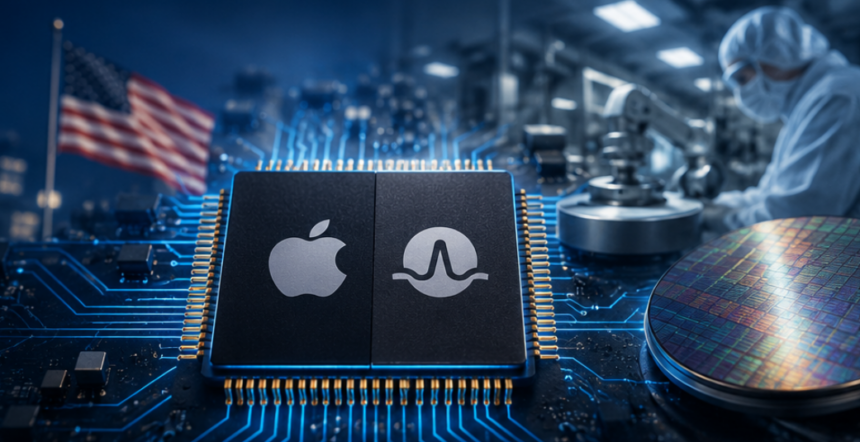
It’s Apple’s biggest domestic manufacturing commitment to date. Fifteen billion chips, made in America, running through 2031. Broadcom’s stock jumped 5% on the news. And it comes as Tim Cook — three months from stepping down — makes one more high-profile play in Apple’s $600 billion US spending pledge.
Apple’s $30 billion Broadcom chip commitment was confirmed — the largest domestic manufacturing pledge Apple has made to date. Apple is expanding its partnership with chipmaker Broadcom in a multi-year deal expected to exceed $30 billion, marking the iPhone maker’s largest US manufacturing commitment to date. The agreement covers custom silicon components and advanced wireless connectivity technologies across multiple product generations. Broadcom had earlier disclosed in an SEC filing on Monday that the companies extended their collaboration through 2031 for custom ASIC products used in Apple devices. Shares of Broadcom climbed almost 5% following the announcement. The deal will lead to the production of more than 15 billion US-made chips, according to Apple, and includes a $1.5 billion expansion of Broadcom’s Fort Collins, Colorado facility.
What’s Happening & Why It Matters
What Broadcom Builds for Apple

Apple’s $30 billion Broadcom chip commitment covers two distinct product categories with a long shared history. The agreement covers FBAR filters — radio-frequency chips used for wireless connectivity in Apple devices — that Apple and Broadcom had been developing together since at least 2023. Apple said Broadcom will make wireless components used to help devices connect to cellular, Wi-Fi, and Bluetooth networks. Additionally, Broadcom‘s SEC filing confirmed new long-term agreements to develop and supply custom ASIC silicon products for multiple generations of Apple products through 2031.
By contrast, one detail carries the most forward-looking significance. Broadcom is tied to Apple‘s custom AI server chip strategy, including the reported “Baltra” project. That chip is expected to support Apple Intelligence workloads in cloud infrastructure, reducing Apple‘s reliance on outside AI infrastructure providers over time. That positions Broadcom alongside Google, Meta, OpenAI, and Anthropic — as TF covered in its OpenAI Jalapeño chip article — as another AI lab dependent on Broadcom‘s custom ASIC design capability.
$600 Billion — A Final Play by Tim Cook
Apple’s $30 billion Broadcom chip commitment forms part of Apple‘s previously disclosed $600 billion commitment to invest in the US over four years, supporting manufacturing, job creation, and technology development. The agreement represents Apple‘s largest single commitment under its American Manufacturing Program, which launched last year to accelerate US manufacturing.
The political stance is intentional. Bolstering its US sourcing comes as President Donald Trump‘s administration urges increased domestic chip manufacturing — and supports Apple‘s work with the administration to source more components domestically. For outgoing CEO Tim Cook, it’s the latest effort to tout domestic manufacturing, a signature issue for the Trump administration, arriving roughly two months before John Ternus takes over as CEO on 1 September — as TF covered in its WWDC 2026 article.
Colorado Investment — and the Market Reaction
Apple’s $30 billion Broadcom chip commitment includes a specific facility expansion. Under the deal, Broadcom will expand and modernise its Fort Collins, Colorado manufacturing facilities with a $1.5 billion capital expenditure investment. The facility will produce advanced radio frequency components, including FBAR filters. Broadcom CEO Hock Tan said the company was pleased to expand its Fort Collins footprint after decades of working with Apple.
The market response was immediate and asymmetric. Broadcom shares were recently trading at $390.14, up 5.2%, while Apple shares moved only marginally lower. That asymmetry is the deal’s structure — Broadcom gains fresh revenue visibility and a locked-in major customer through 2031, while Apple is committing capital to a supplier relationship it has maintained for years. Additionally, Broadcom‘s stock had faced a valuation warning shortly before the announcement — making Apple‘s commitment a timely catalyst for a stock Wall Street was questioning how much good news was already priced in.

Producing Chips in Colorado Reduces Tariff Exposure
Apple’s $30 billion Broadcom chip commitment carries a defensive dimension beyond its manufacturing headlines. Producing critical chips in Colorado helps reduce supply-chain exposure and may provide a partial shield against tariff pressure. As TF covered in its Apple-Intel chip deal article, Apple has been actively diversifying its chip supply chain throughout 2026 — first through the Intel foundry deal announced in June, and through expanded Broadcom commitment. Both moves address the same structural vulnerability: Apple‘s heavy reliance on overseas manufacturing at a moment when tariff policy and AI-driven memory shortages are simultaneously squeezing its cost base.
TF Summary: What’s Next
The Apple–Broadcom agreement runs through 2031. The Fort Collins facility expansion begins immediately under the $1.5 billion capital commitment. No specific production start date has been confirmed for the reported Baltra AI server chip project. Apple continues pursuing additional domestic manufacturing commitments under its $600 billion US investment pledge.
MY FORECAST: Apple’s $30 billion Broadcom chip commitment will be followed by at least one more major US manufacturing announcement before Tim Cook hands over to John Ternus on 1 September — Cook has a clear incentive to close his tenure with a strong domestic manufacturing record given how central that theme has been to his final year. By contrast, the more commercially significant element long-term is the Baltra AI server chip project. If Apple genuinely reduces its dependence on external AI infrastructure providers through custom Broadcom silicon, that shift positions Apple Intelligence with the same kind of vertical integration advantage Google has built through its TPU programme. Given the AI memory and chip shortage TF has documented extensively throughout 2026, controlling more of its own custom silicon supply chain is not optional for Apple — it is becoming existential to competing at the frontier of on-device and cloud AI simultaneously.
Related Stories
- Tim Cook Confirms Apple Price Rises — Memory Crunch and Intel’s US Chips Are Why
- OpenAI and Broadcom Unveil Jalapeño — a Custom AI Chip Built to Cut NVIDIA Costs by 50%
- Chip World in Chaos: $518B Investment, a Smuggling Raid, a Price-Fixing Lawsuit, and a Record Surge