


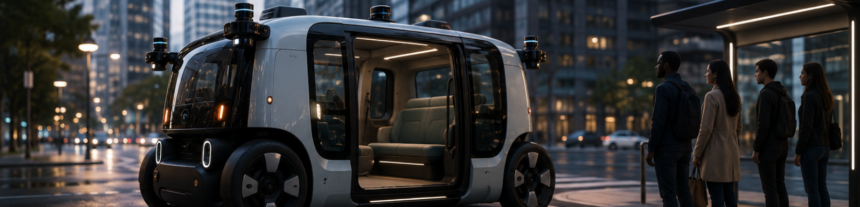
Zoox has served 500,000 riders since September. Every ride has been free. It wants to charge for them — but NHTSA has to say yes first. On 24 June, it showed the redesigned vehicle it will use for commercial service. The core is unchanged. Everything a rider actually touches is new.
Zoox’s production-intent robotaxi redesign debuted — and the word “production-intent” is the most important phrase in that sentence. The redesigned robotaxi is Zoox’s “production intent vehicle,” and the company expects to introduce the model to its existing fleet soon. The company added that it will soon begin large-scale production of its robotaxis at its manufacturing hub in the San Francisco Bay Area that opened last June. The facility will help Zoox grow its robotaxi fleet, eventually producing 10,000 vehicles a year once it’s at full scale. The company — which Amazon acquired for $1.3 billion in 2020 — has served more than 500,000 riders since opening in Las Vegas in September 2025. By contrast, every single one of those rides was free. Zoox is plotting expansion in additional markets and preparing to charge for rides in the future. The one decision standing between free rides and a paid commercial service is a pending NHTSA ruling on Zoox’s commercial exemption petition.
What’s Happening & Why It Matters
What Changed in the Redesign
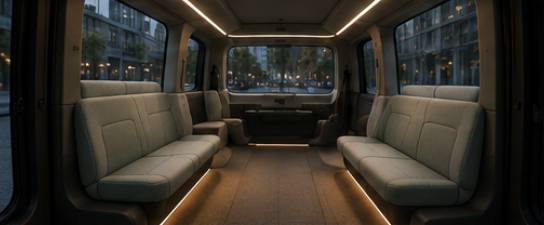
Zoox’s production-intent robotaxi redesign retained everything structural and updated everything experiential. The vehicle’s core specification is unchanged. The cube-shaped robotaxi still lacks a steering wheel and other controls. The company kept the moonroof and starry night lights as well as the 40 cameras, radars, lidars, and infrared sensors. The vehicle still drives bidirectionally, has four-wheel steering, and can transport four people at speeds of up to 75 miles per hour (121 km/h).
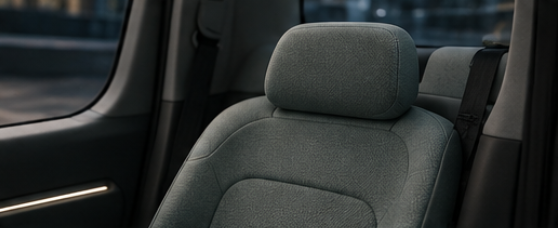
By contrast, the interior received a systematic commercial-readiness upgrade. Zoox added more padding and ergonomic curves to both the seats and headrests and updated the colour, material, and finish with a lighter palette of aloe-green seating and stone-grey flooring and trim. The lighter palette serves a practical purpose beyond comfort. It creates contrasting surfaces that make it easier to spot common items — particularly smartphones — left behind by passengers. Additionally, other interior changes include adding fluting on the charging pad to keep phones in place, enlarging the cupholders, and providing a more visible touchscreen. The exterior received a specific safety update. Zoox enlarged and relocated the bidirectional reflectors, making it easier for passengers, emergency responders, and law enforcement to distinguish the front of the vehicle from the rear. A new speaker, microphone, and two-way audio communication system join the door interface.
The NHTSA Exemption — the Only Thing Preventing Paid Rides
Zoox’s production-intent robotaxi redesign exists within a specific regulatory constraint. Zoox is awaiting approval from the National Highway Traffic Safety Administration to operate as many as 2,500 of its self-driving cars on public roads for commercial purposes. Zoox’s petition is currently under review by NHTSA after public comments closed in early April.
US federal law requires vehicles to carry standard driver controls — a steering wheel, pedals, and related systems. Zoox’s robotaxi has none of these. The company received a demonstration exemption from NHTSA in August 2025, which allowed it to operate free rides during testing. By contrast, a commercial exemption — permitting the company to charge riders — requires a separate and more stringent approval process. NHTSA has not announced a ruling date. The production-intent vehicles unveiled June 24 will join the free-ride fleet later in 2026 as they come off the Hayward production line, with paid rides contingent on the federal ruling.
NHTSA Is Evaluating The Safety Record
Zoox’s production-intent robotaxi redesign is while NHTSA reviews a specific safety record alongside the commercial petition. NHTSA had logged 123 accidents involving Zoox vehicles in autonomous mode as of March 2026. Zoox issued three software recalls between March and December 2025, affecting approximately 860 vehicles total, to address unexpected hard braking, collision prediction failures, and lane-crossing behaviour near intersections. Each recall was voluntary and accompanied by a software fix.
By contrast, the voluntary recall posture is significant for regulatory purposes. Zoox self-reported the lane-crossing behaviour in December 2025 before NHTSA identified it — the approach that Waymo follows. As TF covered in its Waymo recall article, voluntary proactive recalls demonstrate a safety culture that regulators treat more favourably than reactive disclosures. The pattern is the same at both companies: find it, fix it, disclose it.
Hayward Factory — 100 Vehicles per Week, 10,000 per Year
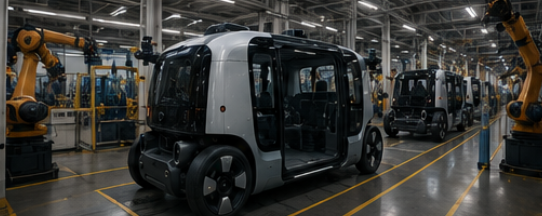
Zoox’s production-intent robotaxi redesign is built for the factory, not just for demonstration. There are practical reasons for the design changes. Last year, Zoox opened a production facility in Hayward, California, where the company expects to one day build 10,000 robotaxis per year. The improvements were made in preparation for volume production, which Zoox says can reach up to 100 vehicles a week.
100 vehicles per week at the current stage scales to approximately 5,200 vehicles per year at sustained production. The 10,000 annual target requires a separate and larger production ramp. Volume production only begins in earnest after the NHTSA commercial exemption clears — because producing tens of thousands of vehicles that cannot legally operate commercially would consume capital without generating revenue.
Waymo Comparison — 500,000 Weekly Paid Rides vs. Zero Paid Rides
Zoox’s production-intent robotaxi redesign arrives while its primary competitor operates at a fundamentally different scale. Zoox is way behind Alphabet’s Waymo, the US robotaxi leader. Waymo recently surpassed 500,000 weekly paid rides across 10 US cities. It plans to bring commercial service to several new cities this year, including London and Tokyo, the first international markets.
Zoox has had 500,000 total riders since September 2025. Waymo completes 500,000 paid rides every week! That gap is sizable — but it is the direct result of a single regulatory difference. Waymo operates vehicles with steering wheels and driver override capability, exempting it from the federal controls requirement. Zoox’s purpose-built design requires the commercial exemption that Waymo never needed. Additionally, Zoox entered into a partnership with Uber to make its robotaxis available through the ride-hailing platform in Las Vegas. That partnership provides distribution infrastructure that Waymo‘s own app must generate independently.
TF Summary: What’s Next
Zoox introduces the redesigned production-intent vehicles to its existing Las Vegas and San Francisco free-ride fleet in late 2026. Paid commercial service launches after NHTSA‘s ruling — with no announced date. The Hayward factory scales to 100 vehicles per week as the commercial exemption progresses. Expansion cities beyond the current four — Las Vegas, San Francisco, Austin, Miami — are planned but not yet announced.
MY FORECAST: Zoox’s production-intent robotaxi redesign will receive its NHTSA commercial exemption before the end of 2026 — and paid rides will begin in Las Vegas by Q1 2027. The three voluntary recalls across 860 vehicles demonstrate the proactive safety posture that federal regulators favour. By contrast, the commercial launch will not immediately close the gap with Waymo. Zoox will reach approximately 5,000 paid rides per week in its first six months of commercial operation — a tiny fraction of Waymo‘s current volume. The product differentiation is real: the purpose-built bidirectional design and carriage-style seating offer a genuinely different passenger experience. Whether that differentiation produces loyalty or merely curiosity will become clear in the first 90 days of paid service. Amazon‘s distribution infrastructure — logistics, technology, and the Uber partnership — gives Zoox a commercial scaling pathway that no other robotaxi startup can match. The paid launch is the beginning, not the arrival.
Related Stories
- Waymo Recalls 3,871 Robotaxis — the Third Major Recall in 14 Months
- US Navy Drone Boat Completes World’s First Autonomous Combat Rescue
- Portugal Self-Driving Cars Bound for Roads in July