


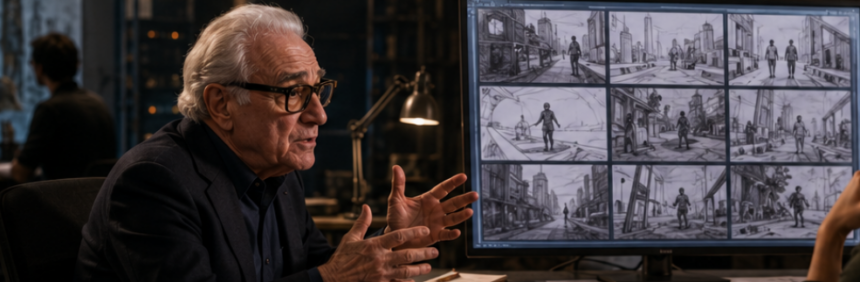
Martin Scorsese became an adviser to an AI image company. He said it helps him turn his ideas into storyboards. Karla Ortiz said he threw every storyboard artist under the bus. Boots Riley said something considerably more emphatic. The most respected filmmaker alive just became the face of AI in Hollywood.
The Martin Scorsese AI controversy slapped the film industry like a dropped slate. Black Forest Labs — a German AI image-generation startup behind the FLUX model — announced that Martin Scorsese, director of Goodfellas, The Irishman, Killers of the Flower Moon, and arguably cinema’s most respected living filmmaker, had joined the company as an adviser. He revealed he has been using FLUX to create storyboards for his current film. At 83 years of age, the man who has spent 70 years pioneering human cinematic storytelling is one of the world’s most prominent filmmakers to publicly endorse generative AI. The backlash from artists, concept designers, animators, and fellow directors was immediate, furious, and at times genuinely creative in its anger.
What’s Happening & Why It Matters
What Scorsese Said — and What He Actually Did
The Martin Scorsese AI controversy hinges on a specific and important distinction. Scorsese has always created his own storyboards. He did not hire a storyboard artist and replace them with AI. He replaced his own hand-drawn work — which he describes as imprecise and difficult to communicate to cast and crew — with AI-generated images that better represent what he sees in his head. “For 70 years, I’ve been creating my own storyboards,” he said in a prepared statement to the New York Times. “There’s always been this problem of how to communicate what you see in your head to your cast and crew. There are some things you have to see and feel.”
It is all measured and focused. Black Forest Labs‘s FLUX tool is, in Scorsese’s telling, a communication aid — not a replacement for human creativity. The film itself, the performances, the direction, the editing and the vision are all still his. The AI generates images. He tells it what to show.
Why the Film Community Is Not Buying It
The artistic community did not engage with that distinction. Reaction was swift and specific. Karla Ortiz — a concept artist who worked on Marvel films and has been a leading voice in the AI art rights movement — wrote on X: “He throws every single storyboard artist he’s ever worked with under the bus, as he demolishes their livelihoods with models that are likely trained on those very storyboards.” That accusation addresses the training data question directly. Black Forest Labs‘ FLUX model — like most image generation AI — was trained on images scraped from the internet, artwork databases, and professional portfolios. Many professional storyboard artists and concept designers believe their work was used without consent to train the very systems that compete with them commercially.
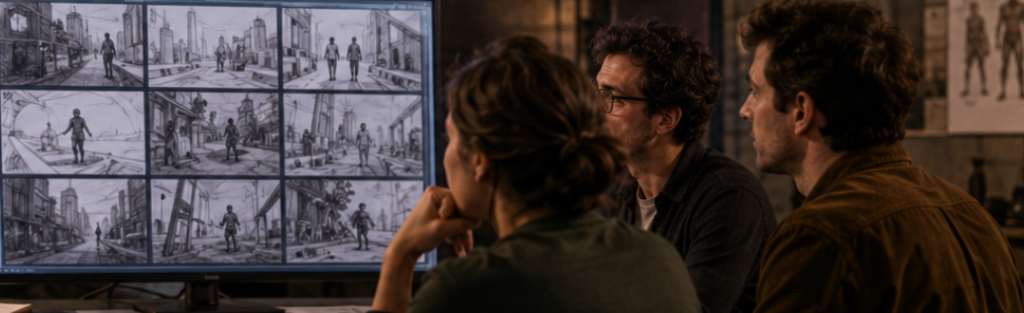
Samuel Deats — director of the Castlevania animated series — was more pointed. “Have some damn pride and respect your peers,” he wrote. He noted that storyboarding a shot took only seconds and that “there is absolutely no reason to need AI built on the stolen work of millions of artists to storyboard your vision.” Separately, filmmaker Boots Riley — director of Sorry to Bother You — offered his own interpretation of why Scorsese might have taken the role. “At 83, they gave his family a gang of money. He wanted the income stream for them. And he feels like AI will fall on its face anyway, so he doesn’t give a f***.” Riley shared his own handwritten storyboards for his current film, I Love Boosters, as evidence that AI tools are unnecessary for the task Scorsese described.
What Black Forest Labs Is — and Why They Need Scorsese
Black Forest Labs was founded in 2023 by former Stability AI researchers. Its FLUX model is widely used by creative professionals and developers for image generation. The company is a direct competitor to Midjourney, Adobe Firefly, and Stable Diffusion. It is growing fast and building toward a commercial scaling moment. Scorsese’s endorsement is not incidental. It is a calculated move by a company that needs cultural legitimacy in a market where AI art tools face ongoing legal challenges, artist boycotts, and regulatory scrutiny.
The strategic logic is clear. If the director of Taxi Driver endorses your product, the cultural argument against AI creative tools is harder to sustain. Scorsese’s credibility as an artist — built across six decades of uncompromisingly human cinema — is exactly what Black Forest Labs is purchasing. By contrast, that same credibility is precisely what makes the endorsement so painful to the artists whose work is being devalued.
The SAG-AFTRA — Bigger Than Storyboards
The Scorsese announcement does not exist in a vacuum. It arrives amid the ongoing battle over AI protections in entertainment. SAG-AFTRA won AI safeguards in its 2023 contract after a major strike — establishing consent and compensation requirements for the use of actors’ digital likenesses. Visual artists, concept designers, storyboard artists, and illustrators — who are not covered by SAG-AFTRA — have no equivalent protections. Their work is commercially vulnerable to AI tools in ways that actors’ likenesses are not.
As TF covered in its ElevenLabs Stan Lee AI resurrection article, the consent question is unresolved across multiple categories of creative work. When a beloved figure endorses a technology that many artists believe has been built on their unconsented contributions, the reaction is not simply an aesthetic objection. It is labour rights politics. Scorsese’s endorsement carries weight because his moral authority in cinema is considered extraordinary. His use of that authority to advance a commercially contested technology strikes many artists as a betrayal of the creative community that sustained his career.
Fairness to Scorsese?
The sharpest criticism of the backlash comes from a structural observation. Scorsese has always drawn his own storyboards. He has not employed a professional storyboard artist in decades of filmmaking. No one working in that role today is losing their job because Martin Scorsese switched from pencil to FLUX. Moreover, his endorsement is specifically and repeatedly limited to the storyboarding function. He is not endorsing AI-generated cinematography, AI performance, or AI direction. He says a tool helps him communicate his vision more quickly in pre-production. The fury the announcement generated — however understandable in its origins — is partly directed at what Scorsese represents rather than what he actually did.
At the same time, the counterargument is equally valid. The symbolic value of the world’s most respected filmmaker endorsing a generative AI product is real and commercially significant — regardless of how he personally uses the tool. When Black Forest Labs uses Scorsese’s endorsement in its marketing, it will not carry the footnote that he uses it only for his own personal storyboarding. The endorsement normalises the product category. Normalisation impacts every artist whose work may have been used to train it.
TF Summary: What’s Next
Black Forest Labs continues to build its FLUX commercial platform, with Scorsese listed as an adviser. No specific advisory responsibilities or compensation details have been disclosed publicly. The Graphic Artists Guild and AI Art Watch — two organisations tracking AI’s impact on visual artists — have not yet issued formal statements on the Scorsese announcement. Congressional hearings on visual artist AI protections are scheduled for late summer 2026.
MY FORECAST: The Martin Scorsese AI controversy will not alter his relationship with Black Forest Labs. Scorsese is 83. He has been in the industry long enough to have weathered every major technological disruption in filmmaking. He will not reverse course under social media pressure. By contrast, the controversy will produce one concrete outcome: it will accelerate the push for a visual artists’ equivalent of SAG-AFTRA’s AI consent protections. The absence of collective bargaining rights for storyboard artists, concept designers, and illustrators is the structural vulnerability that makes the controversy so charged. The Scorsese announcement arrives as Congress is scheduled to hold AI hearings. The testimony of artists reacting to his endorsement will be cited in those hearings. The protections that do not yet exist for visual artists will be closer to existing because of the controversy than they were before it.