



DuckDuckGo’s install surge after Google I/O is one of the clearest consumer signals in recent technology history. The week after Google announced its most aggressive AI search overhaul at Google I/O 2026 — DuckDuckGo reported that US app installs grew an average of 18.1% week-over-week for six consecutive days. The peak arrived on 25 May — a 30.5% single-day increase. On iOS specifically, the story was sharper. iPhone installs averaged 33% week-over-week growth and peaked at nearly 70% in a single day. Meanwhile, traffic to noai.duckduckgo.com — DuckDuckGo‘s AI-free search page — grew an average of 22.7% week-over-week, peaking at 27.7% on 24 May. DuckDuckGo CEO Gabriel Weinberg offered the simplest possible explanation. “Google is force-feeding AI with no way to opt out.”
What’s Happening & Why It Matters
What Google I/O 2026 Triggered
Google called its Search announcement at I/O 2026 “the biggest upgrade to Google’s Search box in over 25 years.” The language was not modest — and the changes it described are genuinely significant. The traditional search box has been replaced with the Intelligent Search Box — a conversational input that accepts complex, multi-part queries and processes videos, images, files, and Chrome tabs as context. Instead of returning a list of links, the new system leads with an AI-generated overview. Traditional blue links appear further down, or not at all. That shift is not a feature add. It is an architectural change in how Google delivers information.
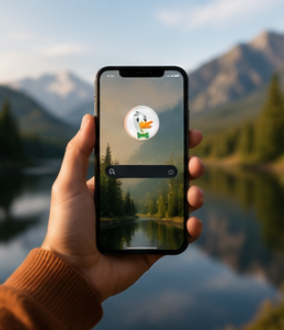
By contrast, Google’s prior AI search features — AI Overviews and AI Mode — had been available as opt-in or parallel features. Users could still navigate to a traditional Google search experience. The I/O announcement collapsed that distinction. AI is the default layer. There is no toggle to remove it. For users who found AI Overviews useful, that is an improvement. For users who found them unreliable, intrusive, or simply unnecessary for their search habits — it is a mandate they did not choose.
The Reaction Says It All
The speed and scale of DuckDuckGo‘s growth is significant precisely because it held through Memorial Day weekend — a period that historically softens app download activity. Weekend traffic usually slows. Growth through a three-day holiday weekend indicates a beyond-momentary reaction to conference coverage. People were changing their default search engine. TechCrunch reporter Natasha Lomas overheard a woman on the phone during the same week saying she was switching to DuckDuckGo because you can “opt out of using AI.” The woman added: “Google just isn’t Google anymore.” That sentiment is not unique to one phone call. It is being documented across Reddit, X, and multiple technology forums simultaneously.

DuckDuckGo explicitly identified the growth pattern as a US-centric response to Google‘s US-focused I/O announcement. International growth was more modest. That geographic specificity supports the interpretation. People in markets where Google‘s AI search rollout fell hardest and fastest reacted most strongly.
What DuckDuckGo Offers — It Has AI Too
The irony in DuckDuckGo‘s surge is worth addressing directly. DuckDuckGo is not an anti-AI company. Duck.ai provides access to models from OpenAI, Anthropic, Meta, and Mistral. Its Search Assist feature generates AI-powered answers similar to Google AI Overviews.AI Image Filter strips AI-generated images from search results. Chief communications officer Kamyl Bazbaz confirmed that both Search Assist and the AI Image Filter are among DuckDuckGo‘s most popular features. Notably, both sit at opposite ends of the AI spectrum — one adds AI to search, the other removes it. Both are popular. That data point is the product insight at the heart of DuckDuckGo‘s entire positioning.
The Opt-In Philosophy: DuckDuckGo’s Actual Differentiator
DuckDuckGo‘s CEO Weinberg articulated the company’s core pitch plainly. “Not only do we respect user choice, but also user privacy. Everything you do in DuckDuckGo is private — we don’t collect search histories or chats, and nothing is used for AI training.” That privacy-first strategy has been DuckDuckGo‘s consistent message for over a decade. At the moment, it combines with a second message that is distinctly more timely: you decide how much AI you use.

The noai.duckduckgo.com URL is the most direct expression of that position. It is a version of DuckDuckGo where every AI feature is disabled by default. No generated answers. No AI-created images in results. Standard web search, as it existed before the current AI wave. Traffic to that page grew 22.7% week-over-week during the I/O reaction period. That is not a nostalgic quirk. It is a segment of the search market that Google has explicitly exited — and which DuckDuckGo is deliberately maintaining.
Google’s Market Position — and What It Does Not Change
Context is essential here. DuckDuckGo holds approximately 2% of the US search market. Google holds approximately 91%. A 30% increase in DuckDuckGo downloads does not threaten Google‘s dominant position. Consumer [tech] history is full of examples where early user pushback against a dominant platform’s product direction was dismissed — and then proved prescient. Microsoft‘s forced adoption of Cortana in Windows 10. Twitter‘s algorithmic timeline replacing a chronological one. Facebook‘s news feed redesign. Each generated exactly the pattern — a surge in alternatives, public frustration, and a corporate rationalisation that growth metrics justified the change.
Google‘s own Q1 2026 earnings confirmed the risk is visible at the board level. Alphabet flagged that AI Overviews may reduce ad click-through rates — a structural concern about whether the shift from links to AI answers affects the company’s core revenue model. AI Overviews answer queries. Answered queries generate fewer clicks. Fewer clicks generate less ad revenue. The user experience change that drove people to DuckDuckGo is the same change creating internal Google risk calculations.
The Moment: AI Assistance vs. AI Control

The DuckDuckGo surge reflects a distinction that the technology industry is only beginning to articulate clearly. Users want AI assistance. They do not always want AI control. Those two things are fundamentally different. An AI that helps you find information faster is valuable. An AI that intercepts your query before you have a chance to express a preference — and decides the format, source, and completeness of your answer — is a different kind of experience entirely. Google has made a clear product decision that the second model is what the majority of users want. DuckDuckGo‘s six-day install surge suggests at least one meaningful segment of the market disagrees.
As TF covered in its Google I/O 2026 article, Google announced Gemini Omni, Gemini Spark, and a full redesign of Search simultaneously. The scale of change Google announced in one week is genuinely unprecedented. By contrast, unprecedented change in a product that 3 billion people use daily generates unprecedented reactions — including people downloading a search engine that held roughly 2% market share and suddenly visible again.
TF Summary: What’s Next
DuckDuckGo‘s install surge has not reversed as of 27 May. The growth sustained through Memorial Day weekend. DuckDuckGo has not provided projections for whether the increase represents durable user acquisition or temporary experimentation. Google‘s AI Search features continue rolling out gradually — the Intelligent Search Box is expanding to all markets where AI Mode is available. The US rollout was the first wave. International markets follow over the coming months.

MY FORECAST: DuckDuckGo’s install surge after Google I/O will not translate into a permanent market share shift — but it will translate into something more commercially important for DuckDuckGo: a clearly defined brand identity as the opt-out alternative. Every subsequent Google AI search upgrade will send a predictable wave of privacy-conscious and AI-sceptical users to DuckDuckGo. That is not a path to overtaking Google. It is a path to becoming the durable, profitable, second-choice search engine for a segment of the market that Google is actively deciding not to serve. The more aggressively Google mandates AI, the more clearly DuckDuckGo‘s market position defines itself. For a company that has operated in Google‘s shadow for 15 years, that is not a bad position to find yourself in during the AI transition.