


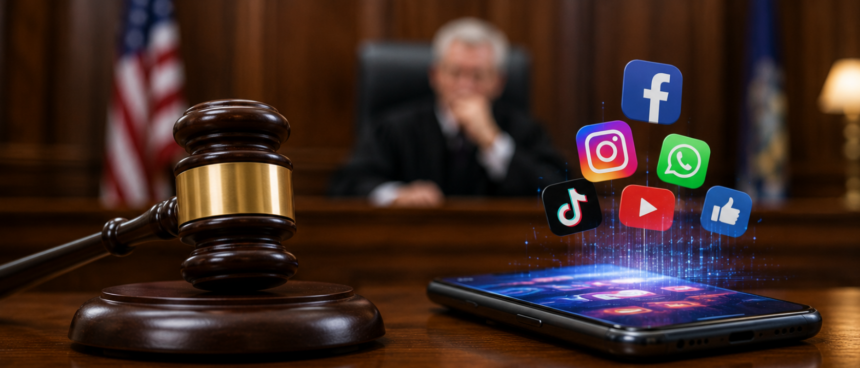
A jury found Meta liable for a young woman’s depression and addiction in March. Meta’s response? Ask the judge to throw the whole thing out.
The social media addiction trial that made history in March 2026 is not over. On 5 May 2026, Meta filed a motion in the Los Angeles County Superior Court seeking to overturn the landmark verdict against the company — or, failing that, to order an entirely new trial. The motion was delivered publicly on 7 May 2026. It is Meta‘s most aggressive legal move since the jury returned its verdict on 25 March. By pursuing this motion, Meta is betting that a judge will do what the jury refused to — rule that Meta bears no legal responsibility for the mental health damage its platforms caused a young woman who began using them as a child.
What’s Happening & Why It Matters
The March Verdict That Started This Fight
The jury verdict at the heart of the social media addiction trial was historic. On 25 March 2026, a jury found that Meta and Google — YouTube‘s parent company — had been negligent in the design of their platforms. The jury also found that both companies failed to warn users of the risks posed by those platforms to young people. The jury awarded the plaintiff — a 20-year-old woman identified in court as Kaley G.M. — a total of $6 million (€5.1 million) in compensatory and punitive damages. Meta bears $4.2 million (€3.7 million) of that total — approximately 70% of the award. Google bears $1.8 million (€1.6 million) — the remaining 30%.
Kaley G.M. testified during the trial that she spent up to 16 hours a day on social media platforms. She said that use exacerbated her mental health struggles, including depression. The case was the first bellwether trial in a massive, coordinated litigation known as In re Social Media Adolescent Addiction Product Liability Personal Injury Litigation. A bellwether trial tests legal theories and evidence before a jury, with the result guiding settlement negotiations across thousands of related cases. The March verdict was the first time a jury returned a finding of liability against Meta in the social media addiction litigation.
Meta’s Core Argument: Section 230 Should Protect Us
Meta‘s motion rests on a legal argument the company has raised throughout the litigation. The company claims protection under Section 230 of the Communications Decency Act — a 1996 federal law that broadly shields online platforms from liability for harms arising from user-generated content. Meta argues that the evidence presented at trial “repeatedly tied Kaley’s mental health challenges to the content she viewed, rather than the design features” — such as autoplay, infinite scroll, and algorithmic recommendation systems.
This is strategic. Section 230 does not protect platforms from liability for their own design decisions. It protects them from liability for content created by their users. If Meta can persuade the judge that Kaley’s harm flowed from the content she consumed — not from the platform’s design choices — the Section 230 shield applies. If the judge agrees with the jury that harmful design features caused the harm, Section 230 offers no protection. Lower court judges across multiple jurisdictions have largely rejected the Section 230 defence in social media addiction cases. Meta is asking this judge to be the exception.
The Scale of What Is at Stake

The social media addiction trial’s March verdict carries implications far beyond the $6 million awarded to Kaley G.M. The bellwether structure means this case is a test run — and the result will shape how tens of thousands of similar cases proceed. Meta‘s own 10-Q SEC filing for Q1 2026 disclosed that plaintiffs have indicated they intend to seek damages in the range of “up to the high tens of billions of dollars” across the coordinated litigation.
The litigation pipeline is enormous. More than 100,000 individual arbitration demands related to social media addiction have arrived at Meta since November 2024. Families, school districts, and state attorneys general have filed separate coordinated cases. Critically, the second user bellwether trial is scheduled to begin on 27 July 2026. The first school district bellwether trial starts on 15 June 2026 in the federal multidistrict litigation. The first state attorneys general trial is scheduled for 5 August 2026. Each of those cases is downstream of the March verdict. Whether that verdict stands or collapses will directly affect each of them.
A Precedent To Change Social Media Liability?
The Section 230 question is the legal hinge of the social media addiction trial. Experts have described the interpretation of that law as potentially having “broad implications for many types of internet companies” — not just social media platforms. If courts conclude that Section 230 does not shield platforms from liability for deliberately addictive design features, the legal exposure for Meta, Google, TikTok, Snap, and virtually every ad-supported content platform will change permanently.
Google has already announced its own plans to appeal the March verdict. The company has asked the court to either set aside the verdict against it or order a new trial — mirroring Meta‘s strategy. Snap and TikTok were defendants in the original case. Both companies settled with Kaley G.M. before the trial began, avoiding the courtroom verdict entirely. Those settlements did not include admission of liability. Their amounts have not been publicly disclosed.
What Kaley G.M.’s Experience Represents

The facts of the case matter beyond the legal arguments. Kaley G.M. began using Meta‘s platforms — Instagram and Facebook — as a child. Over years of sustained use, she developed depression, which she attributed in part to her experience on those platforms. She testified to spending up to 16 hours a day consuming social media content — a level of engagement that the plaintiff’s attorneys argued was the direct product of deliberate design choices by Meta. Those choices include infinite scroll, which eliminates natural stopping points. They include algorithmic recommendation systems that prioritise engagement over user well-being. They include notification design intended to pull users back to the platform as frequently as possible.
Meta‘s own internal research — revealed in 2021 and referenced throughout the trial — showed that company researchers had identified Instagram’s negative effects on teenage girls specifically. That research existed internally while Meta publicly denied harm. The gap between internal knowledge and public statements is central to why the jury found the company not just negligent but also liable for punitive damages in addition to compensatory damages.
Thousands of Families Are Watching
The social media addiction trial in Los Angeles is one piece of a national reckoning. Across the United States, school districts, state attorneys general, and families have filed legal actions against the major social media platforms. The coordinated federal litigation alone covers thousands of individual cases. Many plaintiffs are parents who say their children developed eating disorders, anxiety, depression, or suicidal ideation as a result of exposure to social media platforms during childhood and adolescence. Many more involve young adults — like Kaley G.M. — who began using the platforms before the age of consent.
At the legislative level, the Kids Online Safety Act (KOSA) has passed the Senate but is stalled in the House. Several US states have independently enacted laws restricting minors’ social media access or requiring parental consent. Those laws face their own constitutional challenges. The jury verdict in the social media addiction trial offered the child safety movement something that legislation has not yet delivered in many jurisdictions: a judicial finding that platform design choices constitute legally actionable negligence.
TF Summary: What’s Next
The Los Angeles judge will rule on Meta‘s motion to overturn the verdict. No public timeline exists for that ruling. If the judge denies the motion, Meta will appeal the verdict in the California Court of Appeals. The same judge will rule on Google’s parallel motion. The second user bellwether trial begins on 27 July 2026. The first school district bellwether trial begins on 15 June 2026 in federal court. The state attorneys general trial follows on 5 August 2026. Each of those trials carries its own potential for additional precedent-setting verdicts — and additional motions to overturn them.
MY FORECAST: The Los Angeles judge will deny Meta‘s motion to overturn. Lower courts have consistently rejected the Section 230 design-feature argument, and the evidentiary record from the trial specifically supports the jury’s finding. Meta will appeal — and the Section 230 question will eventually reach a California appellate court, and potentially the US Supreme Court. In the near term, however, the March verdict will stand. That result will accelerate settlement discussions across the coordinated litigation and compel Meta toward offering structured settlements to avoid repeated jury verdicts across hundreds of individual trials. The cost of fighting every case in court is higher than the cost of settling most of them.