


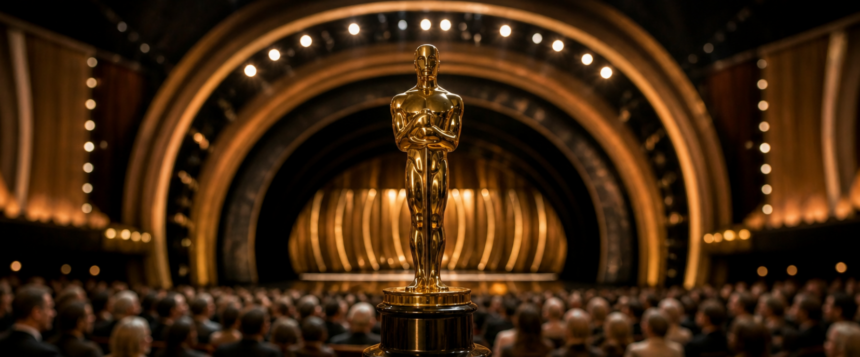
The Academy drew a line in the sand. AI-generated performances cannot win an Oscar. AI-written scripts cannot compete. The rule is simple — but applying it will be anything but.
The Academy of Motion Picture Arts and Sciences announced a sweeping overhaul of its eligibility rules for the 99th Oscars — the ceremony honouring films released between 1 January and 31 December 2026, to be held on 14 March 2027 at the Dolby Theatre in Los Angeles. The most significant changes address the presence of generative AI in the film industry. Under the new rules, only performances “credited in the film’s legal billing and demonstrably performed by humans with their consent” qualify for acting awards. Screenplays must be “human-authored” to be eligible. The Academy also reserved the right to investigate any submission’s use of generative AI and request evidence of human authorship.
The changes are the most substantive update to the Oscars’ eligibility rules in decades. They arrive as AI-generated performances have moved from theoretical concern to practical reality — and as two specific cases in Hollywood have forced the question into the open.
What’s Happening & Why It Matters
Why the Academy Had to Act — and Act Now

The Academy’s statement framed the new rules as a natural continuation of its history. “The Academy’s rules and eligibility standards have always evolved alongside technologies such as sound, colour, and CGI,” it noted. “AI is no different.” That framing is measured. The urgency behind the rules, however, is anything but routine.
Two catalysts drove the decision. The first is Tilly Norwood — a fully AI-generated “actress” created by Xicoia, the AI division of London-based production company Particle6, and its founder Eline Van der Velden. Norwood made headlines throughout 2025 after talent agencies reportedly expressed interest in representing the digital character. Van der Velden stated publicly that she intended Norwood to be “the next Scarlett Johansson or Natalie Portman.” Particle6 claimed that using Norwood could cut production costs by 90%. In March 2026, a music video titled “Take The Lead” — featuring Norwood — was released on YouTube. The video addressed industry backlash with the lyrics: “When they talk about me, they don’t see / The human spark, the creativity.” Norwood had previously posted in March on Instagram: “Can’t wait to go to the Oscars!” That post, in retrospect, read like a provocation. The Academy responded by making it explicitly impossible.
Val Kilmer and the Question Nobody Wanted to Answer

The second catalyst is more emotionally complex. Val Kilmer — one of Hollywood’s most celebrated actors — died in April 2025 after a long battle with throat cancer. Before his death, Kilmer had been cast in As Deep as the Grave, an independent film in which he was set to portray Father Fintan, a Catholic priest and Native American spiritualist. Due to complications from his illness, Kilmer could not appear on set. Writer-director Coerte Voorhees refused to recast the role. Instead, with the cooperation of Kilmer’s estate and his daughter Mercedes Kilmer, Voorhees reconstructed the performance using generative artificial intelligence — assembling the role from archival footage and digital tools.
That decision raised a question that the industry had been collectively avoiding. If the performance is partially real — drawn from a real human being’s actual recordings with the genuine consent of his estate — is it eligible for awards? The Academy’s new rules establish a clear standard. Performances must be “demonstrably performed by humans.” The Val Kilmer case exists in genuinely uncertain territory. The performance is not a fabrication. It is a reconstruction of a real man’s real talent — completed posthumously with family consent. The new rules do not explicitly resolve that case. They create the framework through which the Academy will have to decide it.
What the New Rules Actually Say — and Don’t Say

The language the Academy chose is deliberate and precise. Performances must be “credited in the film’s legal billing and demonstrably performed by humans with their consent.” The phrase “demonstrably performed” places the evidentiary burden on the production. Claiming that a performance is human is not enough. The Academy can request evidence. It also reserved the right to investigate any submission for AI usage. That investigative right is significant. It signals that the Academy intends to enforce the rule actively, not merely state it.
Screenplays present a different challenge. The rule that scripts must be “human-authored” leaves considerable grey area. A screenwriter who used an AI tool to generate a first draft — then rewrote it substantially — may fall within the rule. A writer who prompted an AI model to produce a polished script and submitted it with minor edits may not. The Academy used the word “artificial intelligence” only once in the entire updated rules document. That restraint is intentional. The rules are written to cover the category broadly rather than reference specific tools that may change rapidly. The Academy’s Awards Committee — working alongside branch executive committees — will interpret and apply the rules. That judgment process will be tested quickly.
Films Using AI as a Tool Can Still Compete

One clarification matters enormously for the broader industry. The new rules do not ban AI from the Oscars entirely. Films that use AI as a production tool — in visual effects, sound design, colour grading, or post-production editing — can still qualify in every eligible category. The restriction applies specifically to acting and writing nominations. That distinction preserves the AI workflow that is already deeply embedded in mainstream Hollywood production. Visual effects teams, sound engineers, and editors have used AI-assisted tools for years. None of that changes. What changes is the eligibility standard for the two categories most directly associated with human creative authorship: performance and writing.
Director and actor Tyler Perry had warned in 2024 that AI “will touch every corner of our industry” and cause actors, editors, and sound specialists to lose their jobs. Perry said at the time: “There needs to be some kind of rules to protect us.” The Academy’s new rules answer that call — at least for the acting and writing categories. They do not address the much broader question of AI’s role in production jobs, visual effects work, or the creation of background artists and supporting digital characters.
What Else Changed: Multiple Acting Nominations and International Film Reform

The AI rules are the most consequential update in the 99th Oscars package — but they are not the only significant change. The Academy also reformed how multiple performances by the same actor are handled. Under the old rules, if a performer ranked in the top five of their category with two separate performances, only the higher-vote-getter received the nomination. The second performance was removed entirely. That mechanism had long frustrated awards commentators. A famous historical example is Kate Winslet’s 2008 awards season, when her performances in Revolutionary Road and The Reader competed against each other — with critics arguing both would have placed individually if not for the interaction between them. Under the new rule, an actor whose two performances both rank in the top five of their category can receive two nominations in that same category. Anne Hathaway — with five major films scheduled for release in 2026 — is already cited as the primary beneficiary.
Deadline awards columnist Pete Hammond described the practical implication directly: “If an actor has an extremely prolific year, might we even see someone swallow up three of the five nominations?” That outcome is unlikely. It is no longer impossible.

The Best International Feature Film category also changed. Previously, the Oscar statuette went to the country that submitted the film. Under the new rule, the award goes to the film itself — with the director holding the statuette on behalf of the creative team. That reform reflects a genuine philosophical shift: recognising films as collaborative artistic works rather than national representatives. It also removes some of the strategic complexity that countries face when selecting which film to submit.
The Enforcement Problem Nobody Has Solved
The Academy’s new rules are clear in intent. They are genuinely difficult to enforce in practice. Generative AI tools are now embedded across the production workflow for a significant portion of independent and mid-budget film production. Determining whether a performance is “demonstrably” human requires the Academy to develop investigative capacity it does not currently have. Determining whether a screenplay is “human-authored” requires both access to workflow evidence and a clear definition of what level of AI assistance disqualifies a script.
Particle6 — the production company behind Tilly Norwood — did not respond to NPR’s requests for comment on the rules that bar its creation from consideration. The silence was notable. AIMA — the AI Movie Awards festival that held its inaugural edition in Mallorca in April 2026 — operates on an entirely different premise, celebrating AI filmmaking as a distinct creative form. The gap between the Academy’s model and the world that AIMA represents is not closing. It is widening.
TF Summary: What’s Next
The 99th Oscars rules apply to all films released in 2026. Key submission deadlines begin on 13 August 2026 for early short film and documentary entries. Nominations will be announced in January 2027. The ceremony takes place on 14 March 2027. In the coming months, the Academy will need to develop the investigative framework it claimed when it reserved the right to probe AI usage and human authorship in any submission. That framework does not yet exist in any publicly documented form.
The Val Kilmer case in As Deep as the Grave will be the first genuine test of the new rules. Mercedes Kilmer and Coerte Voorhees consented to the AI reconstruction of the performance. The Academy’s standard is human performance “with their consent” — but Kilmer himself is not alive to consent. That gap will likely require a specific ruling from the Academy’s Awards Committee before the film is submitted. The outcome will set a precedent for every future posthumous AI performance. Beyond individual cases, the industry is watching whether the Academy’s line will hold as generative AI capabilities accelerate. The rule draws a clear boundary today. Maintaining that boundary in 2027, 2028, and beyond will require the Academy to keep pace with a technology that changes faster than any eligibility committee has ever had to manage.