



The nation’s second-largest school district just voted unanimously to pull back on six years of iPad-first education. Parents celebrated. The ed-tech industry took note.
On 22 April 2026, the Los Angeles Unified School District (LAUSD) became the first major school district in the United States to require screen time limits in classrooms. The board voted unanimously in favour of the resolution. Furthermore, the vote was the culmination of more than a year of sustained pressure from parents, teachers, and researchers who argue that excessive device use is damaging children’s learning and wellbeing.
The resolution directs LAUSD staff to develop a detailed, grade-specific screen time policy. Furthermore, that policy must be presented to the board for approval in June 2026. Consequently, the new rules take effect from the 2026–2027 school year. The district serves approximately 430,000 students across Los Angeles — the second-largest school district in the United States. Therefore, whatever LAUSD does, the rest of America watches closely.
What’s Happening & Why It Matters
What the Resolution Actually Requires
The resolution sets clear requirements that staff must build the forthcoming policy around. Furthermore, the rules differ significantly by grade level.

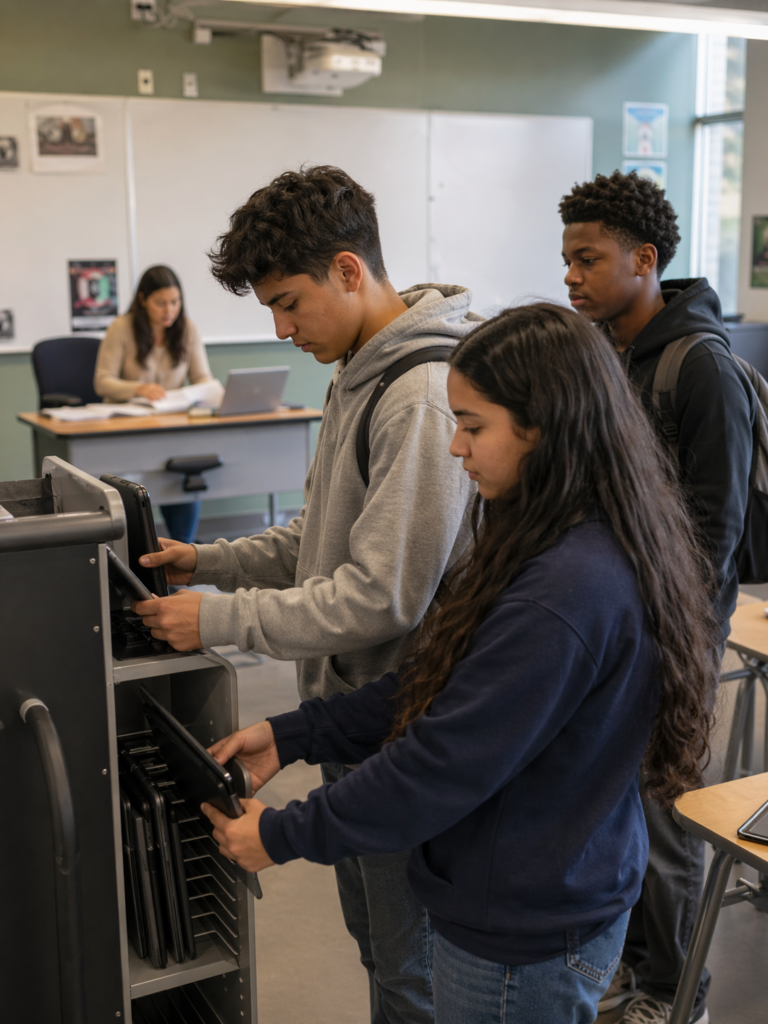
For the youngest students, the change is most dramatic. LAUSD will ban district-issued devices entirely for students in early education through first grade. Additionally, the resolution promotes the use of computer labs over individual devices for students in grades 2 through 5. Families in those grades can still opt in to take devices home — preserving equity of digital access outside school hours. Furthermore, the resolution sets maximum daily and weekly screen time limits by grade level for older students.
Specific limits already appear in the resolution text. Students in grades three to five are limited to one hour of screen time per day or five hours per week. Furthermore, elementary and middle school students cannot use devices during lunch or recess. Additionally, students cannot independently seek out YouTube videos on school-issued devices. The resolution encourages teachers to replace screen-based tasks with paper-and-pen assignments. Furthermore, LAUSD must provide an itemised list of technology purchases at both the district and school level. Consequently, accountability for ed-tech spending is a formal requirement alongside the screen time rules.
A Complete U-Turn From COVID-Era Policy
This resolution represents a sharp reversal of LAUSD‘s recent technology trajectory. Furthermore, that trajectory accelerated dramatically during the COVID-19 pandemic. In 2020, the district launched an aggressive one-to-one device programme — giving every student their own iPad or Chromebook. The goal was equity. Overnight, devices became lifelines for millions of children attending school remotely.

However, when students returned to classrooms, the devices came with them. Board member and resolution co-author Nick Melvoin described what happened next in plain human terms. “Six years ago, we sent every kid in LA home with a device, which was a lifeline. But when they came back, I’m still seeing kids as young as preschool on devices all day,” he said. Furthermore, Melvoin recalled seeing kindergarten classrooms full of children with heads buried in iPads. He described high school students hunched over Chromebooks — clicking through to YouTube and games like Roblox and Minecraft during lunch because they could not use phones.
“We had not recalibrated or reset our relationship with technology post-COVID,” Melvoin added. “It’s really about balance. It’s not about going backwards, it’s about recalibrating that relationship and teaching that balance.”
The Research Behind the Reversal
The resolution is not based solely on parental frustration. Furthermore, the board cited a substantial body of research. The American Academy of Pediatrics states that excessive screen time can lead to vision problems, lower academic achievement, addictive behaviour, and increased symptoms of anxiety and depression. Additionally, the organisation links high device use to reduced attention spans in children.

Furthermore, research cited by Reuters found that children aged 8 to 11 with high screen time have lower cognitive scores and an increased risk for obesity. Melvoin cited studies linking excessive screen time to disrupted sleep patterns. Consequently, the case for recalibration was built on medical, cognitive, and developmental evidence — not just parental preference.
The research on cognitive decline from AI tool use published earlier this week adds further context. Furthermore, the question of what happens to developing brains that offload thinking to screens is not limited to AI chatbots. It applies to classroom devices used passively for hours every day. Additionally, the i-Ready district assessment programme — a digitally delivered tool that has been mandatory since 2023 — drew particular scrutiny. Board member Kelly Gonez successfully amended the resolution to include a formal assessment of i-Ready’s use. Consequently, even mandated assessment technology is subject to review.
The Parents Who Made It Happen
The resolution did not emerge spontaneously from the board. Furthermore, it resulted from a sustained grassroots campaign by a parent group called Schools Beyond Screens. The group has approximately 2,000 members in the Los Angeles area. Members attended board meetings, spoke at district listening sessions, organised on social media, and met directly with administrators and board members. Additionally, the movement is part of a national parent backlash following successful school cellphone bans — with parents questioning why phones were banned while iPads and Chromebooks remained ubiquitous in classrooms.
Parent Martinez Roe described a specific moment of clarity. Her son was in second grade, learning to read and write — and the school expected him to complete all his work on a Chromebook, without a typing class. “He didn’t understand why the keyboard wasn’t in alphabetical order,” she recalled. “This was a real big concern for me because I thought, he’s in second grade, he’s learning how to read, how to write, and you’re expecting him to do this all on a Chromebook.”
Anya Meksin, a parent of two and deputy director of Schools Beyond Screens, described the vote as an inflexion point. “This is an historic reform that we hope will trickle down to the rest of the country very, very quickly,” she said. “We see this as a big cultural shift in how schools approach technology.”
The boardroom reflected the groundswell. Four dozen parents arrived at the meeting. Furthermore, they wore Schools Beyond Screens stickers. They held signs reading “Teachers Over Tech” and “Relationships = Results.” When the vote passed, the room erupted in applause.
Equity, Technology Contracts, and an FBI Investigation

The resolution does not dismiss technology entirely. Furthermore, it explicitly preserves digital access for students outside school hours. Families in grades two to five can still opt in to take devices home. Additionally, the resolution requires the board to consider students’ disability categories alongside grade level when setting device limits. Therefore, students who need assistive technology or adapted digital learning tools retain those protections.
Additionally, the context around LAUSD’s ed-tech spending carries weight. Former Superintendent Alberto Carvalho was placed on leave in February 2026 after the FBI searched his home and office. The investigation reportedly relates to a failed technology company that the district paid $3 million (€2.76 million) to develop a non-functional AI chatbot. Carvalho has denied wrongdoing through his attorney. He has not been charged. Furthermore, the resolution requires the district to present an itemised audit of all technology contracts. Consequently, financial accountability and classroom policy reform are linked in the same document.
What This Means for the Rest of America

A handful of smaller school districts have already moved in this direction. Beverly Hills, Bend, Oregon, and Burke County, North Carolina have all introduced policies favouring paper-and-pencil work over device dependency. Furthermore, lawmakers in 16 states proposed restrictions on classroom technology in early 2026. However, LAUSD is the first national-scale district and a major metropolitan city to formalise screen time limits. Additionally, the board explicitly stated the resolution positions LAUSD as “a national leader in setting thoughtful, research-based limits on student screen use and classroom technology tools.”
Board member Tanya Ortiz Franklin, who co-sponsored the resolution, captured the spirit of the vote. “Let us model for our young people that adults are also learning, and we’re adjusting the rules and regulations that help their learning,” she said. Furthermore, Melvoin was direct about the stakes. “Schools play an important role in providing digital tools, but real equity is not simply about putting a device in every child’s hand. It means ensuring students have access to books and discussions, strong teachers, and meaningful human interaction during lunch and recess. A child sitting in front of a screen for hours is not getting a better education simply because the content is online.”
TF Summary: What’s Next
LAUSD staff must present the full, detailed screen time policy to the board by June 2026. Furthermore, that policy must include specific daily and weekly limits by grade level and subject area. The board will simultaneously review an audit of all technology contracts — including devices, software, digital tools, and applications purchased at both the school and district level. Consequently, the June board meeting will be a critical moment for the practical shape of the new rules.
MY FORECAST: Furthermore, this vote almost certainly accelerates the national conversation. Sixteen US states are already considering restrictions on classroom technology. Additionally, Schools Beyond Screens operates beyond Los Angeles — LAUSD parents and teachers originally founded the national coalition. Consequently, the network is positioned to carry the LAUSD model to districts across the country. For the ed-tech industry — which invested heavily in school device programmes during the pandemic era — the LA vote is a clear signal. The pendulum is swinging back. Furthermore, whether LA’s lead triggers a national recalibration or is a lone outlier depends on whether the June policy delivers the detail and rigour the resolution demands.