

The End of an Era: Apple Names John Ternus as Its Next CEO
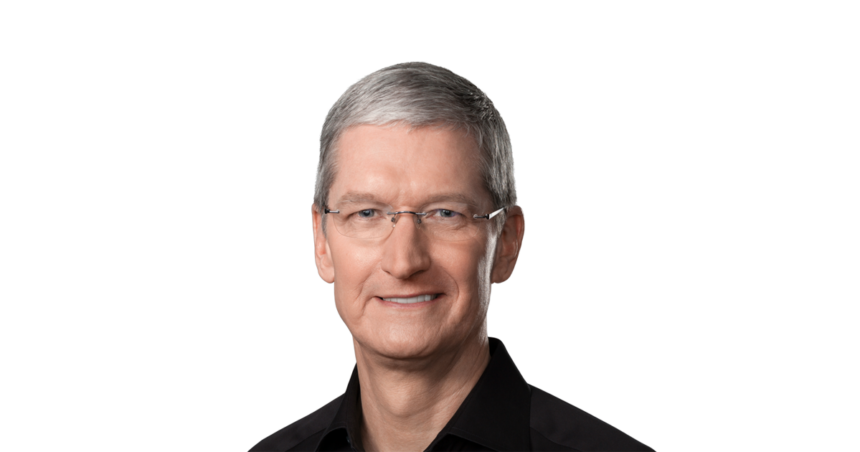
After 15 years at the helm of the world’s most valuable company, Tim Cook is stepping down as Apple‘s Chief Executive Officer. Cook will transition to executive chairman of the company’s board of directors, with John Ternus, Apple’s Senior Vice President of Hardware Engineering, succeeding him as CEO effective 1 September 2026. The announcement arrived on Monday, 20 April, catching many by surprise — particularly after Cook had recently insisted he loved his job too much to leave.
Cook’s departure is Apple’s first CEO transition since he succeeded Steve Jobs in 2011, shortly before Jobs’ death. CNBC For an industry that has watched Cook quietly build one of the greatest corporate runs in history, the news lands with the weight of a genuine epoch ending. Cook inherited an Apple that many believed could not survive without its founder. He then proceeded to build it into something Jobs never could — a $4 trillion company generating over $400 billion in annual revenue.
What’s Happening & Why It Matters
Tim Cook’s Announcement Catches the Market Mid-Stride
Apple’s board unanimously approved the transition following what the company describes as a thoughtful, long-term succession planning process. Cook does not disappear from the picture entirely. As executive chairman, Cook will assist with certain aspects of the company, including engaging with policymakers worldwide. In practical terms, that means Cook handles the geopolitical complexity — trade negotiations, regulatory battles, the Trump administration — while Ternus focuses on product and strategy. That is not a small gift to an incoming CEO.
“It has been the greatest privilege of my life to be the CEO of Apple,” Cook said in the announcement. “I love Apple with all of my being, and I am so grateful to have had the opportunity to work with a team of such ingenious, innovative, creative, and deeply caring people.” The statement is vintage Cook — measured, sincere, and entirely without ego. It is also worth noting what the announcement did not include: any hint of friction, dissatisfaction, or pressure. This was a planned exit, executed cleanly.
The Numbers Behind a Remarkable Run
To understand what Cook built, the numbers tell the story most efficiently. Under Cook’s leadership, Apple’s market capitalisation grew from approximately $350 billion to $4 trillion — an increase of more than 1,000%. Annual revenue nearly quadrupled from $108 billion in fiscal 2011 to more than $416 billion in fiscal 2025.
Apple’s annual profit quadrupled to more than $110 billion during Cook’s tenure, representing one of the most successful runs in business history. Cook arrived when Apple was a great product company. He left it as the most profitable enterprise on earth. The strategic pivot toward services — Apple Music, iCloud, the App Store, Apple TV+, and subscription bundles — gave Apple a revenue engine that does not depend entirely on any single hardware cycle. That was Cook’s masterstroke. It was also the move that critics initially dismissed as uninspired.
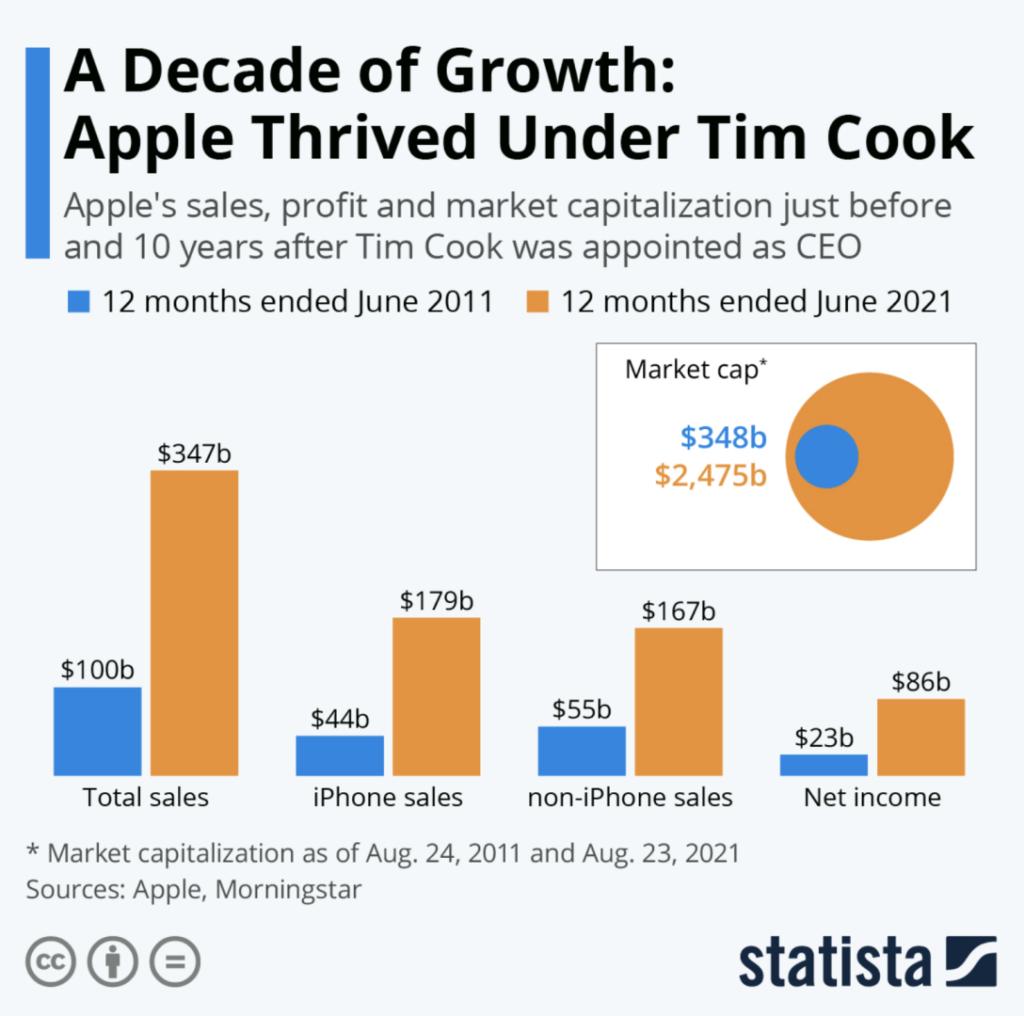
In 2018, Apple became the first company to reach a market capitalisation of $1 trillion. During the 2020s, Apple continued to post record profits and became the first publicly traded company to surpass $3 trillion in market capitalisation, briefly topping $4 trillion in 2025. Three separate trillion-dollar milestones. One CEO. Fifteen years.
What Cook Actually Built
Beyond the financials, Cook’s legacy rests on three structural shifts. First, he transformed Apple’s supply chain into a competitive weapon. Drawing on his long experience in operations and hardware, Cook emphasised tighter control over Apple’s production pipeline — a strategy that culminated in the development of proprietary Apple Silicon chips beginning in 2020. Those chips power every Mac, and they represent the most significant architectural shift in personal computing in a generation.
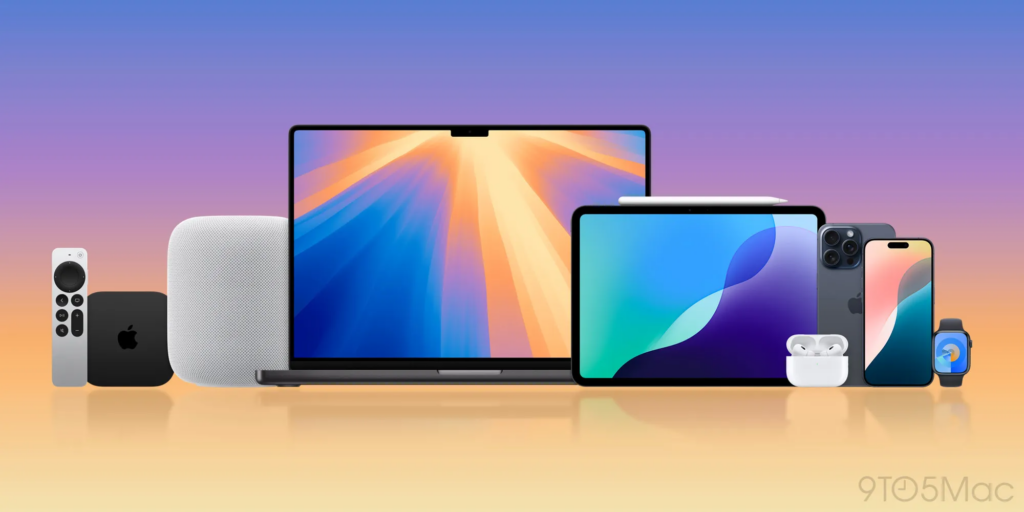
Second, Cook built privacy into Apple’s brand identity at a time when every other Silicon Valley giant was monetising user data. That decision aged exceptionally well. Third, he expanded Apple’s product footprint into entirely new categories — Apple Watch, AirPods, and the Apple Vision Pro — while keeping the iPhone at the centre of a tightly integrated ecosystem.
Cook’s commitment to accessibility ensured that Apple products are usable by everyone. Features originally designed for disabled users — voice control, live captions, screen magnification, and haptic feedback — have benefitted all users. That is not a footnote, but a design philosophy with genuine human impact.
John Ternus: The Engineer Who Inherits the Crown
John Ternus, born in 1975 or 1976, has served as Apple’s Senior Vice President of Hardware Engineering since 2021. He received a Bachelor of Science in mechanical engineering from the University of Pennsylvania in 1997, where he competed on the men’s swimming team. His senior engineering project at Penn involved developing a mechanical feeding arm operable by individuals with quadriplegia using head movements. That tells you something about the kind of engineer he is — and the kind of person.
Ternus joined Apple’s product design team in 2001, his second job out of college. By 2013, he was VP of Hardware Engineering and was promoted to SVP in 2021, making him the youngest member of Apple’s executive team at the time. He has spent 25 years at the company — nearly half his life. There is no CEO candidate anywhere in technology with more accumulated context about how Apple actually works.
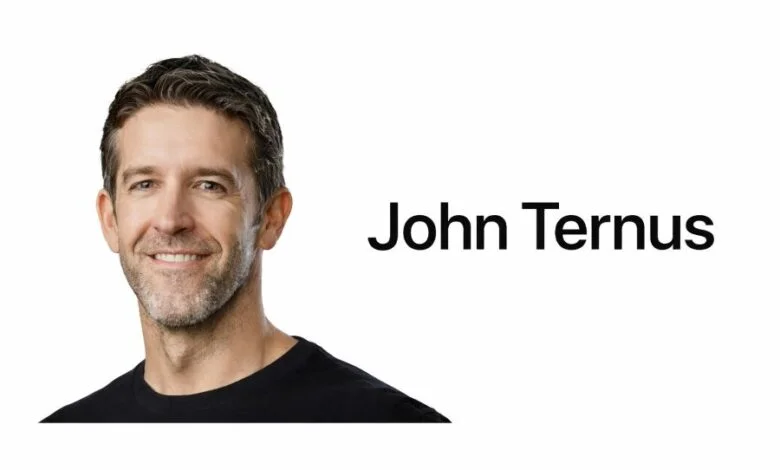
His fingerprints are on every generation of iPad, the latest iPhone lineup, and AirPods. He played a crucial role in the Mac’s transition to Apple Silicon. His team was also essential in developing the new MacBook Neo and the iPhone 17 lineup. Ternus is not arriving to learn the product portfolio — he helped build it.
“Ternus is a hardware engineer, which signals that Apple will seek differentiation in its physical products even as it looks to reframe the device as a substrate for intelligent experiences,” said Forrester principal analyst Dipanjan Chatterjee. Apple’s AI story is still being written. Ternus arrives with a product engineer’s instinct — he will want to solve that problem through hardware, not just software.
Ternus in His Own Words
“I am profoundly grateful for this opportunity to carry Apple’s mission forward,” Ternus said in his statement. “Having spent almost my entire career at Apple, I have been lucky to have worked under Steve Jobs and to have had Tim Cook as my mentor. I am filled with optimism about what we can achieve in the years to come.”
In his 2024 commencement speech at the University of Pennsylvania’s engineering school, Ternus offered a window into his character: “Always assume you’re as smart as anyone else in the room, but never assume that you know as much as they do. With this mindset, you’ll find the confidence you need to push forward, but more importantly, the humility to ask questions.” In an industry dense with performative confidence, that is a refreshing signal from an incoming CEO of the world’s most valuable company.
Ternus’ Challenges Ahead
During his nearly 15-year tenure, Cook oversaw Apple’s jump into wearable technology, but the Vision Pro has struggled to find market adoption since its 2024 release. Ternus owns that problem directly — he was one of the architects of the device. The question of whether spatial computing is a genuine category or a strategic detour will fall to him to answer.
The AI challenge is equally pressing. As CEO, Ternus will have to steer Apple through its challenge to catch up in the AI race and determine what to do with the underlying technology behind the Vision Pro. Google, Microsoft, and Samsung have all moved faster on consumer-facing AI integration. Apple’s approach — prioritising privacy and on-device processing — has kept it behind in the race for AI headlines, while potentially positioning it well for the long game.
Reshuffling the Board Through the Transition
The leadership changes extend beyond the CEO seat. Arthur Levinson, who has served as Apple’s non-executive chairman for the past 15 years, will become lead independent director, effective 1 September. Additionally, Johny Srouji will become Chief Hardware Officer, taking over for Ternus in an expanded role. Srouji, who most recently served as Senior Vice President of Hardware Technologies, will also lead hardware engineering. Apple is rotating its entire senior structure in a single, coordinated move — a sign of how deliberately this transition was planned.
TF Summary: What’s Next
Cook’s final day as Apple CEO will be 31 August 2026. Ternus takes over on 1 September. Between now and then, the two will work through a structured handover — with Cook remaining close enough to ensure continuity while stepping back far enough to give Ternus genuine authority from day one. The transition is clean by design. Apple does not do messy.
For the industry, the arrival of a hardware engineer at the top of Apple sends a clear signal: the next chapter prioritises product differentiation over operational efficiency. The AI race, the future of spatial computing, and Apple’s next category-defining device will all land on Ternus’s desk before the year is out. Cook built the machine. Ternus has to drive it somewhere new — and the world will be watching every move.
— Text-to-Speech (TTS) provided by gspeech | TechFyle