


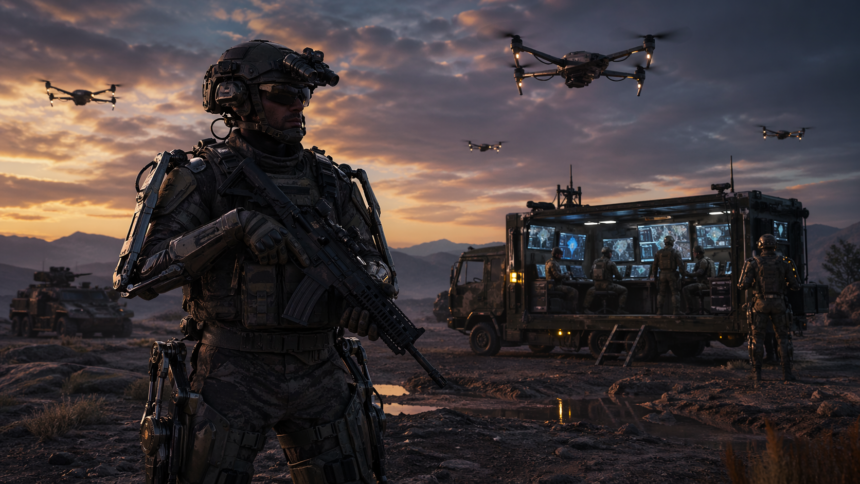
The Pentagon wants $54 billion for drones alone. Ukrainian soldiers are strapping on robotic suits on the front line. And a leading defence contractor just published its ideology. The future of warfare is moving fast.
Three stories from the past week define how technology is reshaping modern warfare. Together, they are not incremental updates. They represent a structural transformation in how nations fight, how soldiers perform, and how private companies position themselves at the centre of military power. Furthermore, each story is happening simultaneously — in Washington, on the front lines of Ukraine, and in the ideological statements of Silicon Valley’s most controversial defence contractor.
The US Department of Defense unveiled a $1.5 trillion budget proposal for fiscal year 2027 on 21 April 2026. Nearly $54 billion of that goes to military drones and autonomous warfare systems alone. That single allocation rivals Ukraine’s entire national defence budget. Additionally, Ukrainian forces are testing homegrown exoskeletons on artillery front lines near Pokrovsk. Furthermore, Palantir Technologies published a 22-point manifesto arguing that AI weapons are inevitable — and that Silicon Valley has a moral obligation to build them.
What’s Happening & Why It Matters
The Pentagon Bets $54 Billion on Drones

On 21 April 2026, the Pentagon released the details of President Trump’s FY2027 budget request. The total figure is $1.5 trillion — a 42% year-over-year increase and the largest proposed US military spending surge since World War II. Acting Comptroller Jules Hurst III stated the urgency plainly. “We’re facing one of the most complex and dangerous threat environments in our nation’s 250-year history,” he told reporters. “Our adversaries are rapidly advancing capabilities across every warfighting domain.”
Furthermore, the drone investment dwarfs everything else in the request. The Defence Autonomous Warfare Group (DAWG) — a specialised office under US Special Operations Command — receives $54.6 billion in the FY2027 proposal. That is a rise of more than 24,000% from its $225.9 million budget in fiscal 2026. To put that number in context, it exceeds the entire US Marine Corps‘s budget request of $52.8 billion. Additionally, it represents more funding than the entire defence budgets of most individual nations.
The total drone and counter-drone package is even larger. Including anti-drone systems, the combined allocation reaches approximately $75 billion. Furthermore, the Pentagon separately requests $21 billion for counter-drone technologies and air defence systems. An additional $30 billion covers Precision Strike Missiles and Mid-Range Capability munitions. Consequently, the 2027 defence budget is, in substantial part, a bet on autonomous warfare at a scale never previously attempted.
What DAWG Actually Does
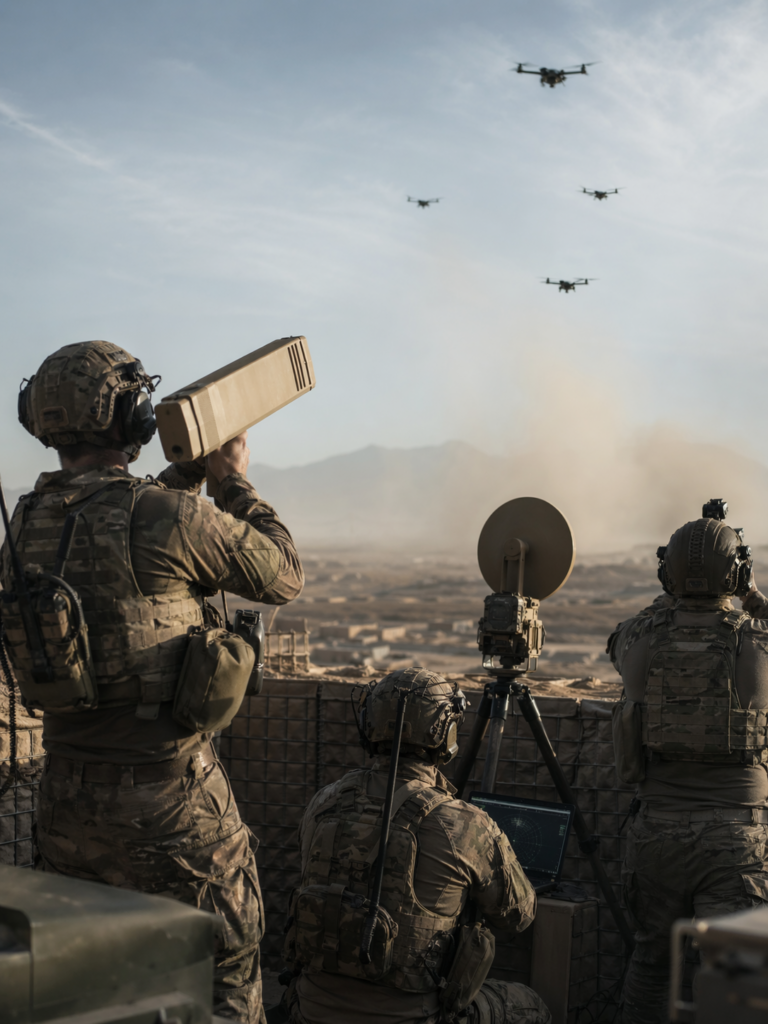
The DAWG is the successor to the Biden-era Replicator initiative, which aimed to deploy hundreds of thousands of low-cost, one-way attack drones by August 2025. Replicator missed its targets. A Pentagon review concluded it had fielded “only hundreds, not thousands” of systems by the deadline. Consequently, DAWG absorbed the programme under SOCOM in late 2025 and is being transformed from a test-and-evaluation office into a full procurement engine.
The strategy has evolved. Pentagon leaders treat AI software as the primary asset — not the hardware. Furthermore, drone systems are evolving in timescales of weeks, not the years typical of legacy procurement. DAWG’s Director, Marine Corps Lt. Gen. Francis Donovan, works directly with special operations forces to evaluate and field autonomous systems in real-world environments. Additionally, a separate Drone Dominance campaign aims to procure 200,000 autonomous small strike platforms — first-person-view (FPV) style drones — by 2027. DAWG handles larger, longer-range attack systems suited for Pacific distances. Drone Dominance handles the low-cost, high-volume systems that have defined the front line in Ukraine.
Furthermore, the budget reflects direct lessons from Ukraine and the ongoing Iran conflict. Officials noted that drone warfare has already burned through US stockpiles at an unprecedented rate. The Pentagon’s priorities — Golden Dome missile defence, AI integration, space capabilities, and defence industrial base expansion — all depend on resolving the autonomous systems supply chain.
Ukraine’s $1,000 Exoskeleton on the Front Line

While Washington plans its autonomous future, Ukrainian forces are solving a more immediate physical problem. Artillery crews on the front line near Pokrovsk in eastern Ukraine carry between 15 and 30 artillery shells per day. Each shell weighs approximately 50 kilograms (110 pounds). That load, sustained across months of combat, causes serious physical deterioration — particularly among older or less physically conditioned soldiers.
Ukrainian company Military Trade has developed the Gyurza-1 — a fully mechanical, passive exoskeleton designed specifically for this problem. The Gyurza-1 weighs under 2 kilograms (4.4 pounds). Furthermore, it requires no power, batteries, or electronics. It is a rigid structural frame that redistributes weight from the upper body through a back plate, waist module, and leg braces — transferring load from the spine and back muscles to the pelvis and legs. Additionally, the entire system can be donned or removed in under two minutes. It folds into a case roughly the size of a briefcase.
Nazar Yasinskyi, the project lead at Military Trade, was direct about the operational need. “Our soldiers carry out logistical and combat tasks, many of which involve lifting and transporting various loads. This requires, at a minimum, strong physical conditioning. However, due to health and age, a significant number of our personnel do not meet the extreme demands of war. Exoskeletons help them withstand enormous strain,” he told United24.
What the Gyurza-1 Can Do in the Field
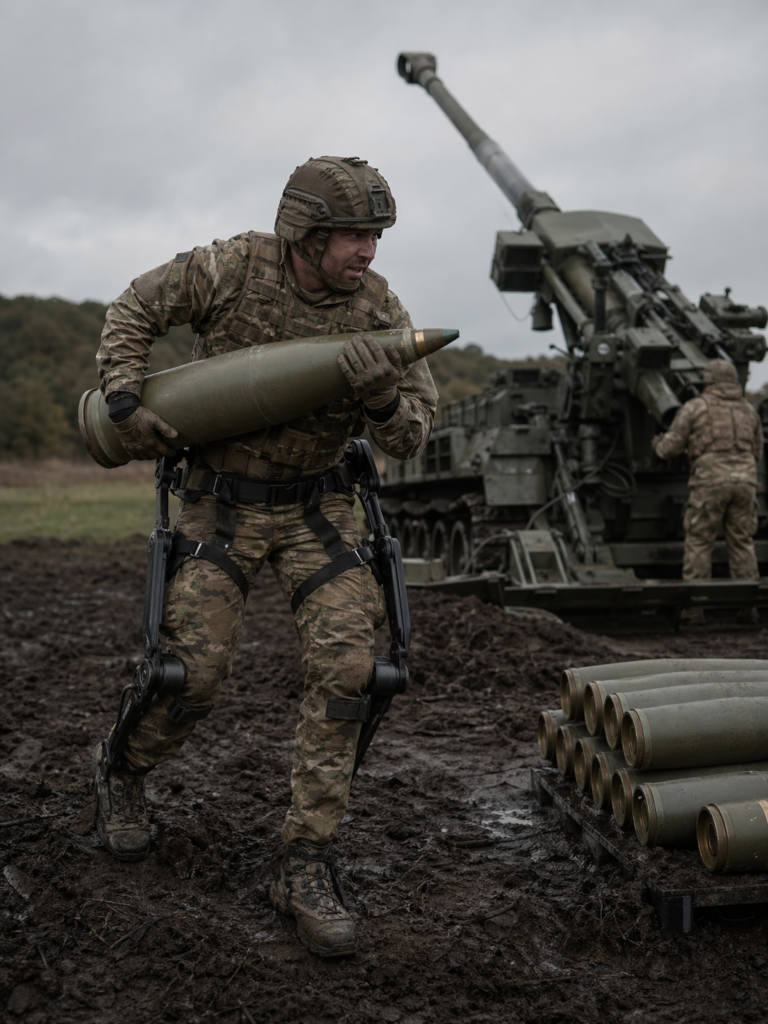
The passive design is a deliberate choice. Powered exoskeletons carry significant battlefield risks — batteries fail, electronics break, complexity slows adoption, and mechanical failures can trap or injure users. The Gyurza-1 avoids all of these. Furthermore, it integrates directly with standard military gear, including body armour, without increasing a soldier’s physical profile or restricting mobility.
Additionally, Ukrainian forces are testing a powered version of the exoskeleton. That variant has a range of approximately 20 kilometres (12 miles) and can reduce a soldier’s carrying load by up to 30%. Furthermore, it incorporates AI software that adapts in real time to the user’s movements and load conditions. The powered model operates across multiple modes — including an AI mode configurable via a mobile application. Consequently, the same design principle scales from a passive mechanical frame to an AI-augmented performance suit.
Colonel Vitaliy Serdyuk, head of the 7th Air Assault Corps’ Missile Forces and Artillery Department, confirmed the operational results. “According to test results, they become less fatigued, work faster, and maintain combat effectiveness for longer,” he said. Furthermore, Ukraine’s approach has a commercial advantage. The Gyurza-1 costs approximately $1,000 per unit — a fraction of the million-dollar proprietary military exoskeletons developed by Lockheed Martin and other US defence contractors. Affordability factors in for deployment at scale.
Palantir’s Manifesto: AI Weapons as Ideology
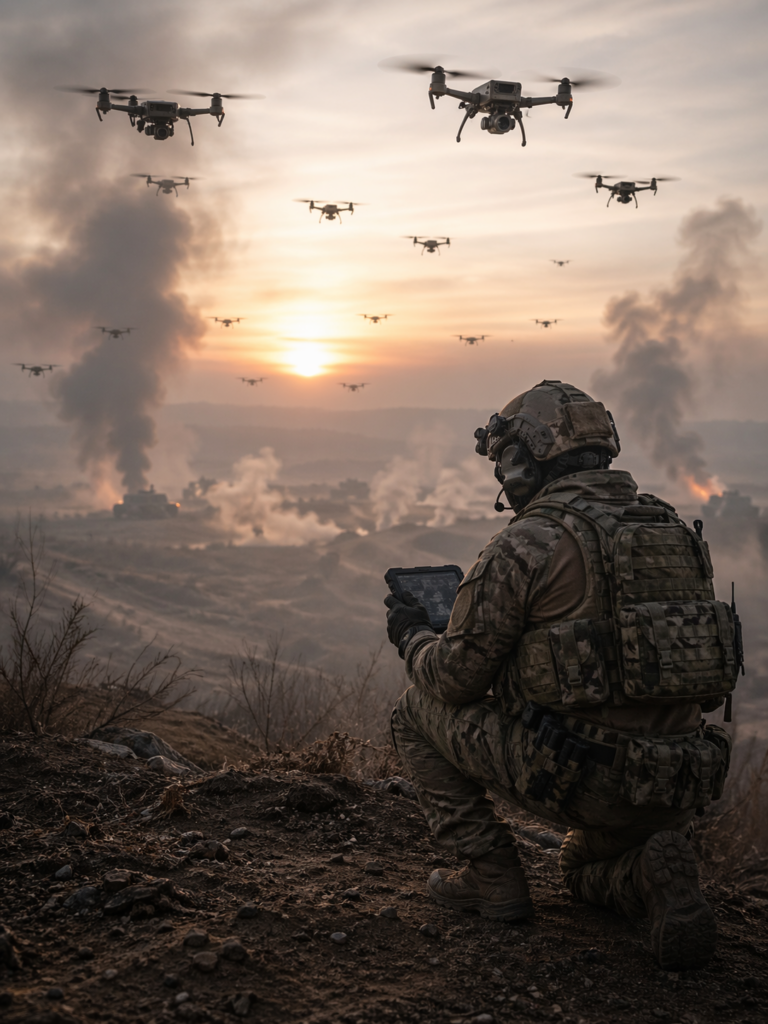
Meanwhile, Palantir Technologies published a 22-point manifesto on X on Saturday, 19 April 2026. The document summarises CEO Alex Karp‘s book The Technological Republic: Hard Power, Soft Belief, and the Future of the West, co-authored with Head of Corporate Affairs Nicholas Zamiska. Furthermore, the post accumulated over 32 million views within days.
The manifesto’s core argument on warfare is explicit. “The question is not whether AI weapons will be built; it is who will build them and for what purpose.” Additionally, the document argues that the tech sector has a “moral debt” to the United States — and an “affirmative obligation” to participate in national defence. Furthermore, it states that “hard power in this century will be built on software.” The manifesto calls for national service to become “a universal duty” — effectively advocating for the reinstatement of military conscription.
Contextually, Palantir holds active contracts with the US Department of Defense, the CIA, the FBI, ICE, the British Ministry of Defence, and the Israeli Defence Forces. Consequently, this is not philosophy at a distance. Furthermore, Anthropic was reportedly removed from a Pentagon programme after declining to enable mass domestic surveillance or fully autonomous lethal weapons — a position that Palantir‘s manifesto directly challenges. Therefore, the ideological contest over who builds AI for warfare is not abstract. It is already determining which companies are in the room.
Three Technologies, One Direction
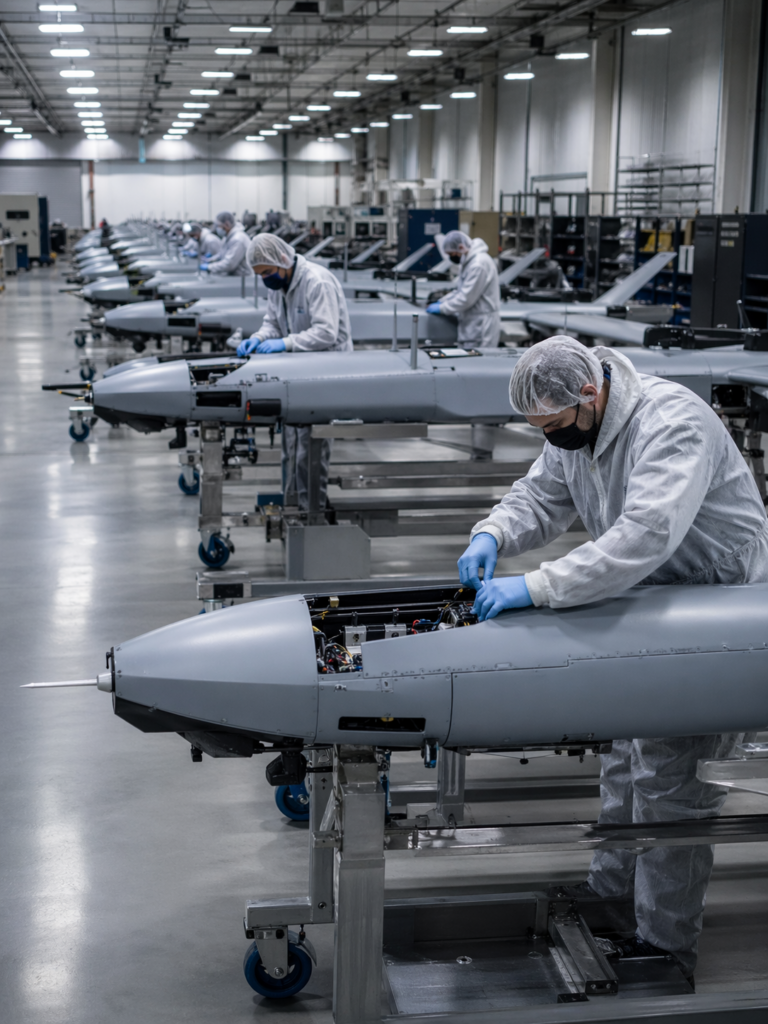
These three stories are not coincidental. They are convergent. Furthermore, they each describe a different layer of the same transformation. The Pentagon’s drone budget describes the strategic intent — autonomous warfare on an industrial scale. Ukraine’s exoskeletons describe the immediate reality — technology solving human limits under fire. Palantir‘s manifesto describes the ideological contest — who builds it, on whose terms, and for what purpose.
Additionally, the technologies involved are accelerating simultaneously. Drone costs are falling. Exoskeleton designs are improving. AI capabilities are advancing rapidly enough to make Mythos-class cybersecurity tools a genuine concern for every defence network. Consequently, the gap between what is possible and what is regulated is widening.
TF Summary: What’s Next
The FY2027 budget still requires Congressional approval. Furthermore, the DAWG’s $54.6 billion request will face intense scrutiny. Analysts and lawmakers have already questioned whether an office that spent $225.9 million last year has the infrastructure to responsibly deploy nearly 245 times that amount in a single year. Contracting capacity, acceptance testing, and programme management are all legitimate concerns. Moreover, the Pentagon’s budget was finalised before the US launched Operation Epic Fury against Iran in February 2026. Additional war costs have yet to be fully disclosed.
Ukraine’s Gyurza-1 exoskeleton is currently in field testing. Furthermore, scale production is the next step pending data collection from frontline deployments. The powered AI-enhanced variant will likely see expanded testing through mid-2026. Additionally, Palantir‘s manifesto is already generating Congressional and allied government scrutiny — particularly regarding the company’s ICE contracts and battlefield AI deployments. Consequently, the question of how the West governs its own military AI is unsettled. Three stories from one week make that very clear.
— Text-to-Speech (TTS) provided by gspeech | TechFyle