


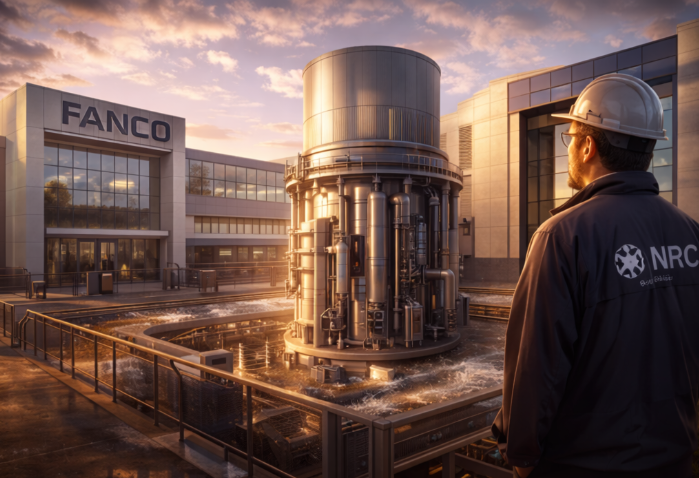
An Indiana startup submitted its EAGL-1 reactor plan to the NRC. It uses tech no other US reactor uses — and it might actually solve the nuclear permitting problem.
Nuclear energy is back in the spotlight. The United States needs clean, reliable baseload power. Data centres, AI infrastructure, and electrification are all driving demand higher. Furthermore, the geopolitical case for domestic energy independence has never been stronger. Into this moment steps First American Nuclear — a Carmel, Indiana-based startup known as FANCO — with a reactor design that challenges decades of assumptions about how nuclear power should be built, cooled, and licensed.
On 15 April 2026, FANCO submitted a Regulatory Engagement Plan (REP) for its EAGL-1 small modular reactor (SMR) to the United States Nuclear Regulatory Commission (NRC). The filing formally opens pre-application engagement between FANCO and the NRC. It is the first official step toward a construction permit. Furthermore, it marks a milestone for US advanced nuclear development. The EAGL-1 is the only reactor of any kind in the United States that uses lead-bismuth cooling technology. That distinction matters far more than it might initially sound.
What’s Happening & Why It Matters
The EAGL-1 Reactor: What It Is and Why It’s Different
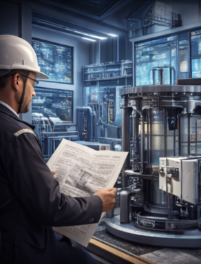
The EAGL-1 is a Generation IV liquid metal fast reactor (LMFR). Each unit produces 240 megawatts electric (MWe) and 600 megawatts thermal (MWt). That output may sound modest compared to a conventional nuclear plant. However, the EAGL-1 is designed to be deployed in clusters. A standard six-reactor cluster produces enough electricity to power approximately 1.5 million homes. Furthermore, it does this with a footprint ten times smaller than that of conventional nuclear sites that generate equivalent power. That compactness has enormous impacts on siting, permitting, and cost.
The cooling technology is the critical differentiator. Most existing nuclear reactors use pressurised water as a coolant. Many advanced reactor designs use liquid sodium, which is highly reactive with both air and water — creating operational and safety complexity. FANCO chose lead-bismuth eutectic (LBE) instead. Lead-bismuth operates at low pressure and does not react with air or water. Consequently, the design eliminates the need for high-pressure systems, large containment domes, and costly intermediate heat-transfer loops. The result is a simpler, more compact reactor with fewer components and lower capital cost.
Furthermore, the reactor’s safety profile is genuinely passive. The non-pressurised, four-loop primary system is enclosed in a guard vessel. All pipe penetrations are above the fuel assemblies. That physical arrangement makes core-uncovering pipe failures physically impossible. Decay heat removal is fully passive. No operator action is required to maintain safety in an emergency — a design engineers call “walk-away-safe”. FANCO CEO Mike Reinboth stated the company’s principle clearly: “FANCO designed EAGL-1 to be licensed under the NRC standards that have kept us safe for decades. This country can’t afford to wait. We need a credible pathway to nuclear now, and that is FANCO’s mission.”
The Regulatory Strategy That Sets FANCO Apart

Most advanced reactor developers face the same problem. Their designs require the NRC to create entirely new regulatory frameworks. That process is slow, expensive, and uncertain. FANCO chose a different path. The EAGL-1 is designed from the ground up to be licensable under the NRC’s existing regulatory framework. That decision distinguishes the EAGL-1 from many other advanced reactor designs currently in development. It gives FANCO a meaningful speed advantage.
The regulatory engagement plan outlines a structured, transparent process. FANCO plans monthly calls with NRC project managers. Additionally, it will hold biweekly technical meetings aligned to white paper review schedules. The company is also establishing a secure electronic reading room that gives the NRC access to calculation packages, design specifications, and test data without burdening the public docket. Furthermore, FANCO is building a lead-bismuth test loop to provide the NRC with real-world performance data. That physical evidence-based submissions, rather than model-only submissions, strengthen the company’s credibility with regulators.
The regulatory approach also draws on a well-documented lineage. FANCO references historical operating data from US liquid metal reactors and international lead-bismuth research. The company participates in the Department of Energy‘s Defence Production Act Fuels Consortium and Fast Reactor Working Group. It also received GAIN Vouchers from Pacific Northwest National Laboratory and support from the DOE Applied Research and Development (ARD) Programme.
Fuel Flexibility: A Competitive Advantage
Most advanced reactor designs require specialised fuel. Tristructural-isotropic (TRISO) fuel and metallic fuels both require substantial research and development, as well as first-of-a-kind fabrication facilities. Those requirements add cost, time, and supply chain risk. The EAGL-1 avoids this problem.
The EAGL-1 initially operates on High-Assay, Low-Enriched Uranium (HALEU) dioxide — a well-understood fuel form that eliminates the risks associated with novel fuel designs. Furthermore, the reactor is designed to accept multiple fuel types and enrichment levels. It can run on standard uranium oxide (UO2), the fuel used by most traditional reactors today. It also accepts mixed oxide (MOX) fuel, transuranic (TRU) fuels, recycled uranium, and fuels derived from existing stockpiles of material that would otherwise are long-term nuclear waste. Additionally, the EAGL-1 can operate in a closed-fuel cycle — reprocessing and reusing spent nuclear fuel on-site. FANCO claims this eliminates up to 95% of long-lasting nuclear waste. Furthermore, the reactor can create more fuel than it burns. That theoretically positions nuclear energy not just as clean, but as renewable.
Bridge Power: Customers Get Power Before Licensing Is Complete
One of FANCO‘s most distinctive commercial ideas is Bridge Power™. The EAGL-1 licensing process takes time. No customer can wait years without power and revenue. Bridge Power solves that problem directly.
FANCO separates the EAGL-1’s core safety systems from the balance-of-plant (BOP) power-conversion block. The BOP includes the turbine, generator, condenser, and condensate systems. Furthermore, the entire BOP uses commercial off-the-shelf components sourced from established industrial suppliers. Therefore, FANCO can construct and commission the BOP using conventional commercial package boilers while the EAGL-1 is still under NRC review. Customers receive gas-fuelled power in the near term. When nuclear licensing is complete, the same infrastructure transitions seamlessly to nuclear power. Consequently, Bridge Power creates an early revenue stream, eases project financing, and reduces supply chain risk.
Furthermore, FANCO has specifically targeted coal plant conversions. The company plans to transform existing coal plants into natural gas facilities and eventually nuclear power plants — using the same workforce and minimal equipment changes. That approach is politically and economically attractive in states with large legacy coal infrastructure.
Indiana, Partnerships, and Context

FANCO is headquartered in Indianapolis and is establishing Indiana as the home of its manufacturing facilities and flagship energy park. Indiana Governor Mike Braun stated that the project would bring “5,000 high-paying, generational Hoosier jobs while cementing our state as a leader in clean, reliable nuclear power.” Furthermore, Indiana enacted House Bill 1007 in May 2025, providing a tax credit for manufacturers of small modular reactors — specifically benefiting the EAGL-1 programme.
The company has engaged AtkinsRéalis as its primary architect-engineer. It is partnering with Purdue University for testing support. Additionally, FANCO is a member of the Nuclear Energy Institute (NEI). The company’s leadership team includes executives with experience at NuScale Power, Constellation Energy, GE Vernova Hitachi Nuclear Energy, BP, and the NRC itself.
The US nuclear context also favours FANCO‘s timing. AI data centres, domestic manufacturing reshoring, and the transition away from fossil fuels are all creating extraordinary demand for clean, reliable, dispatchable power. Wind and solar cannot deliver baseload on-demand. Nuclear can. Furthermore, the SMR approach — with its smaller footprint, factory fabrication, and modular deployment — addresses the cost and construction-schedule challenges that plagued large-scale nuclear projects in the previous decade.
TF Summary: What’s Next
The NRC filing opens the official pre-application phase. FANCO will begin structured engagement with NRC staff through monthly and biweekly meetings, white paper submissions, and test loop data from its lead-bismuth programme. The company aims to demonstrate sufficient technical readiness to file a formal Construction Permit Application (CPA). Timeline details have not been publicly confirmed. However, the structured engagement plan, existing DOE programme participation, and the company’s assembled leadership team all suggest a serious, well-resourced drive toward that permit.
MY FORECAST: Furthermore, FANCO‘s approach — licensing under existing NRC standards, using proven lead-bismuth technology, accepting conventional fuel types, and bridging to revenue through gas power — offers a commercially pragmatic path that many other advanced reactor developers have failed to achieve. The EAGL-1 is unproven at commercial scale. The lead-bismuth expertise base in the US is small. However, if FANCO can navigate the regulatory process as efficiently as it claims, the EAGL-1 could represent one of the more credible pathways to new nuclear capacity in the United States within this decade. The NRC’s response to the regulatory engagement plan will tell us a great deal about how realistic that timeline actually is.
— Text-to-Speech (TTS) provided by gspeech | TechFyle