


Meta spent big, hired aggressively, and took heat for wobbling in the AI race. Muse Spark is the company’s way of saying the spending was not executive retail therapy.
Meta has launched Muse Spark, the first model from Meta Superintelligence Labs, and the release is less routine product update than a reputation repair job with serious ambition behind it. The company says Muse Spark is a smaller, faster model built for reasoning, multimodal tasks, shopping help, health questions, and richer answers across the Meta AI app, website, and later WhatsApp, Instagram, Facebook, Messenger, and Meta’s AI glasses. Meta is even dangling private-preview API access for selected partners while hinting that future versions may be open-sourced.
Meta’s recent AI story had grown clunky. Llama 4 did not light the world on fire. Rivals such as OpenAI, Google, and Anthropic kept stealing the oxygen. Mark Zuckerberg responded in the most Meta way possible: money, urgency, reorgs, and talent raids. Muse Spark is the first real output from that reset. The launch says Meta is no longer content to be the company with giant distribution and mixed AI momentum. Meta wants back into the front rank, and Muse Spark is the opening shot.
What’s Happening & Why This Matters
Rebooting Its AI Story with a New Model Family
Meta says Muse Spark is the first model in a new Muse series created by Meta Superintelligence Labs. The company describes the release as “small and fast by design,” yet still strong enough for complex reasoning across science, math, and health questions, along with multimodal understanding. Meta says the model already powers the Meta AI app and website and will move into more products in the coming weeks.

Meta is clearly trying to reset expectations. Muse Spark is not being sold as the world’s biggest model. Muse Spark is being sold as the foundation of a cleaner scaling path. Meta’s official post says the company is taking a “deliberate and scientific approach,” in which each generation validates the next before going bigger. That phrasing sounds like discipline, and Meta badly needs some discipline in the public story after the uneven reception to Llama 4.
The model emerged after Meta’s prior AI efforts underwhelmed and after the company poured billions into rebuilding the team, including the $14.3 billion Scale AI deal and the recruitment of Alexandr Wang. That context gives the launch a lot more force. Muse Spark is not a side feature. Meta’s new model is the first public sign that an expensive AI reset is supposed to lead somewhere real.
Muse Spark Is Built for Meta’s Products
Meta’s official description of Muse Spark is extremely product-driven. The model is being used to upgrade Meta AI with two modes, Instant and Thinking, while enabling multiple subagents to work in parallel on harder tasks. Meta’s example involved planning a family trip, with separate subagents drafting the itinerary, comparing destinations, and surfacing child-friendly activities.
A product-first design helps because Meta’s strongest advantage has never been pure research prestige. Meta’s real weapon is reach. The company already owns giant surfaces where AI can live: messaging apps, feeds, commerce flows, smart glasses, and creator ecosystems. Muse Spark is therefore not only trying to beat rival models in a lab. Muse Spark is trying to enhance the AI layer threaded through the social and commercial environments that Meta already controls.
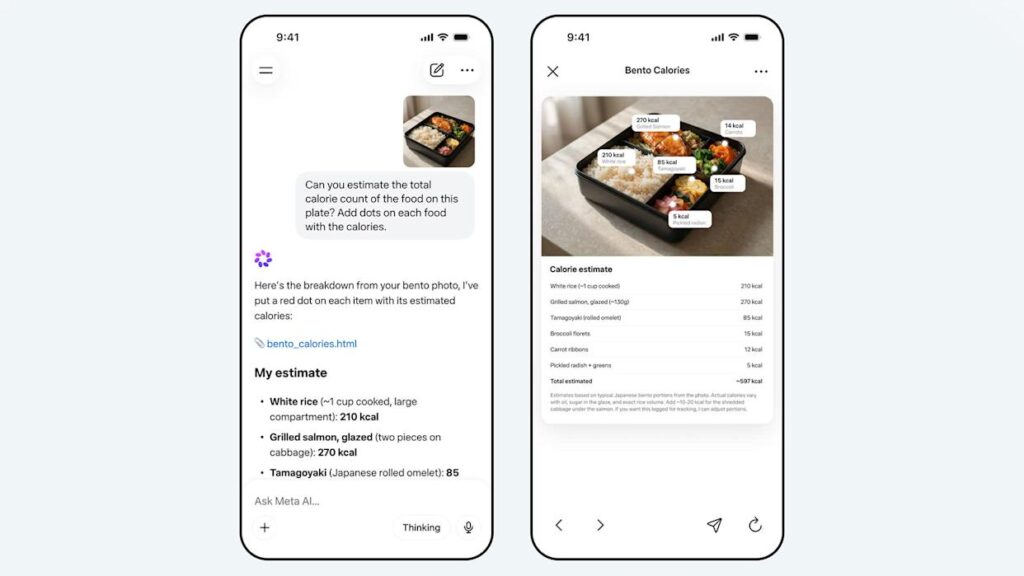
The features point in that same direction. Meta says Muse Spark can identify products, compare alternatives, rank snacks from a photo, respond to chart-based health questions, generate small visual coding projects such as mini-games and dashboards, and eventually reference posts, creators, and context from Meta’s own platforms. That means Meta is building less of a standalone oracle and more of a context engine tied to its own empire.
The sharp takeaway is simple. OpenAI wants you in a chat window. Meta wants AI woven into the habits you already perform inside Meta’s properties.
Commercialising Shopping and Health Features
Meta’s launch copy is not subtle about where the money might come from.
Muse Spark is being pitched as useful for shopping, style, room design, and gift ideas, with recommendations informed by what users and creators already share across Meta’s apps. Further reporting adds Meta is exploring product discovery, image-based calorie estimates, and virtual product previews. In other words, Muse Spark is not only about answering questions. Muse Spark is a transaction helper, a discovery layer, and potentially a shopping funnel with better manners.
Health is another big clue. Meta says health is one of the top reasons people turn to AI, and the company says Muse Spark was developed with input from a team of physicians to support more helpful answers on common health questions and image-based concerns. Meta even consulted around 1,000 physicians while shaping some of the health response capabilities.
That feature set shows Meta is chasing higher-value daily use cases rather than only novelty. Health questions, shopping help, and image understanding pull people back repeatedly. They are sticky and monetizable. They are the kind of tasks that can make a general AI assistant feel less like a toy and more like a habit.
The harder read is even more interesting. Meta is trying to turn AI from a chatbot novelty into a behavioural layer that quietly is between the user and decisions about money, health, consumption, and attention.
Meta’s Catch-Up Is Expensive and Serious
Muse Spark only makes full sense when viewed against Meta’s recent anxiety.
Meta had the scale, the GPUs, the ad machine, and the social graph. What Meta did not have was the clean AI aura enjoyed by some rivals. The release of Llama 4 did not erase that problem. Then came the spending spree. Muse Spark is described as the first output from a newly overhauled AI division and a much costlier talent strategy under Zuckerberg’s direct watch. The company spent heavily, recruited aggressively, and rebuilt its AI stack over the last nine months, according to Meta’s own account.
That makes Muse Spark a strategic credibility test. If the model performs well within Meta’s massive consumer footprint, the company can argue that the spending was justified and the reset was necessary. If the model is half-baked or underwhelming, the launch will reinforce the suspicion that Meta still knows how to distribute AI better than it knows how to define it.
The company seems aware of that risk. Meta’s language around Muse Spark is confident, but not absurdly grand. The model is described as “our most powerful model yet,” though Meta is keeping key details such as model size private and admitting that larger models are still in development. That slight restraint is unusual enough to notice.
Safety Embedded in the Sales Pitch
Meta did not launch Muse Spark without wrapping it in governance language. Alongside the model, Meta published an updated Advanced AI Scalability Framework and described new Safety and Preparedness Reports. The company says Muse Spark was evaluated before release across cybersecurity, chemical and biological risks, crime-related misuse, child safety, violence, and ideological balance concerns. Meta says the model lacks the autonomous capability threshold that would create a higher category of control concern.
Safety language is no longer optional in frontier AI. Every major company has to show some mix of red-teaming, policy outlining, and deployment logic. Meta is clearly trying to sound mature rather than reckless.
Still, the safety narrative does something more practical. It helps support the company’s ambition to move Muse Spark across messaging products, social surfaces, and wearable devices. A model that touches personal context, shopping suggestions, and health questions needs more than speed. A model like that needs political cover.
So yes, the framework sounds responsible. The framework is also part of the market strategy. A company does not publish preparedness reports for poetry.
Muse Spark Raises the Stakes for Everyone
The Muse Spark model seems built to exploit a different battlefield from the one many competitors prefer.
OpenAI still dominates the mainstream AI brand conversation. Google has depth, infrastructure, and search leverage. Anthropic has trained the vast majority of enterprise users. Meta’s advantage is different. Meta can deploy AI across social apps, conversations, creators, and commerce at an enormous scale. If Muse Spark is even good enough rather than category-dominating, that may still be enough to change the competitive map.

The Verge reports that Muse Spark will soon roll out to WhatsApp, Instagram, Facebook, Messenger, and Meta’s AI glasses. At the same time, the model is slated to replace previous Llama variants across those products. That kind of rollout means a model does not need to win every benchmark to win attention. A model only needs to show up in the places people already live.
That should worry rivals. Distribution can flatten the advantage of raw technical prestige if the user experience is smoother and more present in daily behavior.
The spicy version is even simpler. Meta is trying to turn ubiquity into an AI moat.
TF Summary: What’s Next
Muse Spark is the first public product from Meta Superintelligence Labs, and the launch signals a more serious phase in Meta’s AI comeback. The model already powers Meta AI on the app and web, with expansion planned for WhatsApp, Instagram, Facebook, Messenger, and Meta’s AI glasses. The company is using Muse Spark to strengthen reasoning, multimodal tasks, health help, shopping flows, and richer context built from its own ecosystem, while hinting that larger models and possible open-source successors are already on the way.
MY FORECAST: Meta will not win the AI race by sounding nobler than everyone else. Meta will try to win by making AI harder to avoid inside the products that billions already use. If Muse Spark performs well enough, the company’s giant consumer footprint will do the rest. The bigger risk lies in trust, privacy, and overreach. A model woven through shopping, health, messaging, and social context may feel useful fast. A model like that may present as invasive very quickly.
— Text-to-Speech (TTS) provided by gspeech | TechFyle