


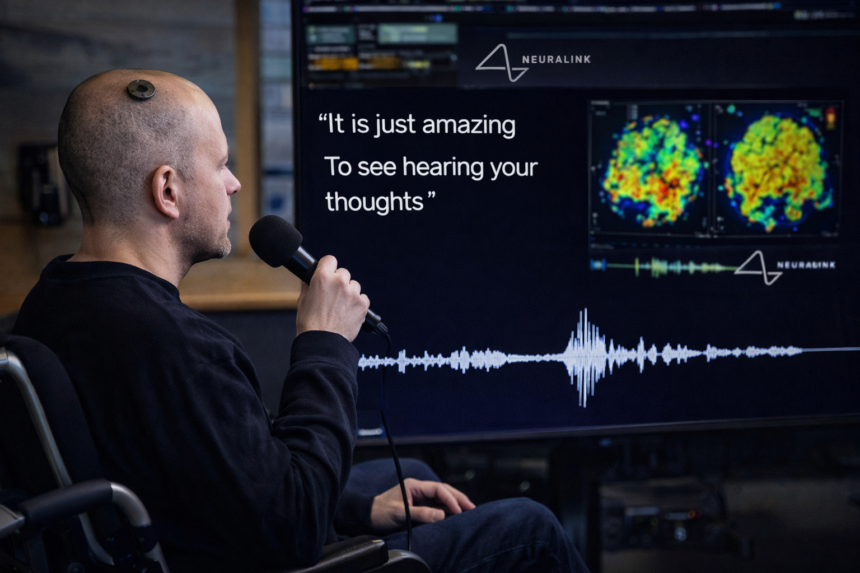
Neuralink’s latest speech demo brings brain-computer interfaces closer to real conversation.
Neuralink says its brain chip can directly translate brain activity into audible words. The company’s newest update shows a person with severe speech loss using a brain-computer interface (BCI) to turn intended speech into spoken output. That is a major step for assistive technology, especially for people who can no longer speak clearly or quickly with their natural voice.
Communication is one of the hardest losses many neurological patients face. A cursor controlled by thought is impressive. A voice restored through neural signals is more personal, more immediate, and far more human. Neuralink is not alone in this race. Still, its demo has brought fresh public attention to the idea that BCIs may move from moving a mouse to rebuilding speech itself.
What’s Happening & Why This Matters
From Cursor Control to Speech Restoration
Neuralink’s early public story focused on control. The company showed users moving cursors, browsing the web, posting online, and playing games with their thoughts. They proved that a brain implant could capture useful signals and turn them into digital actions.
This latest move shifts the focus toward speech restoration. Instead of only translating intent into cursor motion, Neuralink is trying to decode imagined or planned speech and convert it into spoken output. That changes the emotional weight of the technology. Controlling a laptop is useful. Speaking again is life-changing.
Reuters reported in September 2025 that Neuralink planned a trial for speech impairments, with company president Dongjin “D.J.” Seo saying the goal was to let people “go directly from brain to voice without any keyboards in between.” He added, “If you’re imagining saying something, we would be able to pick that up.” That quote is even more important because the company has begun to show what that vision is in practice.
Faster, More Natural Communication
The practical problem here is simple. Many people with ALS, paralysis, or other severe neurological conditions can still think clearly, but they cannot speak naturally. Existing communication tools can help, but they are often slow, tiring, or awkward. Some require eye-tracking. Some rely on selecting letters or words one at a time.
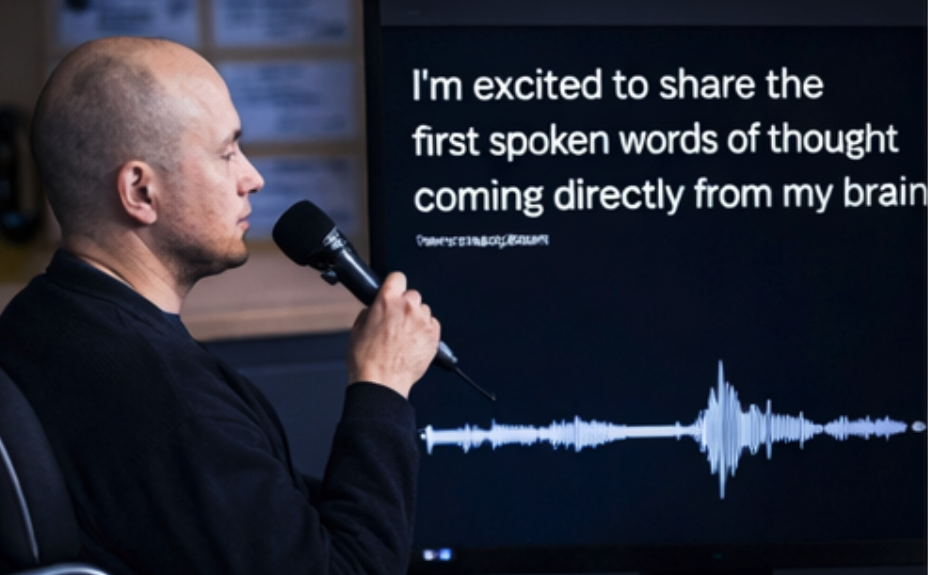
A speech-focused brain-computer interface aims to cut that friction. If the system can detect intended speech from brain activity and convert it into text or spoken audio, the user can communicate more fluidly. That counts for conversations with family, caregivers, doctors, and coworkers. It relates to dignity, too.
This is why the latest Neuralink progress has drawn so much attention. The company is not only making a machine respond to thought. It is aiming to restore one of the most personal functions in human life: a voice.
Building Momentum for Months
The new demo did not appear from nowhere. Reuters reported in September 2025 that Neuralink planned to launch a speech-impairment trial in October 2025, targeting people who had lost the ability to speak. That same report said the U.S. Food and Drug Administration gave the device a ‘Breakthrough Device’ designation for speech, which can help speed development and review.
Speech recognition has been part of a comprehensive roadmap. Neuralink was not improvising a side experiment after success in cursor control. It was building toward a more ambitious assistive target.
Reuters also reported in January 2026 that Neuralink had 21 total participants enrolled in trials worldwide, up from 12 people reported in September 2025. The company said one major goal of the expanding trials was to understand variation across participants and improve both the hardware and the surgical procedure. Those numbers are important because speech decoding is unlikely to work perfectly across every brain, condition, and implant placement without testing.
Still Investigational Tech, Not Consumer-Grade
It is important to keep the excitement grounded. Neuralink’s implant is still an investigational device. The company’s official trial page says its N1 Implant is designed to help people with severe speech impairment output verbal thoughts as text or synthesised speech. The product is being studied. It is not approved as a mainstream consumer device.
Public reaction to Neuralink often swings between two extremes. One side treats every demo as proof that science fiction has arrived. The other side treats every update as hype. The reality sits in the middle. N1’s made meaningful progress, but it is still early days.
Clinical trials exist for a reason. Researchers need to understand reliability, accuracy, latency, safety, durability, and user fatigue. A system that works in a controlled demonstration still needs to prove it can perform in daily life.
Brain-to-Speech Competition Is Heating Up
Neuralink gets the biggest headlines because Elon Musk is involved. That does not mean Neuralink is alone. Reuters noted in 2025 that Synchron was already testing an implant to help people with motor impairment type on a computer. Academic labs have worked on speech decoding for years. Other BCI groups are pursuing similar goals using different implants and signal processing methods.
Competition in the field is maturing. Brain-computer interfaces are no longer one flashy startup against a blank wall. There is a wider race involving startups, universities, hospitals, regulators, and different hardware approaches.
In practical terms, that is good news for patients. Competition can accelerate progress, pressure companies to improve safety, and give doctors more than one path to consider in the future. It can even cool some of the hero narrative around any single company. The field is bigger than one brand.
The Real Challenge Is Not Only Decoding Words
Turning brain activity into audible speech sounds like one clean problem. In reality, it contains several hard problems at once. The system needs to capture useful neural signals. It needs to decode them with enough accuracy. It needs to generate output fast enough to feel conversational. It needs to keep working over time without major degradation.
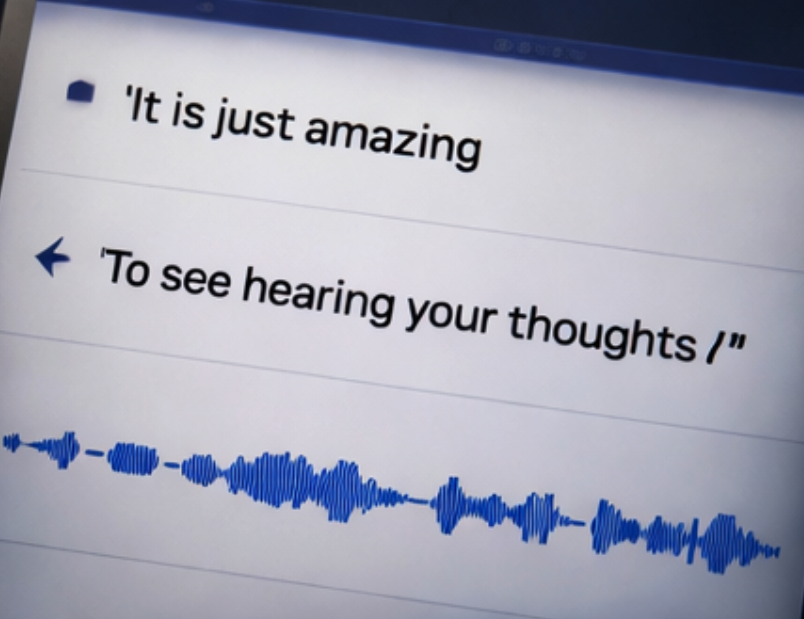
That is before the human layer even starts. Speech is not only words. It carries emotion, timing, rhythm, emphasis, and social nuance. A restored voice that sounds robotic or delayed can still improve life, but it does not fully replace natural speech.
This is why Neuralink’s progress is important but not final. The company may help people say more, sooner, and with less effort. The deeper challenge is helping them sound like themselves, communicate in real time, and trust the system in everyday settings.
Ethics and Privacy Will Follow the Technology Closely
Whenever brain-computer interfaces advance, the same ethical questions return, and for good reason. What neural data gets collected? Who stores it? How secure is it? Can users control what the system outputs? What happens if a signal is misread or a private thought is interpreted incorrectly?
The questions factor in even more in speech restoration because communication is intimate. A BCI that helps someone speak is dealing with signals tied closely to intention and identity. That raises higher stakes than a system used only to move a cursor or tap a virtual button.
Neuralink’s progress will bring more attention to the concerns. That is not a sign of panic. It is a sign that the field is moving into territory where privacy, consent, and trust matter as much as engineering.
Restoring Autonomy
The company has articulated its mission around restoring autonomy to people with severe unmet medical needs. It’s January 2026 “Two Years of Telepathy” update emphasised that users had already employed the implant to browse the internet, post on social media, and control digital tools through thought.
Speech restoration fits naturally into that mission. Communication is autonomy. A person who can express choices, ask questions, tell stories, and speak with family has more control over daily life than someone forced to rely only on slow or exhausting workarounds.
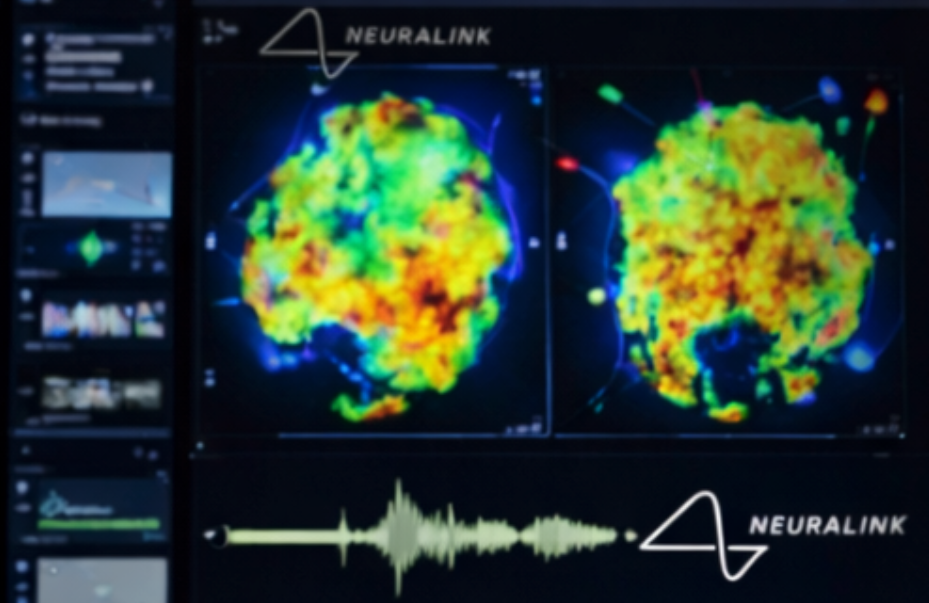
Updates matter beyond the wow factor. It fits into a broader shift in which BCIs are moving from demonstration value to lived value. The field will be judged less by how futuristic it is and more by whether it makes daily life less frustrating for the people who need it most.
Public Expectations for BCI Technology
For years, public imagination around brain implants focused on extreme ideas: mind-controlled games, memory upgrades, or sci-fi-style mental downloads. Those ideas drew attention, but they often missed the more immediate use cases.
Speech restoration is easier for people to understand. Most people know someone who has struggled to communicate after a stroke, ALS, or another serious condition. That familiarity may help brain-computer interfaces feel less abstract and more medically relevant.
That shift could reshape the conversation around BCIs. Instead of asking whether implants will create superhumans, more people may start asking whether they can restore lost human abilities. That is a healthier framing, and it may help the field win support.
TF Summary: What’s Next
Neuralink’s latest progress in brain-to-speech technology moves its BCI program closer to restoring real-world communication for people with severe speech loss. The company has spent the last two years proving that thought can control digital tools. It is driving toward something more personal: turning intended speech into audible words. That shift gives the technology a stronger medical purpose and a wider public impact.
MY FORECAST: Speech restoration will become one of the most important proving grounds for the entire BCI industry. Neuralink will keep getting attention, but the field has as much influence. The winners will not only accurately decode speech. They will deliver systems that are safe, fast, natural, and useful in everyday life. If that happens, BCIs will stop looking like futuristic experiments and start looking like practical assistive technology.
— Text-to-Speech (TTS) provided by gspeech | TechFyle