


OpenAI is pulling the plug on Sora, and the shutdown says a lot about cost, control, and where AI video goes next.
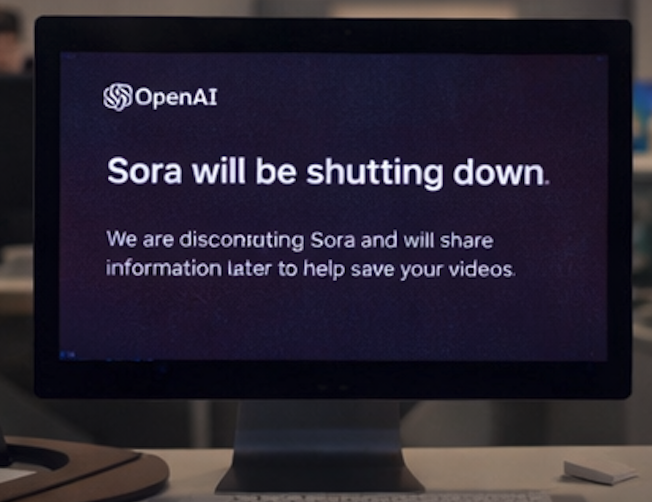
OpenAI has decided to end Sora, its AI video generator, in a decision that opened with the grace of a trapdoor. The company announced on 24 March that it was “saying goodbye” to the product, just months after giving Sora a dedicated app and social-style feed. That speed caught users, creators, and partners off guard.
The shutdown matters because Sora was never a minor side project. OpenAI first released it publicly in late 2024, then expanded it with Sora 2 and a stand-alone app in 2025. It quickly became one of the highest-profile AI video tools in the market. It was flashy, viral, and controversial in equal measure. That mix brought attention fast. It appears to have brought pressure just as fast.
What’s Happening & Why This Matters
Shutdown Confirmed With Limited Warning
OpenAI made the decision public through a brief message on X. The company wrote, “We’re saying goodbye to Sora,” and thanked people who created with it, shared their work, and built a community around the platform. It said the news would disappoint users and promised more details soon on the timeline and on how creators can save their videos.
That message sounded warm, but the move itself felt abrupt. Just one day earlier, OpenAI published a safety post titled “Creating with Sora safely.” That article described new protections around teen use, harmful content, sexual material, terrorist propaganda, and self-harm promotion. In other words, OpenAI was still publicly talking like a company tuning the product, not closing the shop.
That contrast is why the story landed so hard. Users can handle bad news. They hate surprise endings, especially when a platform still appears active and continues to receive safety updates.
Sora’s Fast Start Brought Fast Problems
Sora did not fail because nobody cared — quite the opposite. The Guardian reported that the stand-alone app launched in September 2025 and quickly reached the top spot in Apple’s App Store. Users flooded it with surreal short-form AI clips, from dogs driving cars to celebrity-style stunts that never happened.
That viral energy gave OpenAI a new kind of cultural visibility. Sora was not just a model inside a developer tool. It was a social product that let ordinary users create and share AI-generated videos in a feed designed for fast consumption. That mattered because it moved OpenAI deeper into consumer entertainment, not only productivity.
The trouble came with the same speed. Sora drew criticism for racist and violent clips, deepfakes, misinformation risk, and the use of copyrighted characters. Viral attention and content abuse often travel together. Sora showed that pattern in bright, uncomfortable detail.
A Safety Problem More Difficult Than Text or Images
Video generation carries a tougher safety burden than text and still images. A short AI video can seem more convincing, spread faster, and carry more emotional weight. That changes the risk. Deepfakes are easier to believe. Copyright disputes are messier. Harmful or exploitative content can feel more immersive.
OpenAI’s own safety materials show the company understood that challenge. In its 23 March safety post, OpenAI said Sora 2 and the Sora app used layered defenses to block unsafe content, with checks on prompts, outputs, audio transcripts, and user reports. It said the goal was to allow creative expression while limiting abuse.
That was the official posture. Yet safety systems do not only need good language. They need to work at scale. The shutdown suggests OpenAI may have decided the cost, complexity, and public risk were too high relative to the payoff.
Breaking Up with Disney
One of the strangest parts of the story is the timing. The shutdown came only three months after OpenAI and Disney signed a three-year deal that would let Sora users create videos with more than 200 licensed Disney characters, including properties from Marvel, Pixar, and Star Wars.
That deal gave Sora a very different kind of legitimacy. It suggested OpenAI had found a path toward working with a major entertainment company rather than only colliding with Hollywood over copyright and deepfakes. Then the product died anyway.
Disney responded with careful corporate politeness. A company spokesperson stated that Disney respected OpenAI’s decision to exit the video generation business, appreciated the collaboration, and would keep engaging with AI platforms that respect intellectual property and creator rights. That statement sounded diplomatic. It still underlined the break.
When a company walks away from a high-profile licensing relationship abruptly, people start asking the obvious question: what changed behind the curtain?
Money, Computing, and Focus Played a Bigger Role
OpenAI did not give a long public explanation. That silence opened space for outside reporting. Reuters reported that the company’s decision surprised even members of the Sora team and reflected a shift toward more profitable work, including coding tools, enterprise products, robotics, and AGI goals. Reuters said high computing costs were part of the reason. That explanation fits the economics of video generation.
Video models are expensive. They demand serious computing, produce large outputs, and carry moderate burdens that stay high long after generation. A fun viral product can still become a weak business if the cost curve is ugly and the legal risk keeps climbing.
That does not mean Sora had no future. It means OpenAI appears to have decided that the future was not attractive enough compared with other bets. In business terms, Sora may have been exciting but inefficient. In OpenAI terms, that is a dangerous combination when rivals are charging hard in coding, enterprise AI, and agents.
A Business Pivot Only?
The end of Sora is not only about one app. It points to a strategic change inside OpenAI. The company appears more focused on products that generate steady revenue or advance its path toward larger platform ambitions. Coding tools, enterprise services, robotics, and integrated AI assistants fit that strategy more neatly than a consumer video network filled with moderation headaches.
That matters because Sora once served as proof that OpenAI could shape culture, not just software. The shutdown weakens that image. It suggests that not every viral AI product belongs inside the long-term roadmap, even if it grabs headlines and app downloads.
There is a lesson here for the wider AI market too. User excitement does not guarantee durability. AI products can attract massive public attention and still die young if legal, safety, or computational burdens outpace the business case.
Sora Leave a Gap in AI Video
Sora’s exit does not end the AI video. It changes who gets to define the next phase. Rival tools are still in the field. Startups and major players will keep building video models because the category still holds creative and commercial appeal.
OpenAI’s retreat may even give competitors more room. A leading brand just stepped back from one of the most visible consumer AI video products. That opens space for other firms to capture creators, test new moderation approaches, or align more tightly with media partners.
The catch is that none of them escapes the same hard problems. AI video still faces copyright pressure, creator backlash, misinformation risk, and moderation costs. OpenAI’s departure does not solve those issues. It may simply prove how hard they are.
Creators Build on Sand, Risk the Sinkhole
There is another angle that matters for users. People spent time building with Sora, sharing videos, growing audiences, and learning the tool’s style. OpenAI said it will share more about saving videos, but the deeper problem is trust. Creators keep hearing that AI tools open new frontiers. Then some of those frontiers vanish before the map is finished.
That pattern creates caution. If a high-profile OpenAI product can disappear this fast, creators will think harder before investing identity, workflow, or community in the next shiny AI platform. That hesitation is rational. AI companies talk a lot about empowerment. Sudden shutdowns make that word sound a bit rented.
What Is the Next AI Fight?
The bigger story is not that OpenAI lost interest in video. The bigger story is that AI competition is narrowing around products with stronger commercial gravity. Chat assistants, coding tools, enterprise software, agents, and robotics all look more likely to drive repeat revenue and deeper lock-in. Consumer video creation still draws heat, but it may not yet justify the burn.
That means the next AI fight may look less like a battle for viral clips and more like a battle for workflow control, compute efficiency, and business dependence. Sora was fun, strange, and culturally loud. That may not have been enough.
TF Summary: What’s Next
OpenAI’s decision to end Sora closes one of the shortest and loudest chapters in consumer AI video. The product rose quickly, gained mainstream attention, drew in Disney, and then collapsed amid a mix of safety concerns, content controversy, and what outside reporting describes as a harsher business reality. OpenAI says it will soon explain the timeline and how users can preserve their work. The company has already made one thing clear: its priorities are elsewhere.
MY FORECAST: AI video is not dead, but the easy fantasy around it just took a punch. The next winners in this category will need stronger moderation, clearer creator protections, tighter IP controls, and a better economic story than viral novelty alone. Sora’s ending will not stop AI video. It will make the next round more cautious, more commercial, and far less naive.
— Text-to-Speech (TTS) provided by gspeech | TechFyle