


Rivian wants the R2 to be an SUV and think like a rolling edge computer.
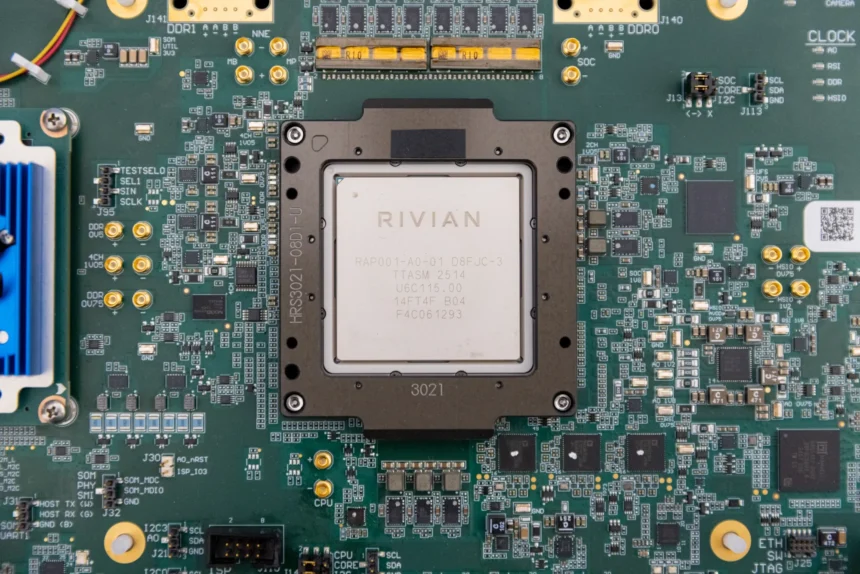
Rivian is not treating AI as a loose future promise. It is wiring it into the next R2 with custom silicon, more sensors, smarter driving software, and a new in-car assistant. The company says the R2 uses its first in-house AI chip, the Rivian Autonomy Processor (RAP1), inside a new Gen 3 Autonomy Computer. Rivian says the vehicle employs roofline lidar, upgraded cameras, better radar, and more local AI compute for autonomy and cabin features.
That matters because Rivian is trying to drive beyond “cool electric truck company”. The Tesla competitor’s goals include being a “serious software-defined vehicle company.” The R2 is already the brand’s most important product in terms of price and volume. Now, it is becoming the clearest test of whether Rivian can turn AI hardware and software into a real selling point instead of a glossy keynote trick.
Currency conversions from 10 March 2026 (€1 = $1.1641, $1 = €0.86).
What’s Happening & Why This Matters
A First In-House AI Chip
Rivian says its new chip, RAP1, is the core of its next autonomy path. It combines a processor and memory into a single package and is designed for AI and autonomous driving tasks. The upcoming R2 will use two RAP1 modules inside what Rivian calls its Gen 3 Autonomy Computer. The company says this new computer is 2.5 times more energy efficient than the current system and delivers four times the performance of the Gen 2 setup. Rivian says ACM3 can process about 5 billion pixels of sensor data per second.
That is a big jump for a midsize SUV. It tells us Rivian is not treating the R2 like a cheaper R1 with fewer toys. It is treating it like the platform where its software and autonomy story gets more serious. Efficiency likewise matters here. In an EV, every saved watt helps, even when the customer never notices it directly. The power budget, heat load, and compute stack all affect what the car can do later through updates.
This helps explain why Volkswagen Group invested $5 billion (€4.29 billion) in Rivian. The source says Volkswagen wanted access to Rivian’s software-defined vehicle technology and expertise. That is not a small side compliment. It suggests other automakers see Rivian’s value in code and compute, not only sheet metal and batteries.
The R2 Sensor Stack Upgrade
Rivian says the R2 will add a lidar array integrated into the roofline above the windshield. It says the design avoids the bulky “taxi-cab” hump seen on some rivals. The platform will use 11 cameras with a combined 65 megapixels and five redesigned radar units. Rivian says the short-range radar performance is strong enough to eliminate ultrasonic parking sensors.
That sensor mix matters because it provides Rivian with greater redundancy and more detail. Cameras help with rich visual interpretation. Radar helps in poor conditions. Lidar adds depth and distance confidence. Put together, the system is trying to make the R2 more capable without making it look like an engineering experiment on wheels. That design restraint matters. Buyers want advanced hardware, but most do not want their family SUV to resemble a science project.
The package’s size and pricing make it more interesting. The R2 Performance starts at $57,990 (€49,810) before the $1,495 (€1,284) delivery charge. It offers up to 330 miles (531 km) of range from an 87.9 kWh battery, plus 656 hp (489 kW) and 609 lb-ft (825 Nm) from a dual-motor setup. The R2 itself measures 185.9 in (4,722 mm) long, 78.1 in (1,905 mm) wide, and 66.9 in (1,699 mm) tall, with a 115.6 in (2,936 mm) wheelbase.
Hands-Free First, Then Eyes-Off… Later
Rivian says its autonomy roadmap runs through what it calls a Large Driving Model — an AI system trained for complex real-world driving. The company says the model will soon power Autonomy Plus, a driver-assistance suite that launches in early 2026 for current R1 owners. Rivian says it will expand hands-free driving coverage to 3.5 million miles (5.63 million km) of U.S. and Canadian roads. It further says the system will allow hands-free driving on some non-highway roads with clear lane markings.

Pricing is set at a one-time upgrade of $2,500 (€2,147) or $50 (€43) per month. That gives buyers a familiar software-era choice: buy the feature outright or rent it forever, and try not to think too hard about the math.
Rivian says the roadmap eventually leads to point-to-point hands-free driving in the R2, then eyes-off driving, and eventually Level 4 autonomy in defined conditions. That is ambitious language, so it deserves caution. Plenty of carmakers talk confidently about autonomy before the road reminds them that cones, weather, glare, and human stupidity still exist. Still, the hardware changes make the pitch more believable than empty marketing would. Rivian is clearly building the R2 to support a longer software arc.
R2 AI Won’t Stop at Driving
Rivian used the event to show how the new hardware supports its new Rivian Assistant, an AI voice system designed to work online and offline and to interact with vehicle apps and services. In a live demo, Rivian used the assistant to check a Google Calendar, identify appointments, reschedule a meeting, pull a destination from that meeting, search nearby restaurants, and send top options with an updated ETA.
That matters because many in-car assistants still act as polished disappointments. They can turn on the seat heater. Then they stumble when asked to do anything slightly layered. Rivian is trying to jump past that limitation by making the assistant more conversational and more deeply tied to the car’s services. The older R2 pricing source states that the vehicle is equipped with 200 sparse TOPS of edge AI compute dedicated to the in-cabin experience. That is local computing to help power the future assistant and Autonomy+.
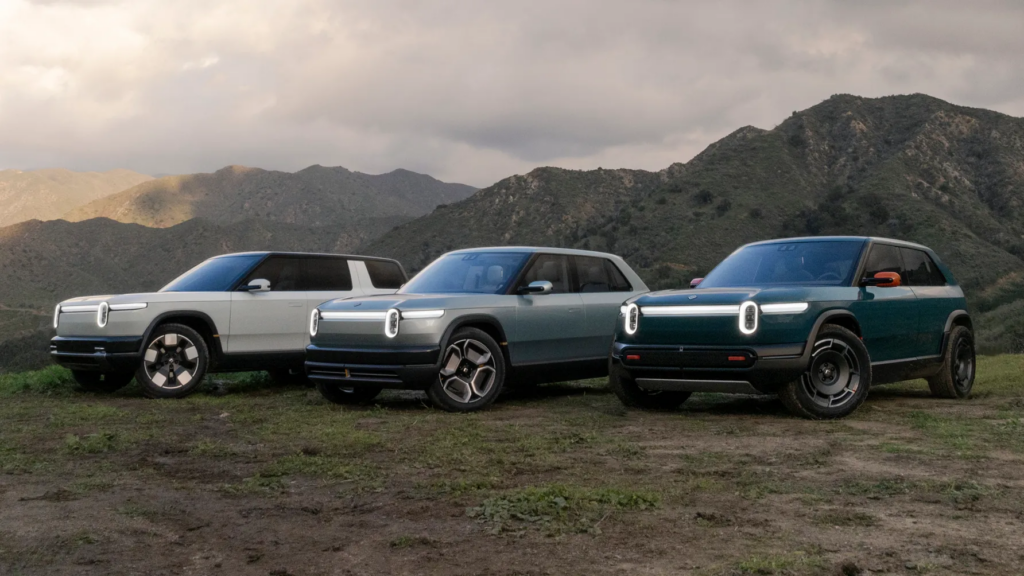
The rest of the R2 package helps the bet. Rivian says the R2 Premium arrives in late 2026 at $53,990 (€46,380). 2027 brings the R2 Standard at $48,490 (€41,655) with a 345-mile (555 km) range. Later in 2027, Rivian plans a smaller-battery version, approximately $45,000 (€38,657) with roughly a 265-mile (426 km) range. Cargo space is 28.7 cu ft (812 L) with the rear seats up and 79.4 cu ft (2,248 L) with them down. That suggests to TF that Rivian is trying to blend tech with a more mainstream pricing appeal.
TF Summary: What’s Next
Rivian is turning the R2 into more than a smaller electric SUV. It is making it the launch vehicle for its first in-house AI chip, a new autonomy computer, lidar, better radar, higher-resolution cameras, a large driving model, and a more capable in-car assistant. The company is pairing that tech with real pricing and launch timing, which makes the story more concrete than most autonomy pitches.
MY FORECAST: The R2 will matter because it tests whether Rivian can sell AI as real utility. If the chip, sensors, and software updates work well, Rivian strengthens its case as a software-assisted automaker with a serious future. If the autonomy features overpromise or the assistant is gimmicky, buyers will treat the AI as an expensive garnish on an already crowded EV plate.
— Text-to-Speech (TTS) provided by gspeech | TechFyle