


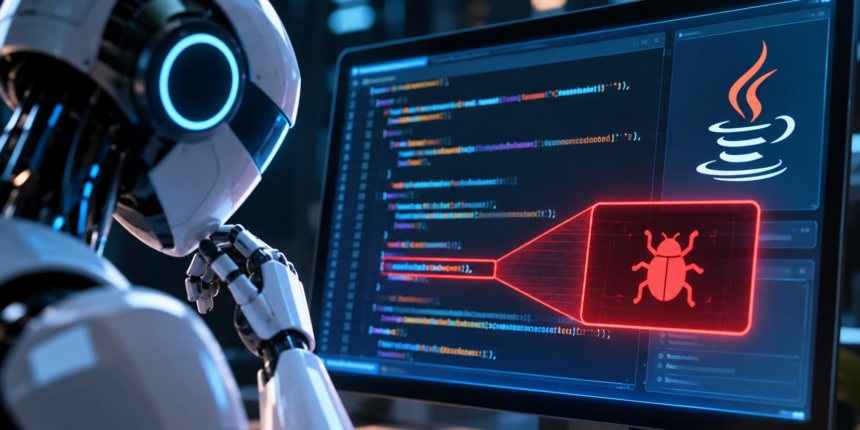
Calif used OpenAI’s Codex to find the bug in about an hour, and Oracle patched it on disclosure day.
Calif disclosed the Java4Shell flaw in OpenJDK on 17 November 2026, and Oracle patched it the same day. The memory-corruption bug can let an attacker run code on a server without a password.
Java is the world’s third most popular programming language, and Calif estimates 90% of Fortune 500 companies run it. TF covered the same AI-assisted vulnerability trend in its cybercrime round-up for 16 November 2026.
What’s Happening & Why It Matters
What Calif Found

Calif, a US security firm, found a memory-corruption flaw in the Base64 decoder of OpenJDK, the free Java runtime. The flaw is tracked as CVE-2026-114938 and nicknamed Java4Shell. Calif says the bug is in hand-written assembly code for the final few characters.
An input of 64 “A” characters followed by an equals sign makes the code miscalculate a length. It writes 64 bytes into a buffer meant for about 50. Euronews says an attacker could take over a vulnerable server over the internet without a password.
How AI Did the Work
Calif researcher Quang Luong used Codex, OpenAI’s coding agent, to audit OpenJDK. He found the bug in about an hour for under $200 in tokens. AI agents then produced most of the exploit chains, which took about two more hours.
Luong judged much of Codex’s output to be low-quality. OpenAI did not disclose which model ran inside Codex. The New York Times reported GPT-6 Cyber, per BankInfoSecurity, and other outlets state it as fact. Outlets spell the researcher’s surname in two ways.
Who Is Exposed
The optimized code runs on chips with AVX-512 instructions, so ARM64 systems are unaffected, per CyberScoop. Calif showed unauthenticated code execution in Keycloak, Jira, Confluence, Jenkins and PingFederate. It showed authenticated execution in Kafka, Solr and Elasticsearch.

Calif says no universal exploit exists, and impact depends on how an organisation uses Base64. It is withholding product-specific details until users can upgrade. No exploitation in the wild had been reported at publication. None of the related CVEs were on the CISA Known Exploited Vulnerabilities list.
Patch, Severity and Coordination
Oracle shipped patched builds on 17 November in a November update covering 652 flaws. Calif rates the bug 9.2 under CVSS 4.0, which is critical. Oracle rates it 8.1 under CVSS 3.1, citing high attack complexity, per DEV Community.
Calif coordinated with the Five Eyes partners and major cloud providers before the announcement. European national cybersecurity authorities are tracking patch rollout. British researcher Kevin Beaumont called the flaw “not world ending” and advised patching as usual. Upwind says details leaked before the patch, but CyberScoop reports no leak.
My take: One researcher, one AI agent and about $200 produced a critical flaw in code with years of use. PHP2Shell came on 21 October, so Java4Shell is the second such find in weeks. Defenders get the same tools. Patch OpenJDK builds first, then check which products bundle a Java runtime.
TF Summary: What’s Next
Organisations must patch Oracle and OpenJDK builds and check bundled runtimes. Calif plans to release product-specific details once users have upgraded. Researchers will keep pointing AI agents at old, popular code.
MY FORECAST: Attackers will exploit CVE-2026-114938 in the wild by 31 January 2027. Security researchers will disclose another AI-assisted critical flaw in a major language runtime by 31 March 2027.
Related Stories
- TF Cybercrime Round-up: 16 November 2026
- TF Cybercrime Round-up: 13-15 November 2026
- Gemini 4 Hydrogen Replaces Gemini 3.8 Flash as Google’s Everyday AI Model
- Apple Wants Siri to Act as an Agent, and Bloomberg Says an Agent Could Arrive in 2027
- France Blames Iran’s Revolutionary Guards for European Fridge Hacks