


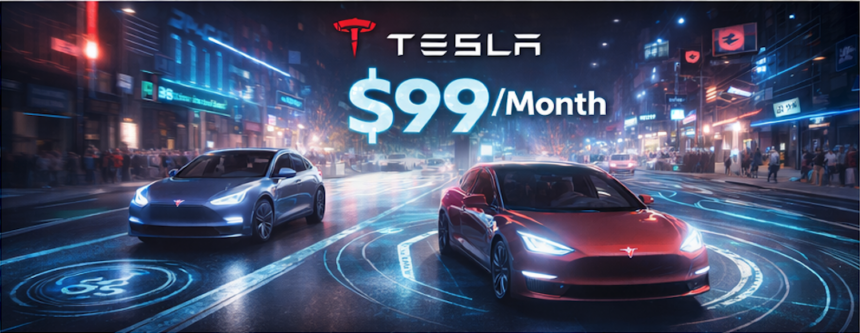
Tesla rewrites its driver-assistance playbook and pushes Full Self-Driving as the new default upsell.
Tesla spent years treating Autopilot as the entry point. It came bundled. It felt permanent. Drivers bought cars assuming that some version of hands-on lane support would remain part of the deal.
Tesla changed that expectation.
The company removes Autopilot as a named feature tier and steers customers toward a new monthly subscription: Full Self-Driving (FSD) for $99 per month. Tesla positions the change as simplification. Many drivers see something else: a pricing reset and a sharper push toward recurring revenue.
This moment matters because Tesla no longer sells driver assistance as a static feature. Tesla sells it as a service. That mirrors the broader software economy, where ownership fades and subscriptions rule.
What’s Happening & Why This Matters
Tesla Drops Autopilot as the Familiar Middle Ground
Tesla offered an innovation ladder:
- Autopilot was the baseline.
- Enhanced Autopilot was an upgrade.
- Full Self-Driving is the premium.
That structure gave buyers a clear middle option. Now, the ladder is headed for storage.
The company removed Autopilot from the pricing model and elevated FSD as a subscription service as the central offer. Tesla set the new monthly cost at $99, undercutting earlier price points that hovered closer to $199.
This establishes a clear business goal: Tesla wants more drivers inside the paid autonomy ecosystem.
A Tesla vehicle already contains the cameras, sensors, and computing stack. Tesla monetizes that installed base through software activation. That resembles how Apple sells iCloud storage or how Adobe sells Creative Cloud. The hardware is the platform. The subscription enables the engine.
FSD Becomes Tesla’s Real Product, Not the Car
Tesla sells vehicles, yes. But Tesla increasingly treats the car as the delivery mechanism.
The company describes autonomy as the long-term prize. Elon Musk repeatedly frames FSD as the difference between Tesla and every other automaker.
Musk previously stated:
“The value of Tesla is autonomy. That is the story.”
Tesla pushes that story farther. A $99 subscription eases the psychological barrier. More drivers try it, feeding Tesla’s training loop. More drivers normalize the idea that assisted driving is a monthly bill… a monthly choice.
That strategy also answers Wall Street’s favorite question: where does Tesla find growth beyond car sales?
Recurring software revenue may be one answer.
Safety, Scrutiny, and the Regulatory Shadow
Tesla’s autonomy branding always attracts attention from regulators.The National Highway Traffic Safety Administration (NHTSA) continues to investigate crashes involving Autopilot and FSD behavior.
Tesla insists drivers remain responsible. Tesla describes FSD as supervised. Critics argue the naming creates confusion. That confusion is part of the pricing shift.
Tesla wants mass adoption. Regulators demand clarity while consumers want convenience without risk. The subscription model increases usage, which increases scrutiny.
Tesla enters a phase where autonomy becomes less of a premium niche feature and more of a mainstream expectation. That raises the stakes.
Why $99 Matters More Than It Looks
$99 feels like a streaming bill. That is not accidental. Tesla sets a price point that feels normal, not exotic.
That matters because autonomy adoption depends less on technology and more on behavior: Will people pay monthly? Will they use it daily? Do they trust the system?
Tesla believes the answers are Yes by making the decision easier. The subscription also creates optionality. Some drivers may subscribe only for road trips. Some subscribe seasonally or even churn monthly on-and-off.
Flexibility creates a software-style revenue curve instead of a one-time purchase.
The Competitive Signal to Waymo, GM, and Everyone Else
Tesla’s plan pressures rivals. Waymo runs robotaxi fleets and GM retreated after Cruise setbacks. Traditional automakers still struggle to sell autonomy features at scale. Tesla instead bundles autonomy into the consumer ownership experience, then sells upgrades through software. This is not robotaxis first. This is subscription autonomy first.
Tesla tells the industry: autonomy becomes a consumer SaaS product.
Customers React: Value or Paywall?
Tesla owners respond in mixed ways. Some welcome cheaper FSD access. Others see feature erosion. Autopilot once felt included. Now Tesla nudges drivers toward paid tiers.
That creates a familiar modern frustration: the car feels less like property and more like a platform with locked features.
The broader consumer economy already lives here: Seat heaters behind paywalls. Software unlocks for horsepower. Subscription safety tools. Tesla simply pushes the trend faster.
TF Summary: What’s Next
Tesla turns driver assistance into a clearer subscription business. The company removes Autopilot as a comfortable middle tier and places Full Self-Driving for $99/month at the center of its autonomy strategy. That move expands adoption, increases recurring revenue, and forces regulators and consumers to confront autonomy’s real-world risks faster.
Tesla treats software as the primary growth lever. Every driver who subscribes becomes both a customer and a data contributor. That feedback loop defines Tesla’s future of autonomy.
MY FORECAST: Tesla doesn’t stop at $99. Tesla builds autonomy into an everyday bill, just like streaming. Tesla makes autonomy the new Netflix. More drivers subscribe as competitors copycat. Governments respond with stricter language rules and tougher enforcement. Autonomy becomes less of a tech demo and more of a regulated consumer utility.
— Text-to-Speech (TTS) provided by gspeech