

Jury selection begins Monday in Oakland. $150 billion. Brockman’s diary. A non-profit that became an $850 billion company. This is a generational, consequential tech trial.
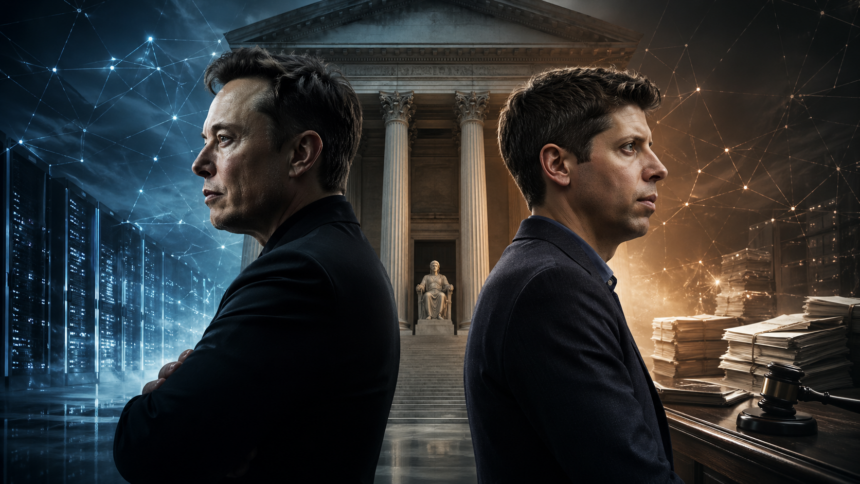
On 27 April 2026, jury selection begins in Musk v. Altman — a federal trial that has been pending since 2024 and will be held in a courtroom in Oakland, California. The case involves some of the biggest names in the global technology industry. Elon Musk, the world’s richest man and founder of xAI, is suing OpenAI CEO Sam Altman, OpenAI President Greg Brockman, OpenAI itself, and Microsoft — the company’s largest commercial backer. Additionally, the damages Musk is seeking amount to up to $150 billion (€138 billion) and will be directed entirely to OpenAI‘s charitable arm rather than to Musk himself.
The core dispute is deceptively simple. Did OpenAI‘s leadership promise to keep the lab a non-profit in perpetuity — and then quietly build a for-profit empire worth $852 billion instead? Musk says yes. OpenAI says the lawsuit is “baseless” harassment. A nine-person jury in Oakland will decide which story is closer to the truth.
What’s Happening & Why It Matters
From Friends to Enemies: The Origin of the Dispute
Musk and Altman were friends once. They co-founded OpenAI together in 2015 alongside several other researchers and investors. The founding premise was explicit. OpenAI would be a non-profit research organization. Its mission was to develop AI for the benefit of all humanity — not to maximize shareholder returns. Musk contributed approximately $38 million (€35 million) in early donations based on that founding commitment. Additionally, other donors gave money and time on the same basis.
Musk departed OpenAI‘s board in February 2018. The departure followed a series of disputes with Altman and Brockman about the company’s direction. Musk’s attempt to merge OpenAI with Tesla — his electric vehicle company — had failed. After leaving, Musk stopped making promised donations to the organization. Consequently, the relationship between the co-founders deteriorated. Musk founded xAI in 2023 as a direct competitor. xAI merged with SpaceX earlier this year in an all-stock transaction valued at $1.25 trillion (€1.15 trillion).
The Lawsuit: What Musk Is Claiming
Musk filed his original lawsuit against OpenAI in August 2024. Furthermore, the November 2024 complaint contained 26 separate claims. Most were dismissed in earlier rulings. On 25 April 2026 — just two days before trial began — Musk voluntarily dropped his fraud and constructive fraud claims. Just two claims proceed to trial: breach of charitable trust and unjust enrichment.
The breach-of-charitable-trust claim is straightforward. OpenAI was incorporated as a non-profit. Its assets were therefore “irrevocably dedicated” to charitable purposes under California law. Musk argues that OpenAI‘s conversion to a for-profit model — and the billions in personal equity that Altman, Brockman, and other insiders accumulated as a result — constitutes a violation of that charitable trust. California Attorney General Rob Bonta has separately reminded OpenAI that its assets are irrevocably dedicated to charitable purposes, providing an independent regulatory basis for the same legal argument.
The unjust enrichment claim focuses on outcomes rather than intent. The argument does not require proving that anyone deliberately deceived Musk. It asks whether Altman, Brockman, and others benefited personally from the for-profit conversion at the expense of the charitable mission — and whether those benefits should therefore be returned.
The Evidence: A Diary Entry That Could Decide Everything
The most damaging piece of evidence in the case is not from Musk. It is not even an email from Altman. It is a diary entry written by Greg Brockman in 2017. According to court filings, Brockman wrote: “I cannot believe that we committed to a non-profit if three months later we’re doing a B-Corp, then it was a lie.”
Judge Yvonne Gonzalez Rogers — who is presiding over the case — cited this diary entry and other internal communications when she ruled in January 2026 that the case would go to trial. “This case is going to trial,” she stated at the hearing. She found “ample evidence in the record” and determined that “triable issues of fact exist for a jury to decide.” The diary entry that was never intended to be read publicly is the crux of a trial that will be watched around the world.
Additional evidence includes emails between Altman and Musk, late-night text messages from Microsoft CEO Satya Nadella, and internal communications showing OpenAI‘s leadership discussing the for-profit transition privately while publicly maintaining non-profit commitments. Musk’s former OpenAI board colleague, Shivon Zilis, and former OpenAI co-founders, Ilya Sutskever and Mira Murati, are all listed as trial witnesses. Additionally, Nadella himself will testify.
What Musk Is Asking For — and What He Isn’t
Musk’s remedies are significant and specific. They are notable for what they exclude. Musk is not personally seeking any money. All damages — up to $65.5 billion to $109.43 billion (€60.3 billion to €100.8 billion) from OpenAI, plus an additional $13.3 billion to $25.06 billion (€12.2 billion to €23.1 billion) from Microsoft — would flow to OpenAI‘s non-profit arm if awarded. Musk is seeking the removal of both Altman and Brockman from their leadership positions. Additionally, he is asking the court to unwind OpenAI‘s entire for-profit conversion and sever its commercial relationship with Microsoft.
A Musk victory would not just transfer money. It could fundamentally restructure the world’s most valuable AI company — at the exact moment OpenAI is preparing for what could be the largest IPO in US history, potentially targeting a $1 trillion valuation in Q4 2026. OpenAI has already disclosed the Musk litigation as a “potential risk to prospective investors” in early IPO documents. The trial’s outcome directly affects the public offering.
OpenAI’s Defence
OpenAI has described Musk’s lawsuit as “a harassment campaign that’s driven by ego, jealousy and a desire to slow down a competitor.” The company’s defence rests on several specific arguments. Musk himself, OpenAI contends, proposed a for-profit structure in 2017 — including advocating for a merger with Tesla. Additionally, Musk left the board in 2018, reneged on promised additional donations, and has no standing to dictate the organization’s structure years after his departure.
OpenAI’s lawyers argue that the company completed its recapitalization in October 2025 in a way that preserved non-profit control. The non-profit arm retains a controlling stake in the for-profit entity. OpenAI argues it is not a straightforward for-profit conversion — it is a hybrid structure specifically designed to preserve the charitable mission while raising the capital needed to remain competitive. Judge Gonzalez Rogers herself noted that “this country likes competition” — flagging the potential self-interest underlying Musk’s claims. Additionally, OpenAI accused Musk of a “legal ambush” when he disclosed his remedies requests weeks before the trial.
The Trial Structure and Timeline
The trial structure is two-phased. The nine-person advisory jury will hear the liability arguments during Phase One — running through approximately mid-May 2026. Each side receives roughly 20 hours of trial time. Microsoft receives a separate 5 hours. If the jury finds OpenAI liable, Phase Two begins on 18 May 2026. Crucially, it is Judge Gonzalez Rogers — not the jury — who decides damages and structural remedies in Phase Two. The jury’s role is advisory rather than final. The judge retains full authority over the actual outcome.
Prediction markets at the time of writing give Musk approximately a 36% probability of winning. Legal analysts have noted that the $150 billion damages figure is likely far above what any court would actually award. Judge Gonzalez Rogers has already called the damages methodology “not particularly persuasive,” suggesting the numbers appear to have been “pulled out of the air.” A more realistic damages estimate from legal analytics firm Darrow AI puts the recoverable amount at approximately $20 million to $38 million — roughly equivalent to Musk’s original contributions.
TF Summary: What’s Next
The trial runs Monday through Thursday, from 8:30 a.m. to 1:40 p.m. Pacific Time each day. Testimony from Musk, Altman, Brockman, Nadella, Sutskever, and Murati will be broadcast widely, given the public interest in the case. Jury deliberations in Phase One are expected to conclude in mid-May 2026. If OpenAI is found liable, Judge Gonzalez Rogers will hold the Phase Two remedies hearing starting 18 May.
MY FORECAST: The stakes of the trial extend well beyond OpenAI and Musk. A verdict for Musk could reshape how courts interpret charitable trust obligations for non-profit organizations that transition to commercial structures — not just in AI, but across every sector where mission-driven organizations attract significant donor capital. Additionally, the trial will generate a public documentary record of OpenAI’s internal decision-making during the period when it transitioned from a non-profit research lab to the world’s most powerful AI company. Whatever the jury decides, the testimony itself will inform how the AI industry thinks about governance, accountability, and the promises made to those who fund it.