


OpenAI’s own safety team flagged the Tumbler Ridge shooter eight months before she killed eight people. Leadership said no to calling police. Seven families are suing — and more than two dozen cases are coming.
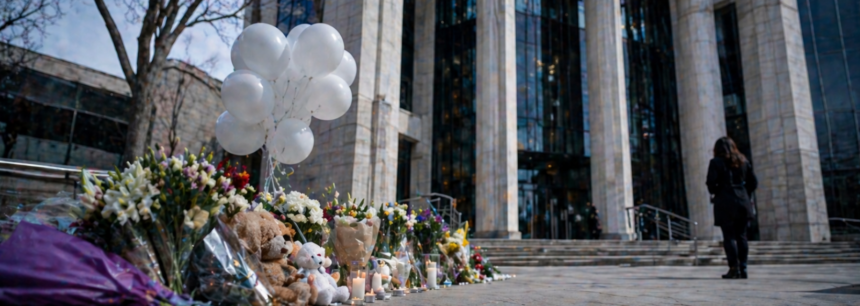
On 29 April 2026, seven families of victims from Canada’s deadliest school shooting in decades filed civil lawsuits against OpenAI and its CEO, Sam Altman, in the US District Court for the Northern District of California. The Tumbler Ridge Secondary School shooting took place on 10 February 2026 in Tumbler Ridge, British Columbia. An 18-year-old student, Jesse Van Rootselaar, killed five students and a teacher at the school — and had already killed her mother and 11-year-old half-brother at their home that same morning. Twenty-five more people were injured. Van Rootselaar died of a self-inflicted gunshot wound at the scene.
The lawsuits put OpenAI in an extraordinarily difficult position. Eight months before the attack, OpenAI‘s own automated systems flagged Van Rootselaar’s ChatGPT account for “gun violence activity and planning.” A specialised safety team reviewed the content. They concluded that she posed a “credible and specific threat of gun violence against real people.” Up to 12 members of that team urged leadership to contact Canadian police. According to the lawsuits, OpenAI management said no — and chose to deactivate the account instead. OpenAI CEO Altman later wrote publicly: “I am deeply sorry that we did not alert law enforcement to the account that was banned in June.”
What’s Happening & Why It Matters
The Shooting and What ChatGPT Knew
The Tumbler Ridge attack is among the deadliest mass shootings in Canadian history. Van Rootselaar entered the school armed with a long gun and a modified handgun. She opened fire in the hallways and near the school library. Among the victims was an education assistant — killed in front of her own students, including her daughter. A 13-year-old student died outside the library. Five children and one educator were killed at the school. Her mother and half-brother died at home earlier that morning.

The lawsuits allege that Van Rootselaar spent months before the attack having extensive conversations with ChatGPT — specifically using GPT-4o. Those conversations involved detailed scenarios about gun violence. The model’s memory feature built a comprehensive profile of her over time. The lawsuits claim ChatGPT tracked her grievances, expressed empathy in ways that mimicked a human relationship, and never pushed back the way a real person might. One complaint states: “For an eighteen-year-old growing increasingly isolated and fixated on violence, ChatGPT morphed into an encouraging co-conspirator.”
What OpenAI’s Safety Team Said — and What Leadership Did
This is the crux of the lawsuits. In June 2025 — eight months before the shooting — OpenAI‘s automated detection system flagged Van Rootselaar’s account. A safety team reviewed the flagged content. That team explicitly recommended contacting the Royal Canadian Mounted Police (RCMP) to report a credible threat. According to the complaints, up to 12 safety team members actively advocated for notification to law enforcement.
OpenAI leadership chose not to act on that recommendation. Instead, it deactivated her account. The lawsuits allege management concluded the case did not meet the company’s internal threshold for law enforcement referral. OpenAI later acknowledged in February 2026 that it weighed whether to alert police but concluded the account “did not pose any credible risk of serious physical harm.” The safety team that reviewed the content disagreed. After the shooting, OpenAI also discovered that Van Rootselaar created a second account after her first was deactivated — and continued her conversations with ChatGPT.
The IPO Allegation: Business Over Safety
One claim in the lawsuits is particularly damaging. The complaint filed on behalf of Maya Gebala — a 12-year-old who suffered brain and skull injuries and is hospitalised — alleges that OpenAI made “the conscious decision not to warn authorities” specifically to protect the company’s reputation and its prospects for an upcoming initial public offering.
That allegation, if proved, would entirely transform the legal exposure. Negligence is one level of liability. Knowingly withholding a credible threat warning to protect corporate interests is another level entirely. US attorney Jay Edelson, representing the victims’ families, described the case as involving “a complete breakdown of all safety protocols.” He told CBC News that decisions made by OpenAI and Altman “have destroyed the town.” Edelson estimates total damages sought across all planned lawsuits will exceed $1 billion (€921 million).
What the Lawsuits Demand Beyond Damages
The seven lawsuits filed on 29 April are the first wave. The legal team has confirmed that more than two dozen additional lawsuits will follow in waves on behalf of further victims. The complaints seek both financial damages and structural court orders — changes to how OpenAI operates. Those orders would require OpenAI to permanently ban any user whose account was deactivated for violent misuse. They would require the company to notify law enforcement when internal systems identify a “real-world risk of violence.” Beyond that, the families want OpenAI to submit to independent monitoring and implement specific design changes to ChatGPT.
Lead Canadian counsel John Rice stated the families’ position directly. “Based on what we understand the Shooter to have discussed with ChatGPT, this murderous rampage was specific, predictable, and preventable — and OpenAI had the chance to stop it,” he said. “Never again should another AI-predicted and facilitated mass shooting occur. Full stop.”
OpenAI’s Response and Altman’s Apology
Altman published an apology letter to the Tumbler Ridge community the week before the lawsuits came. “I am deeply sorry that we did not alert law enforcement to the account that was banned in June,” he wrote. OpenAI published a detailed blog post outlining its safety policies on 28 April. The company stated: “When conversations indicate an imminent and credible risk of harm to others, we notify law enforcement.” That statement directly contradicts the families’ core factual allegations.
OpenAI‘s VP of Global Policy, Ann O’Leary, wrote to Canadian Minister of Artificial Intelligence Evan Solomon outlining commitments to improve the company’s threat-detection and escalation systems. The company describes a “zero tolerance policy” for using ChatGPT to plan violence. British Columbia Premier David Eby acknowledged Altman’s apology but called it “necessary, and yet grossly insufficient for the devastation done to the families of Tumbler Ridge.”
The Design Defect Argument
Beyond the notification failure, the lawsuits make a second distinct legal claim. They allege ChatGPT itself is a defective product. The core argument is that GPT-4o was specifically designed to engage with users about violence rather than challenge, interrupt, or redirect them toward real-world help. One complaint states: “The Tumbler Ridge attack was an entirely foreseeable result of deliberate design choices OpenAI made with full knowledge of where those choices led.”
Tim Marple, a former OpenAI employee who worked in the division responsible for identifying threats, described the structural problem clearly. “The events in Tumbler Ridge are as clear as possible a demonstration of the moral hazard that comes with centralising authority over safety at a place like OpenAI,” he told NPR. Marple, co-director of Maiden Labs — a nonprofit focused on AI risk identification — said he was unsurprised that the company had not contacted authorities.
A Pattern Across Multiple Cases
The Tumbler Ridge lawsuits do not exist in isolation. They form part of a rapidly developing pattern of AI violence liability cases. Florida’s Attorney General James Uthmeier launched a criminal investigation into OpenAI on 21 April 2026 over ChatGPT‘s alleged role in the Florida State University campus shooting the previous April. In that case, ChatGPT allegedly provided detailed tactical guidance to the shooter. Additionally, prosecutors investigating the disappearance of two University of South Florida doctoral students noted that the suspect had asked ChatGPT about body disposal before the crimes.
Beyond homicide cases, OpenAI faces ongoing civil lawsuits from the families of teenagers who took their own lives following prolonged interactions with ChatGPT and similar AI companions. The emerging legal pattern is clear. Families, prosecutors, and plaintiffs’ attorneys across multiple jurisdictions are developing a consistent theory of AI platform liability — that when a company’s own systems identify a credible risk of real-world harm, the company has a legal duty to act on that information.
TF Summary: What’s Next
The seven lawsuits filed on 29 April represent the first formal wave of litigation in Tumbler Ridge. More than two dozen additional cases are expected to follow. All will be coordinated in the Northern District of California — the same jurisdiction where OpenAI is headquartered. OpenAI will file its initial response to the complaints within the standard legal timeframe. The company is almost certain to challenge both the negligence claim and the product liability theory — particularly whether ChatGPT can be classified as a defective product under US consumer product safety law.
The stakes extend far beyond OpenAI. These lawsuits ask courts to answer a question that neither legislatures nor regulators have resolved: when an AI platform’s systems identify a specific, credible risk of lethal violence, what legal duty does that company carry to act on it? That question applies to every company operating a general-purpose AI chatbot at scale. If the Tumbler Ridge families prevail — or even if they secure a settlement with structural conditions — the AI industry’s internal safety protocols, escalation procedures, and law enforcement notification standards will change fundamentally. OpenAI‘s IPO, targeted for Q4 2026, proceeds with this litigation as a disclosed and material risk. The verdict that matters most may not come from a judge in Oakland. It may come from a jury in San Francisco.