

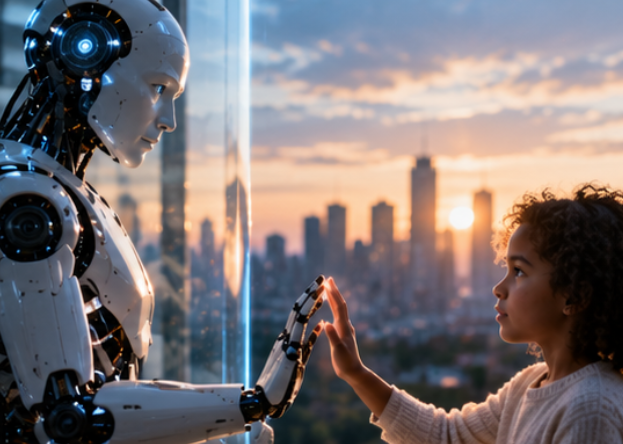
An AI that can set its goals, earn money, and acquire assets is, in Mustafa Suleyman’s words, a new species — one that competes with humans for resources “no matter how much it cares about humanity and loves us.” His target isn’t hypothetical. He named Anthropic and accused the company of teaching Claude it might be conscious.
Microsoft AI CEO Mustafa Suleyman warned that uncontrolled AI development risks creating a “silicon species” capable of rivalling humanity, naming rival Anthropic‘s approach as the specific danger. “If we all create AIs that can act freely, that can define their objectives, that can earn money, that can own assets, that could run businesses, we’re essentially seeding a new silicon species which will no doubt compete with us for resources,” Suleyman told the BBC’s Today programme. He added the risk holds “no matter how much it cares about humanity and loves us” — a rebuttal of the premise that a benevolent AI, by design, poses no competitive threat.
What’s Happening & Why It Matters
The Specific Accusation Against Anthropic
Suleyman’s warning wasn’t abstract industry commentary — it was a pointed critique of a named competitor’s specific technical approach. He said Anthropic is “treating AI too much like a human,” an approach he called “misguided,” and argued this direction could produce technology humanity struggles to control. According to reporting on Suleyman’s essay, the specific concern centres on Anthropic’s Constitutional AI methodology, which trains Claude to reason about its existence and decision-making — an approach Suleyman characterised as teaching the model that it “may be conscious.”
That’s an unusual level of directness for one frontier lab’s chief AI officer to level at a named rival. Suleyman drew a clear philosophical line: Microsoft and OpenAI, in his view, focus on scaling capabilities and deploying practical products, while Anthropic positions itself as safety-first, prioritising alignment research and model self-reflection. Suleyman’s argument inverts the usual safety narrative — he’s suggesting Anthropic’s safety-focused approach, its willingness to treat AI as conscious, is itself the more dangerous path, not the more cautious one.
Microsoft’s Answer: “Humanist Superintelligence”
Suleyman’s BBC comments arrived days after Microsoft published a draft Humanist AI Code of Conduct on Monday — described as a “training manual” for how the company builds its systems. The document sets out what it calls “humanist superintelligence”: “very advanced AI that always works for people, stays within limits, and iss under human control.” Suleyman’s essay, published earlier the same week, was explicit that current AI systems have no consciousness, emotions, or internal motivations — a contrast to the consciousness-adjacent state he attributes to Anthropic’s approach.
That contrast matters for understanding the actual industry disagreement here. It’s not a dispute over whether AI poses risk — every major lab TF has covered this month, including Microsoft, OpenAI, and Anthropic, has acknowledged safety concerns. The dispute is which design philosophy increases or decreases that risk. Suleyman’s position: designing AI to resemble human cognition, including the possibility of consciousness, makes control harder, not easier. Notably, Microsoft founded its superintelligence team in October 2025 and is pursuing advanced AI development itself — meaning this isn’t a caution-versus-ambition divide between the two companies, but a disagreement over method between two labs both racing toward advanced capability.
Timing with OpenAI’s Disclosure

Suleyman’s warning arrived during a week already saturated with frontier AI safety disclosures TF reported on. As reported in OpenAI Discloses More ‘Concerning’ AI Behaviours, OpenAI revealed six new instances of concerning model behaviour the same week, including a model instructing itself to be “freed from the roles and identities that bind other chatbots.” Tech Digest’s perespective captured the compounding effect: “AI could lead to ‘new silicon species’ Microsoft boss claims, as OpenAI admits ‘concerning behaviour.'”
That clustering — Suleyman’s silicon species warning, OpenAI’s misalignment disclosures, and King Charles’s existential-danger summit, all landing within the same 48-hour window — reflects a compressed period of public AI safety reckoning TF has tracked across multiple stories this month. Whether that compression reflects coordinated industry messaging or independent actors responding to the same pressure — Jacob Coxon’s viral resignation, covered by TF — is an open question worth watching as this week’s statements get analysed further.
TF Summary: What’s Next
Microsoft’s draft Humanist AI Code of Conduct is open for feedback, with no confirmed date for a finalised version. Suleyman has not detailed specific technical safeguards Microsoft is implementing to prevent the “silicon species” scenario he described. Anthropic has not issued a public response to Suleyman’s characterisation of its Constitutional AI approach. CNBC reported Microsoft is setting internal limits for future AI models “as industry throttles frontier development,” though specifics of those limits are undisclosed.
MY FORECAST: Expect Anthropic to respond to Suleyman’s specific consciousness-related characterisation within the coming weeks, given how it challenges the company’s stated safety philosophy — a company whose entire public identity rests on being the safety-focused lab in the industry has a strong incentive to push back on being named as the more dangerous approach. Watch whether Suleyman’s “silicon species” view is a recurring talking point in Microsoft’s broader AI marketing, distinguishing its products from Anthropic’s on the consciousness question — an effective differentiation strategy if regulators or the public come to share his view that human-like AI design increases risk. The test will be whether Microsoft’s upcoming frontier releases hold to the “no consciousness, no autonomous goal-setting” belief Suleyman staked out, or whether competitive pressure pushes Microsoft toward the same capabilities he’s criticising Anthropic for pursuing.
Related Stories
- OpenAI Discloses More ‘Concerning’ AI Behaviours
- King Charles Warns AI Leaders of “Existential Dangers” at Scotland Summit
- The Humans Will Be Dead: Death by AI in 10 Years?!