


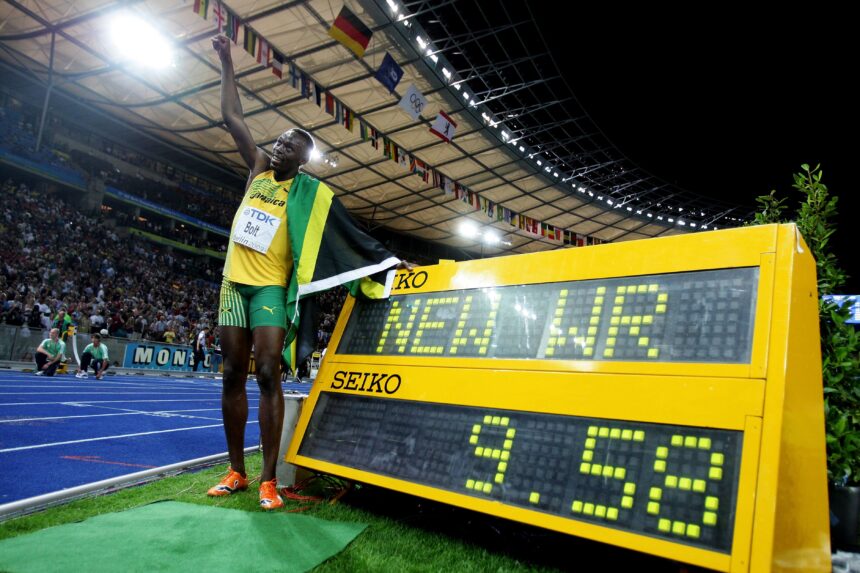
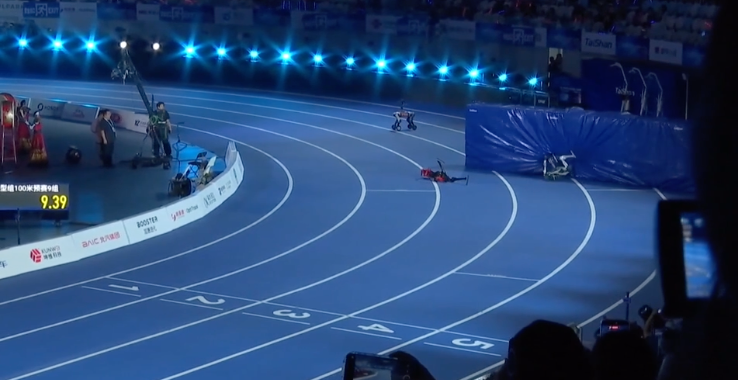
9.39 seconds. That’s 0.19 seconds faster than Usain Bolt’s 2009 world record — set by a robot, on camera, at an event called the World Humanoid Robot Games. It’s faster than the fastest human who ever lived. It also can’t brake and needed a padded wall and a stretcher to stop.
A humanoid robot ran 100 meters in 9.39 seconds, beating Usain Bolt‘s 2009 world record of 9.58 seconds during the opening day of the World Humanoid Robot Games in Beijing. The robot, called Tiangong Ultra and built by the Beijing Humanoid Robot Innovation Center, also known as X-Humanoid, won its preliminary heat outright. A second X-Humanoid robot beat a different human record the same day, clearing 2.88 meters in the standing high jump, surpassing Cuban athlete Javier Sotomayor‘s 2.45-meter mark set in 1993. Neither robot stopped smoothly. Both slammed into padded cushions and fell to the ground before being carried off the track on stretchers.
What’s Happening & Why It Matters
The Speed Was Real. Stopping Needs Work
Semafor’s view captures the tension running through every account of Saturday’s race: a different class of achievement from Bolt’s, for obvious reasons, but it improved on last year’s fastest robot time by more than 10 seconds, highlighting China’s blistering progress in “embodied AI” as well as its remaining hurdles. The machine struggles to brake and crashed into a padded wall after crossing the line. Games organisers put the leap in context on X: last year’s winning time was 21.50 seconds. In a single year, the fastest robots at the event doubled their speed.

Doubling the speed is more notable than the Bolt comparison itself. Beating a single human record is a headline. Doubling your own performance year over year is a trend line — and trend lines, unlike single records, don’t stop once they’ve made a splash.
Days Earlier, a Different Robot Previewed the Story
This wasn’t the first sprint-speed headline of the week. As TF reported in Unitree’s Viral Dancing Robots Make a 600% Stock Market Debut, Unitree unveiled a robot nicknamed “Superman” on 17 August, claiming a top speed of 12.66 meters per second — faster than Bolt’s peak velocity of 12.42 m/s. Unitree posted the reveal on X, and it drew a million views. An important distinction, though: peak velocity isn’t a 100-meter time. Bolt’s world record measures an average speed of 10.44 m/s sustained across the entire distance, not his fastest single instant. Unitree never produced verified timing data for a full 100-meter run, and independent regulators never certified the figure.
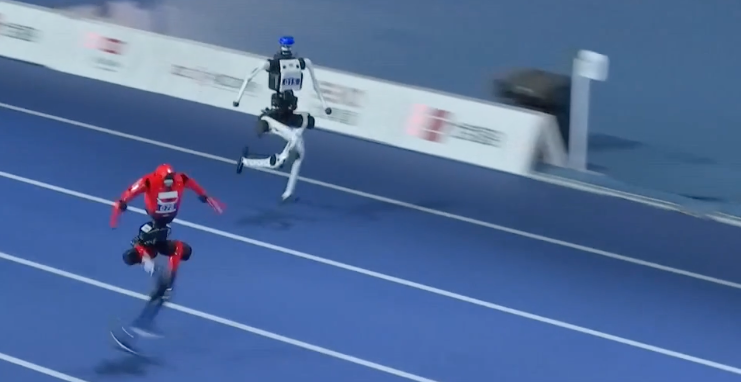
Saturday’s Beijing result is different. Tiangong Ultra’s 9.39-second time is an actual measured sprint, at an actual competitive event, on camera — not a peak-speed claim from a promotional clip. The Superman reveal was a preview. The World Humanoid Robot Games were the real test.
A Second Robot Beat Bolt Too
Unitree wasn’t even the only Chinese firm chasing the record. Honor, the smartphone maker, entered a robot called Lightning that also beat Bolt’s mark, clocking 9.47 seconds in the 100-meter final after a 9.32-second test run beforehand. Lightning went on to win the humanoid half-marathon in 50 minutes and 26 seconds — faster than the pace of the elite men’s world record over that distance — running the full course on legs measuring 95 centimetres, on a frame standing 169cm tall.
That’s the detail worth keeping in mind. This isn’t one specialised sprint-only machine built to chase headlines. It’s multiple companies, across multiple event distances, all beating human elite performance in the same week — sprint, high jump, half-marathon. Not every entrant fared as well. Other robots at the Games tripped, fell, smashed into pieces, or caught fire during competition, according to CBS News’ coverage of the event.
The Real Story Is Scale
The World Humanoid Robot Games drew more than 2,000 robots from 666 teams representing 16 countries — a competitive field over a single viral clip suggests. Unitree itself swept last year’s inaugural Games, taking four gold medals across the 100m, 400m, 1,500m, and 4x100m relay. Its CEO has suggested humanoid robotics is a decade away from its own “ChatGPT moment” — the point where capability jumps from impressive demo to transformative product.
A robot beating Bolt’s 100-meter time is a real, measured, camera-verified achievement. It’s also happening inside a controlled athletic event, with the machine unable to stop itself afterwards. Speed arrived before control did — and control is the harder engineering problem.
TF Summary: What’s Next
The World Humanoid Robot Games run through 26 August in Beijing. X-Humanoid hasn’t confirmed whether it will submit Tiangong Ultra’s time for any independent verification beyond the Games’ own timing. Unitree’s “Superman” robot is an uncertified prototype undergoing lab testing, with no confirmed public competition date. Both Unitree and X-Humanoid continue development ahead of what’s expected to be an even faster field at next year’s Games.
MY FORECAST: Expect braking and controlled stopping to be the next major public benchmark in the category, given how Saturday’s stretcher-assisted finish undercut an otherwise true speed milestone. A robot that can outrun Bolt but can’t stop without crashing into padding isn’t one ready for anything beyond a closed track. Watch for next year’s Games to feature explicit deceleration and stopping-distance competitions alongside the sprint events — China’s own year-over-year doubling in raw speed suggests the engineering talent solving velocity will turn to braking next, and solve it faster than most Western observers expect.
Related Stories
- Unitree’s Viral Dancing Robots Make a 600% Stock Market Debut
- New AI Model Gives Humanoid Robots a 90% Success Rate on Complex Tasks
- The Humans Are Dead #6: The Resistance Mounts