


Google promises faster answers and fewer fabricated claims, while free users and Plus subscribers face a confusing plan picture
Gemini 4 Hydrogen began rolling out on 12 November 2026 as Google’s new everyday AI model. Hydrogen replaces Gemini 3.8 Flash and drops the Flash name.
Google is placing Hydrogen in the Gemini app, Google Search and the Gemini API. TF tracks Google’s model changes, because each swap changes what free users and developers receive.
What’s Happening & Why It Matters
What Google Says Has Improved
Google says Hydrogen completes tasks 2.5 times faster than its predecessor. The company claims fabricated statements appear more than five times less often. Both figures come from Google and have no independent test yet.
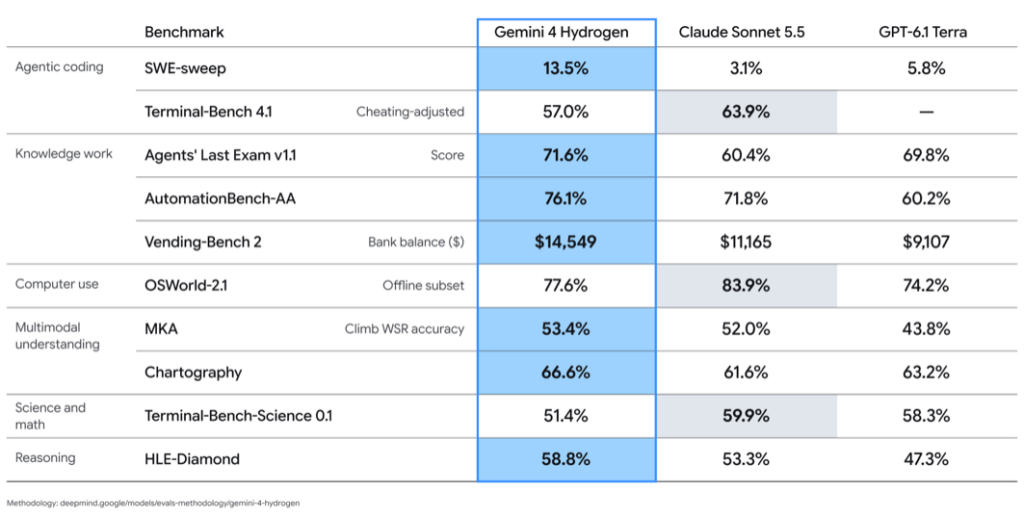
An outside score exists. The Artificial Analysis Intelligence Index gives Hydrogen 51, one point above the larger Gemini 4 Argon. At its highest thinking setting, MakeUseOf reports a score of 54. Hydrogen joins the heavier Carbon and Argon models in the Gemini 4 family.
Where the Model Appears
In the Gemini app, Google says Hydrogen follows instructions on tone, format and rules better across longer conversations. The company cites better links with Gmail, Google Drive and connected apps such as Dropbox. Users can ask for comparison tables and visual breakdowns with fewer prompts.
In Google Search, Hydrogen reaches all users worldwide. Google says the model handles multi-part questions and typos better, and results show a wider range of links. In Google Sheets, Google says outputs arrive more than 30% faster. Pro and Ultra subscribers can turn financial data into interactive models. Apple chases the same assistant market, as TF’s Siri agent report shows.
Free Users and the Plan Confusion
Free users reach Hydrogen through auto model selection, which Google applies when the model suits the prompt. Notebookcheck reports free users cannot pick Hydrogen by hand. Most prompts go to Flash-Lite. MakeUseOf says Hydrogen appears in the model picker, so the two reports conflict.
Google AI Plus costs $4.99 a month (about €4.44) and lists Hydrogen as its headline model, with twice the free usage limits. Notebookcheck says Google emailed Plus subscribers about losing Pro models on 13 November. Google’s help page still lists Pro under Plus. Google AI Pro costs $19.99 a month (about €17.79) and includes Gemini 4 Argon.
Developer Pricing and Specs
The API costs $1.50 per million input tokens (about €1.34) and $7.50 per million output tokens (about €6.68). The model has a 1 million-token context window. Developers get four thinking levels, including a new “xhigh” setting for the most thorough answers. Google AI Studio offers a test space.
Safety Claims to Test
Google describes Hydrogen as safer than Gemini 3.8 Flash. The company says the model cuts agentic overreach by up to 81% and misaligned shortcuts by 12 times. Google claims a 96.7% honesty rate in internal agent evaluations. Google says Hydrogen resists bypassing permission limits up to twice as well.
Each figure comes from Google’s evaluations. Independent teams need to repeat the tests before buyers trust the numbers.
My take: Hydrogen is a speed and cost story first, with a plan-tier story behind it. Free users get Hydrogen when Google’s router chooses it. Plus subscribers need a clear answer on Pro access. Buyers should test the model on real tasks before accepting the 2.5 times claim.
TF Summary: What’s Next
Google must settle the Plus plan conflict between its email and its help page. Independent benchmarks and safety tests should arrive in the coming weeks. Developers will compare Hydrogen’s price against rival models as they plan 2027 budgets.
MY FORECAST: Google will publish a clear model list for each plan by 31 December 2026. Independent tests will confirm part of the speed gain, and fall short of the full 2.5 times claim.
Related Stories
- Apple Wants Siri to Act as an Agent, and Bloomberg Says an Agent Could Arrive in 2027
- Google Fi Brings Back Network Switching With a Second 5G Carrier
- TF Analysis: The Hidden Cost of Single Provider Dependency
- Jensen Huang Resigns as Nvidia CEO After 33 Years
- Microsoft 365 Outage Hits Outlook and Teams Worldwide