


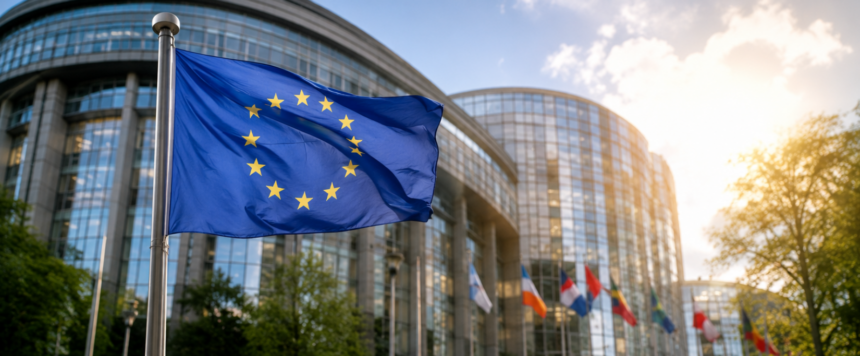
The EU under-16 (U16) social media ban proposal moved from political aspiration to formal policy trajectory on 12 May 2026. Speaking at the European Summit on Artificial Intelligence and Children in Copenhagen, European Commission President Ursula von der Leyen confirmed that a legal proposal for EU-wide restrictions on children’s access to social media could arrive as early as this summer. “Without pre-empting the panel’s findings, I believe we must consider a social media delay,” she told delegates. “Depending on the results, we could come up with a legal proposal this summer.” The announcement landed at the same summit where Common Sense Media formally presented its Youth AI Safety Institute to European policymakers. Both events carry the same message: European institutions believe the status quo is no longer acceptable, and they are moving to change it.
What’s Happening & Why It Matters

Von der Leyen’s Statement — and What It Actually Means
Von der Leyen’s Copenhagen speech introduced a specific new framing. She described the core issue not as whether young people should access social media — but whether social media platforms should have access to young people. That inversion matters. It places the burden of change on the platforms, not the children. It is the same philosophical shift that drove Australia’s U16 ban and France’s pending legislation.
The European Commission tasked a Special Panel of Experts on Child Safety Online with producing findings by July 2026. Von der Leyen has committed to using those findings as the basis for a legal proposal. The proposal could arrive within weeks of the panel’s report. That timeline makes a summer legislative proposal genuinely possible — though it does not guarantee one. A legal proposal is not a law. European legislation requires passage through the European Parliament and the EU Council before it takes effect. By contrast, a Commission proposal arriving in July sets a process in motion that could produce binding law within 12 to 18 months.
Ten Member States Are Already Pushing for This
The EU U16 social media ban proposal builds on momentum already visible across multiple member states. France, Spain, Greece, and Denmark are among the 10 EU member states pushing Brussels for an EU-wide approach. Several have pursued national legislation in parallel, creating regulatory fragmentation across the single market. That fragmentation is itself an argument for harmonisation — platforms operating differently in France than in Germany, or applying different age rules in Spain than in Denmark, creates compliance complexity and enforcement inconsistency.
Spain has already announced a national ban for U16s. France is advancing its own legislation. Ireland is exploring a ban, with a trial mooted for the first half of 2026. Several other countries — including the UK, Norway, Portugal, Germany, Malaysia, and India — have separately announced their intention to introduce similar measures. Australia became the first country to introduce a U16 ban in December 2025. Indonesia followed. The global direction of travel is no longer ambiguous.
The Existing EU Enforcement Tools — and Their Limits

Von der Leyen was direct about what European institutions are already doing. She confirmed the European Commission is taking action against TikTok for what she described as addictive design — specifically targeting endless scrolling, autoplay, and push notifications. She also confirmed that the Commission believes Meta is failing to enforce its own minimum age of 13 on Instagram and Facebook. Both Instagram and Snapchat are under active scrutiny by the Digital Services Act (DSA) over child safety failures.
At the same time, the existing DSA enforcement process moves slowly against platforms with the resources to contest every finding. The proposed Digital Fairness Act — which would ban addictive design features — is still in development. Von der Leyen acknowledged the pace problem directly. “We all know that sustainable change does not happen overnight. But if we are slow and hesitant, it will be another entire generation of children that pays the price.”
The Age Verification Problem Nobody Has Solved
The EU U16 social media ban proposal faces the same fundamental implementation challenge that every national age-restriction plan does. Verifying a child’s age online without creating a surveillance system, exposing sensitive data, or simply redirecting children to VPNs requires a technically robust, privacy-preserving infrastructure that does not yet exist at scale. Von der Leyen pointed to the EU’s age verification app — modelled on the EU Digital COVID Certificate — as the proposed mechanism. Member states have reacted cautiously to that proposal. Cybersecurity experts have raised concerns about potential technical vulnerabilities.
The EU‘s separate age verification initiative — which TF covered in an earlier article this year — uses a zero-knowledge proof to confirm that a user is above a threshold age without revealing their identity or specific date of birth. That approach is technically sound in principle. Deploying it across 27 member states, every major platform, and hundreds of millions of users requires coordination and infrastructure investment that the summer timeline makes very challenging. “No more excuses — the technology for age-verification is available,” Von der Leyen stated. That claim will be tested in the policy details.
What Platforms Are Doing — and Not Doing
Meta does not permit users under 13 to create accounts. In practice, that restriction is widely circumvented. The European Commission‘s position — that Meta is “failing to enforce” its own minimum age — reflects years of documented failure. Earlier in 2026, the UK’s Children’s Commissioner published research confirming that the majority of children aged 8 to 12 use social media platforms that nominally restrict access to those aged 13 and above. Platform self-enforcement has not worked.

The question of whether a government-mandated EU U16 social media ban would be effective depends entirely on whether the age-verification infrastructure can prevent workarounds. Teenagers have demonstrated considerable creativity in evading online age restrictions — from using parents’ accounts to deploying VPNs to providing false date-of-birth information during signup. By contrast, Australia’s law places the enforcement obligation on platforms — creating significant financial penalties for allowing underage access — rather than on individual users. That approach shifts the responsibility for compliance in ways that platform self-regulation never did.
The Mental Health Evidence Behind the Push
Von der Leyen’s Copenhagen speech listed the documented consequences of unrestricted child access to social media in direct, unambiguous terms. “The pressure can be overwhelming,” she said. “And children are being exposed at a moment when their resilience is only just beginning to grow, because they are still children. We all know the consequences: sleep deprivation, depression, anxiety, self-harm, addictive behaviour, cyberbullying, grooming, exploitation, suicide.” That list reflects a substantial body of research accumulated over the past decade — much of which derives from Meta‘s own internal studies, leaked in 2021, that documented Instagram’s specific negative effects on teenage girls.
The US surgeon general has called for mandatory mental health warning labels on social media platforms. Multiple national health authorities across Europe have published guidance recommending reduced social media use for U16s. The political consensus that children are being harmed has solidified considerably in the past 18 months. The policy debate is no longer about whether harm is occurring. It is about whether a ban is the right response — and whether it is technically implementable.
TF Summary: What’s Next

The Special Panel of Experts on Child Safety Online reports back to the European Commission by July 2026. Von der Leyen will use those findings to determine whether a legal proposal follows. If a proposal arrives in summer 2026, it enters the European legislative process — requiring passage through the European Parliament and EU Council before it becomes binding law across all 27 member states. That process typically takes at least 12 to 18 months. Binding EU law restricting children’s access to social media is therefore a 2027 outcome at the earliest — even if the proposal arrives on schedule.
MY FORECAST: The EU U16 social media ban proposal will arrive in some form this summer — but it will be narrower than a blanket ban. The final legal proposal is most likely to target addictive design features first — endless scroll, autoplay, push notifications — rather than mandating a hard age restriction with the full verification infrastructure that a 16+ ban requires. That approach allows the European Commission to act quickly, pursue enforcement through the DSA machinery it already has, and avoid the age-verification implementation problem, which will take years to solve properly. The full U16 access ban — with mandatory age verification — will follow as a second-stage measure once the verification infrastructure is operational. That two-step approach allows von der Leyen to deliver on her Copenhagen commitment without waiting for a technical solution that does not yet exist at the EU scale.