


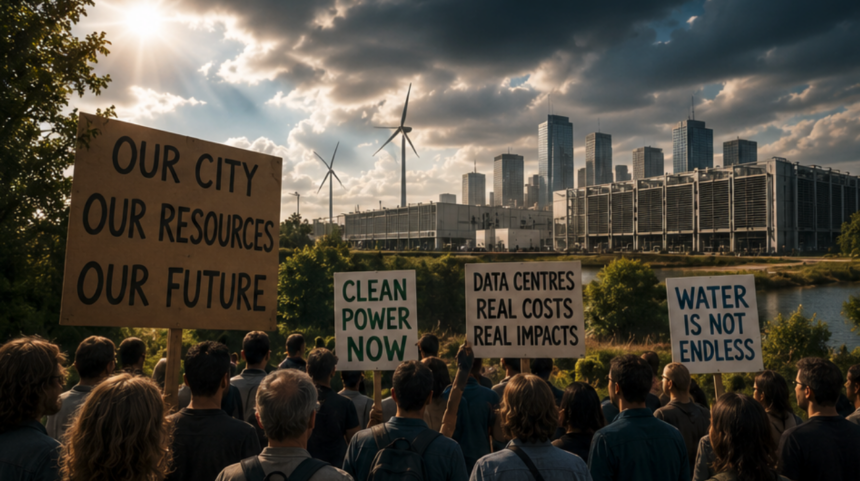
Phoenix and Melbourne started a conversation. It became a global pact. 40 mayors from four continents set conditions for accepting data centres in their cities. The same day, the UN Secretary-General told AI companies to come clean about their environmental footprint. Both events happened during London Climate Action Week.
The C40 Cities global data centre pact launched at London Climate Action Week — and it represents the first coordinated attempt by city governments to set standards for AI infrastructure on a global scale. Forty mayors from cities across four continents signed a landmark pact setting out the conditions under which they will accept AI data centres. It is the first coordinated global attempt by city governments to get ahead of data centre expansion before it overwhelms them. On the same day, UN Secretary-General António Guterres launched a separate but directly connected initiative. Guterres urged every major artificial intelligence company to measure and publicly disclose their environmental impact as well as commit to powering every data centre with renewable energy by 2030. He called it the AI Environmental Transparency Initiative. His message was blunt. “It is time to come clean. If AI is to help build a better future, it must be honest about what it costs us.”
What’s Happening & Why It Matters
The Pact: Four Continents, Six Conditions
The C40 Cities global data centre pact grew from a specific and practical conversation. The pact grew out of a conversation between the mayors of Phoenix and Melbourne, who found they were wrestling with identical problems: data centres consuming vast quantities of electricity and water. The result is a set of common standards covering clean energy, site selection, water use, and community benefit. The pact lists several specific conditions. Urban data centres should be built on abandoned or underutilised land that minimises negative impacts on noise, heat and air pollution. Developments should be fuelled by renewable energy and battery storage. Data centres should reduce water use and emissions, as well as capture waste heat.
About half the 40 signatories are US cities, including Seattle, Chicago, Miami, Phoenix and Palo Alto. European cities from Greece, Spain, Italy, Germany, the UK and Norway also signed, alongside cities in Canada, Kenya, South Africa, Sierra Leone, Côte d’Ivoire, India, Australia and Lebanon. Notably, no Southeast Asian city signed. None of Southeast Asia’s cities signed the pact, despite the region accounting for a quarter of global energy demand growth.

What the Mayors Are Facing
The numbers behind the C40 Cities global data centre pact are stark. About 1,700 data centres are already located across C40’s network of cities and development is expected to grow by more than 40% in 50 of those cities. In Phoenix specifically, pending permit requests in the metropolitan area alone would double the city’s electricity demand if all were approved. In Melbourne, the scale is equally alarming. If Melbourne follows through on all its current plans, data centres will consume up to 20 billion litres of water annually — or around 4% of the city’s drinking water supply.
Phoenix Mayor Kate Gallego described the dilemma that every signing city faces. “We understand the importance of [the] innovation, it’s creating great jobs in our community. We just want to make sure that we get it right for our local residents and for the health of our planet.” Melbourne Lord Mayor Nicholas Reece added the competitive dimension. “We don’t want to see a race to the bottom between cities where governments, desperate for investment, are chasing data centres on any terms possible. We want to see a better framework in place so that the investment rush in data centres can be a win-win.”

What C40 Managing Director Said
C40 Cities managing director Cassie Sutherland articulated the pact’s purpose with precision. “We found out that the challenges in every region around the world were very similar. Our approach was to say OK, how do we use a global mayoral voice to come together with the conditions under which they will accept data centres.”
By contrast, Sutherland was direct about the pact’s limitations. Mayors are limited in what they can do alone. The vision must be translated into local regulations and guidelines, with buy-in from utilities, other government tiers and the private sector. The pact is a standard-setter, not an enforcement mechanism. Each city must convert it into local zoning, permitting, and utility regulations. That translation process is where the actual power is — and it is uneven across 40 different legal and political environments.
Guterres at London Climate Action Week

The UN Secretary-General’s speech addressed the same problem from a higher altitude. Guterres proposed the AI Environmental Transparency Initiative, arguing AI companies should measure and disclose the impact of their increasingly in-demand technology. The context for his speech was specific. As Europe baked under a second heatwave in as many months, Guterres delivered a speech in London that painted a stark picture of a planet that has just endured its 11 hottest years on record. “Climate chaos is accelerating before our eyes,” Guterres said.
His data point on coal was the sharpest in the speech. Currently, coal sources about 30% of the electricity consumed by data centres globally, according to the International Energy Agency. Renewable energy supplies about 27%, natural gas 26%, and nuclear 15%. AI companies market themselves as sustainable future technologies. The Secretary-General of the United Nations just confirmed that they run primarily on coal and gas.
The UN University Report: Nation-Scale Footprints
The Guterres initiative builds on a UN University report published earlier in June 2026. By 2030, the global data centres powering artificial intelligence are projected to consume 945 terawatt-hours of electricity — nearly triple the combined annual electricity use of Pakistan, Bangladesh, and Nigeria, countries collectively home to more than 650 million people. Additionally, a UN study found that the facilities consumed more electricity than all but 10 countries in 2025. By 2030, they could use more power than all but five countries.
Professor Kaveh Madani — the report’s lead author and 2026 Stockholm Water Prize Laureate — addressed the efficiency paradox directly. “A lot of people think that the environmental footprint of AI reduces, as technology improves and processes are more efficient. But that is only a partial picture. More efficient and affordable AI and energy mean more consumption of AI, making the overall footprint far bigger than what we save through efficiency gains.”
Both Initiatives Connect, But Are Also Limited
The C40 Cities global data centre pact and the Guterres AI Environmental Transparency Initiative are complementary but distinct. The mayors are setting location and resource conditions at the city level. The UN Secretary-General is demanding disclosure and renewable energy commitments at the company level. By contrast, neither initiative creates a binding enforcement mechanism. Mayors can deny permits. They cannot force disclosure from companies that build elsewhere. Guterres can call for transparency. He cannot compel it.
As TF covered in its Seattle data centre moratorium article and Amazon water disclosure article, the infrastructure accountability conversation has been building throughout 2026. The C40 pact and the UN initiative represent its arrival at the international coordination stage.
TF Summary: What’s Next
The C40 pact is a framework for individual city regulations — not a treaty. Each of the 40 signing cities must translate it into local permitting and utility policy. The Guterres AI Environmental Transparency Initiative is a political appeal — not a regulatory requirement. The International Energy Agency will publish updated data centre energy projections in Q3 2026 that will inform both initiatives. COP31 — scheduled for Turkey in November 2026, Guterres’ final conference as Secretary-General — will feature both the C40 framework and the transparency initiative on the agenda.
MY FORECAST: The C40 Cities global data centre pact will produce its first binding local regulations in Seattle, Chicago, and Phoenix within 12 months. Those three cities already have the political will — Seattle’s 9-0 moratorium demonstrated it. The C40 framework gives them internationally coordinated language for their local ordinances. By contrast, the Guterres transparency initiative will not produce binding corporate disclosure requirements. It will produce a pilot programme — three to five major AI companies voluntarily joining a UN-managed disclosure framework before COP31, in exchange for reputational credit. That credit is worth something to companies preparing IPOs and managing ESG investor scrutiny. Anthropic and Microsoft are the most likely early joiners. Meta, xAI, and Amazon are the least likely. By COP31, the voluntary-versus-mandatory debate will be the defining question in AI environmental governance — and the answer will not yet be settled.
Related Stories
- Seattle Approves 1-Year Moratorium on Data Centres
- Amazon Data Centres Used 2.5 Billion Gallons of Water in 2025
- Alphabet Raises $80 Billion for AI — Berkshire Hathaway Leads With $10 Billion