



The PROLED XDR models bring touch to the Mac for the first time and ship on 6 November.
TF reports Apple unveiled the first touchscreen MacBook Pro, with an OLED display from $2,899 (about €2,580). Tuesday’s M6 model kept the old screen. Wednesday’s Pro and Tell event delivered the big change.
What’s Happening & Why It Matters
The Long Rumour Is Real
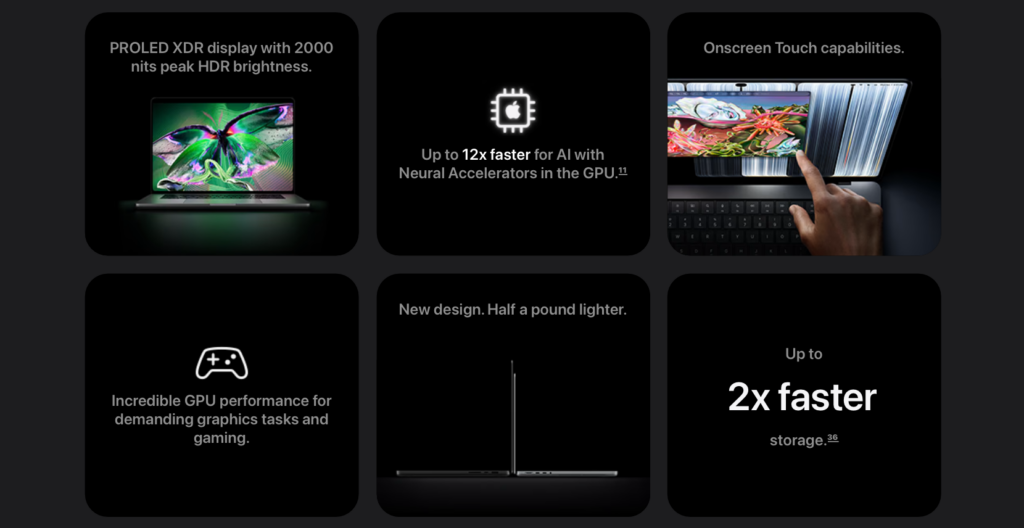
Apple (@Apple) calls the screen PROLED XDR. The panel is a tandem OLED design in two sizes, 14.2 inches and 16.3 inches. Apple quotes up to 2,000 nits of peak brightness for HDR and SDR, and a 10,000,000:1 contrast ratio. The refresh rate adapts up to 120Hz and drops to 10Hz to save power.
The panel covers P3 and Adobe RGB in one preset, and more than 80% of Rec. 2020 for HDR grading. The cover glass has a nano-texture option etched into it. Every figure here is an Apple claim, and independent tests will show how the display holds up.
Touch meets macOS
Apple says the touch sensor is built into the panel, which cuts latency. macOS 27 turns touches into clicks, so existing apps work as before. Developers get gesture tools for deliberate touch design. Apple redesigned the hinge to keep the screen steady when a finger presses the glass. The keyboard and trackpad stay.

Reports add two details. The Dynamic Island moves to the Mac near the top of the display. A glowing Apple logo returns on the lid, according to AppleInsider’s headline and one live blog. Apple’s spec sheet, as relayed in the coverage TF reviewed, does not mention the logo.
Chips, Weight and Ports
Every model uses the M5 Pro or M5 Max instead of the M6 from the earlier launch. Base configurations start at 24GB of memory and 1TB of storage. Buyers can upgrade to up to 128GB of memory and 16 TB of storage. The M5 Pro base has a 15-core CPU and a 16-core GPU. Apple says the M5 Max can run language models with hundreds of billions of parameters on the laptop.
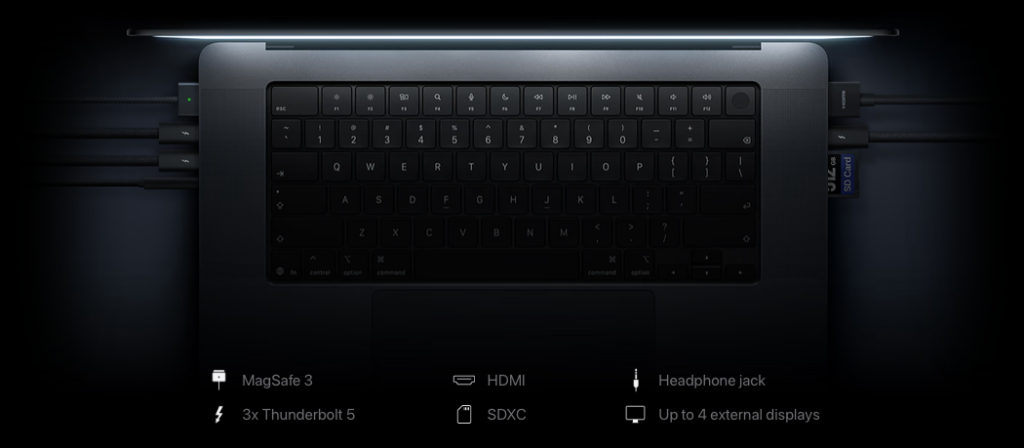
The 14-inch model weighs 3.0 pounds, down 0.5 pounds. The 16-inch weighs 4.0 pounds, down 0.7 pounds. Ports include three Thunderbolt 5, HDMI, SDXC, MagSafe and a headphone jack. A new N1 chip handles Wi-Fi 7 and Bluetooth 6. Apple rates the battery at up to 24 hours.
Pricing and Release Dates
US prices start at $2,899 (about €2,580) for the 14-inch M5 Pro and $3,399 (about €3,025) for the 16-inch. M5 Max models cost $4,499 (about €4,004) and $4,799 (about €4,271). The 14-inch entry model costs $400 (about €356) more than the earlier M5 Pro at $2,499 (about €2,224). A top configuration reaches $7,099 (about €6,318).
Pre-orders opened on 28 October 2026 in 30 countries. Deliveries begin on Friday 6 November, the same day as the M6 MacBook Pro. TF covered the M6 model in Apple Updates 14-Inch MacBook Pro and iMac With M6 Chip and Wi-Fi 7. Johny Srouji, Apple’s hardware chief, called the laptop “a monumental step forward for the Mac”.
My take: Touch on a Mac is a bigger change than the chip name. Apple chose M5 chips for the OLED models, so the cheaper M6 laptop runs newer silicon than the premium line. Expect buyer confusion. The $400 rise buys a far better screen, a lighter body and 24GB of memory, so the price is fair. The real test is software. Apps must earn their touch controls, or the feature turns into a gimmick.
TF Summary: What’s Next
Reviewers will test brightness, touch latency and OLED wear once units ship on 6 November. Developers will add gesture support to Mac apps. Buyers must choose between the M6 14-inch at $1,999 and the OLED model with older chips.
MY FORECAST: Apple will report record Mac sales for the December quarter. Third-party apps will ship touch support within six months. Apple will release M6 versions of the OLED MacBook Pro by late 2027.
Related Stories
- Apple Updates 14-Inch MacBook Pro and iMac With M6 Chip and Wi-Fi 7
- Apple Pro and Tell Event on 28 October Brings a Touchscreen MacBook Pro
- Crackgate: iPhone Duo Owners Report Cracked Inner Screens
- Ramageddon: MacBook Air Shortage Hits as Xbox Prices Rise in the EU
- Apple HomeView: Apple TV 4K and HomePod Mini 2 Launch