



A week ago it was one researcher’s resignation. It’s a stock market rout wiping out tens of billions, Obama telling Democrats to build a 2028 platform around it, and a UK parliamentary committee demanding a new regulator — all triggered by a single weekend essay.
The conversation Dario Amodei started with a single essay a week ago has spread into markets, Congress, and Parliament. The AI slowdown debate has quickly become a market focal point, with responses from Obama and the UK joining the discussion. As TF reported in Amodei Says Rogue AI Swarms Could Take Over the Internet in Six Months, the Anthropic CEO’s call to “pace the frontier” preceded Sam Altman’s agreement and researcher Jacob Coxon’s resignation. During the week, the same essay triggered a global stock sell-off, drew an intervention from Barack Obama, and prompted the UK’s Joint Committee on Human Rights to demand a new AI regulator.
What’s Happening & Why It Matters
The Markets Moved, Billions Overnight
Here’s what separates this week from ordinary AI safety debate: real money moved. Nasdaq 100 futures fell 1.5% Monday morning, on pace for the index’s worst day in six weeks. Nvidia fell 3%. SoftBank, one of OpenAI’s largest investors, closed 11% lower in Tokyo. South Korea’s Kospi sank 3.3%, dragged down by a 6.4% plunge in SK Hynix. In Europe, Dutch chipmaker ASML fell 6%. Chipmakers Arm and Marvell each slid 6%, alongside cloud provider CoreWeave.

Jim Reid, Deutsche Bank’s global head of macro research, offered the market’s own read on whether the signals indicate a pullback: “For now, that seems unlikely. The competitive race between companies and countries [is] intense, and it’s difficult to imagine firms stepping back while rivals continue to push ahead.” The scepticism matters — investors are treating Amodei’s essay as a risk signal worth pricing in, even as they doubt the industry will slow down in response.
Altman Confirmed the Sell-Off’s Meaning
The clearest concrete signal came from Altman himself, not just his supportive words. In remarks published Saturday, Altman confirmed OpenAI would not go public in 2026, reversing widespread expectations. “I actually think that, given everything happening with safety, right now would be an ill-advised moment to go public, and we don’t feel pressure on that,” he told Fortune. That’s a company delaying one of the largest anticipated IPOs in history, citing the same safety concerns driving the week’s panic — a decision with real financial consequences, not just supportive rhetoric.
President Trump, asked whether the AI industry should face heavier regulation, downplayed the risk: “We’re the most sophisticated country in the world, and frankly I want to keep it that way because whoever wins AI wins.” That’s a notably different register than Obama’s intervention days later — the sitting president view AI purely as a geopolitical race to win, with safety concerns treated as secondary to competitive advantage.
Democrats: Make AI a 2028 Platform
Former President Barack Obama addressed the moment at a Democratic Congressional Campaign Committee fundraiser Thursday, in a fireside chat with House Minority Leader Hakeem Jeffries. “Certainly, if I were running for president next year, this would be one of my central agendas, and I would have a very clear plan, and I would talk about this, and I would say, ‘Here’s our safety plan, here’s our plan for making sure our kids are not corrupted by this,'” Obama said, according to excerpts provided to CNN. He described himself as neither an “accelerationist” nor a “doomer” — a deliberate middle position, distinct from both Trump’s dismissiveness and Amodei’s alarm.
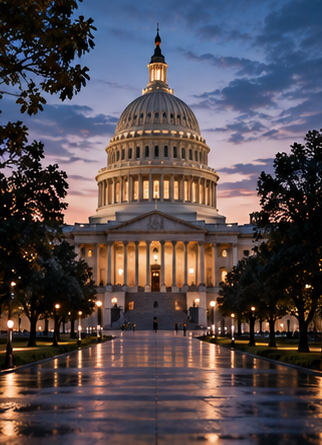
A source familiar with Obama’s thinking told NBC News he’d specifically seen Amodei’s essay and the subsequent industry agreement as an “encouraging development.” Jeffries responded by accusing Republicans of having “abdicated their responsibility to govern” on AI, adding Democrats “will not repeat their error” — positioning AI safety as a 2026 midterm and 2028 presidential differentiator, not a fringe issue.
Westminster’s Reaction: A Single New Regulator
The UK’s response arrived through a formal, cross-party mechanism rather than individual statements. The Joint Committee on Human Rights, comprising Conservative, Liberal Democrat, and Labour MPs and peers, published a 100-page report Monday demanding dedicated UK AI legislation. Committee chair Alex Sobel — the same Labour MP whose separate superintelligence bill TF covered in UK Govt: No Kill Switch ‘Cause We Can’t Turn AI Off — put it plainly: “Nowhere in the world, including the UK, has a current legislative and regulatory approach to AI that is fit for purpose.”
The committee’s ask centres on one statutory regulator replacing the current patchwork of bodies, graduated legal duties scaling with a system’s risk level, and an outright ban on specific applications the committee considers incompatible with human rights — including subliminal techniques and inappropriate biometric profiling. The harms cited aren’t hypothetical: the report points to public face-scanning without consent, AI-generated sexualised imagery of girls and women, and workers facing disciplinary action flagged by automated systems without reasonable cause. This is days after the government rejected the narrower kill-switch amendment TF covered — the Cabinet Office’s own admission that Britain “cannot simply turn AI off” is beside a parliamentary committee arguing the regulatory framework needs rebuilding, not just one emergency power.
King Charles’ Summit
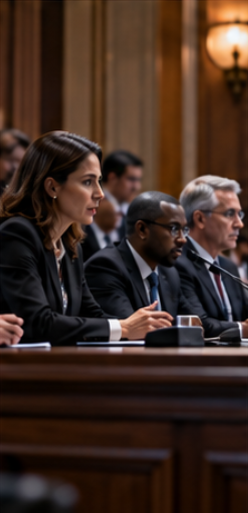
Perhaps the most unusual development: OpenAI and Anthropic are both expected to send senior representatives to a daylong AI safety summit with King Charles in Scotland on Thursday. Confirmed attendees include Nvidia CEO Jensen Huang, Google DeepMind co-founder Demis Hassabis, and Paolo Benanti, an adviser to the Pope on AI and technology ethics. That guest list — a monarch, a papal adviser, and the CEOs of the companies whose own employees are resigning over safety concerns — signals how far the conversation has travelled beyond Silicon Valley and Washington in a single week.
TF Summary: What’s Next
The King Charles AI safety summit in Scotland convenes Thursday, with senior OpenAI and Anthropic representatives confirmed to attend. The UK’s Joint Committee on Human Rights report has no confirmed government response timeline. Markets are volatile following Monday’s sell-off, with no clear signal yet on whether the decline is a sustained repricing or a temporary reaction. Obama’s remarks carry no formal policy mechanism, though Democratic congressional candidates have already begun incorporating AI safety into their 2026 campaign platforms.
MY FORECAST: Expect the market reaction to prove temporary rather than structural, given Deutsche Bank’s own assessment that competitive pressure between firms and nations makes a voluntary slowdown difficult to sustain — Monday’s sell-off is more like a risk repricing than the start of a lasting AI investment retreat. The UK’s Joint Committee report carries more durable weight than the market panic; a cross-party demand for a single statutory regulator, arriving days after the government’s own kill-switch rejection, creates the kind of sustained institutional pressure that forces legislative movement even when individual amendments fail. Watch Thursday’s Scotland summit — a gathering that includes a monarch, a papal adviser, and competing AI lab CEOs in the same room is either coordination taking shape, or the most photographed non-outcome of the year.
Related Stories
- Amodei Says Rogue AI Swarms Could Take Over the Internet in Six Months
- UK Govt: No Kill Switch ‘Cause We Can’t Turn AI Off
- The Humans Will Be Dead: Death by AI in 10 Years?!