

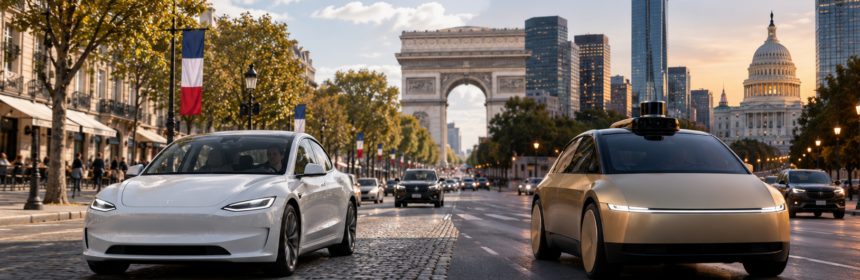
Musk got a “constructive” phone call, and Paris reversed its own July decision within weeks. Meanwhile in Austin, federal regulators opened an investigation into Tesla’s driverless Cybercab hours after its first passenger climbed in — using the exact process that held Amazon’s Zoox back for four years.
France began road-testing Tesla’s Full Self-Driving system Wednesday, two months after Transport Minister Philippe Tabarot said the technology’s safety trade-offs weren’t sufficient to justify approval. Tabarot changed course following what he called a “constructive” phone call with Elon Musk, posting on X: “With two vehicles being made available, we are now entering a new phase: that of on-road trials.” The same week, roughly 5,000 miles away in Austin, NHTSA opened a formal investigation into Tesla’s Cybercab — a two-seat robotaxi with no steering wheel, pedals, or mirrors — hours after Tesla put the first ones on public roads.
What’s Happening & Why It Matters
8 Weeks: “Not Sufficient” to “Constructive”
The reversal in France is genuinely striking given how recently the opposite position was stated. In July, Tabarot said FSD’s safety trade-offs weren’t yet sufficient to justify authorization, specifically citing concerns around speed limitation and driver attention warnings. By September, France had reached what officials describe as “months of technical collaboration” with Tesla, adapting the system specifically for French roads, and Tabarot’s own tweet credited his direct conversation with Musk for unlocking the change.
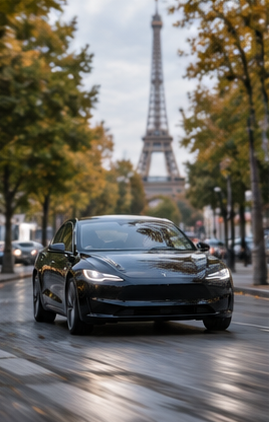
France isn’t testing FSD in isolation. The Netherlands’ road authority approved Tesla’s system on a provisional basis in April, prompting Belgium, Denmark, Estonia, and Lithuania to follow suit ahead of a bloc-wide EU vote that could happen as early as October or as late as December. France wants its own data specifically to verify what the Netherlands and Tesla have already reported, rather than simply accepting another country’s approval as sufficient. Results are expected mid-to-late September — timed precisely to inform how France votes when the EU decision comes.
Zoox Held Back by Same Regulatory Process
Meanwhile, Tesla’s Cybercab launch in Austin ran directly into the exact question that once stalled a rival for years. NHTSA opened Audit Query AQ26002 covering roughly 1,000 Cybercabs, examining whether Tesla correctly determined that certain federal motor vehicle safety standards simply don’t apply to a car with no human controls at all. That’s not a routine defect investigation — it’s a challenge to the foundational legal basis Tesla used to put the vehicle on public roads in the first place.
As TF covered in Amazon’s Zoox Redesigns Its Robotaxi for Commercial Launch, Amazon’s Zoox faced an identical challenge in 2022 after self-certifying its own steering-wheel-free robotaxi. That process took four years to resolve — recalling its entire 105-vehicle fleet, filing for a formal exemption from eight separate safety standards, and finally receiving commercial clearance in July 2026, just weeks before Tesla’s own launch. NHTSA Administrator Jonathan Morrison framed the current probe plainly: “NHTSA fully supports the safe development and deployment of automated vehicles. But as the federal regulator, we need to ensure that all of our laws are followed.”
US: Challenging Federal Motor Vehicle Safety Standards
The technical crux of NHTSA’s investigation is specific and genuinely unresolved. Federal Motor Vehicle Safety Standards were written assuming a human driver — they reference steering wheels, brake pedals, and mirrors as standard equipment because, until recently, every car had them. Tesla’s answer was to determine some of those standards simply don’t apply to a vehicle with no human controls to regulate. NHTSA now wants to see the technical justification behind that determination, not the vehicle’s driving performance itself.
Notably, the Department of Transportation has separately proposed removing the manual-controls requirement entirely for vehicles designed to be autonomously driven — a rule change that, if finalized, would retroactively validate exactly the argument Tesla is currently being investigated for making. Transportation Secretary Sean Duffy has led a broader initiative to speed up automated vehicle approvals, including the A2SCEND consortium, a three-year, $5 million project aimed at replacing the current state-by-state patchwork with unified national performance standards.
Tesla’s Launch Undercuts Playbook
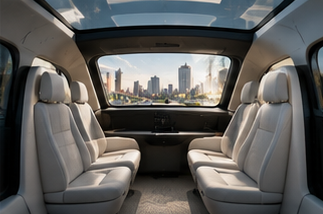
Even Tesla’s rollout style diverged from its typical approach. Electrek’s reporting described the Austin launch as a “nothing-burger” by Tesla standards — no livestreamed reveal, no stage presentation, no public remarks from Musk. Instead, Tesla invited a small group of shareholders and friendly influencers to ride first, reportedly requiring NDAs, before opening rides more broadly through the Robotaxi app. That’s a considerably quieter debut than Musk’s usual approach to major product announcements, and it arrived the same day NHTSA’s audit became public.
Current law permits NHTSA to grant petitions allowing up to 2,500 vehicles per manufacturer annually to operate without traditional controls — the exact mechanism Zoox used to secure its July clearance. Whether Tesla pursues that same formal exemption path, or continues arguing its self-certification was correct from the start, will likely determine whether Cybercab’s regulatory timeline looks anything like Zoox’s four-year journey.
TF Summary: What’s Next
France’s FSD test results are expected mid-to-late September, feeding directly into the EU’s bloc-wide vote on Tesla’s autonomous driving technology, expected as early as October or as late as December. NHTSA’s Audit Query AQ26002 continues examining Tesla’s Cybercab certification process, with no confirmed timeline for its conclusion. Tesla has stated it plans to gradually expand Cybercab deployment to additional locations and vehicle models regardless of the ongoing federal review.
MY FORECAST: Expect France’s test results to come back favorably, given how directly Tabarot’s own reversal signals the political groundwork has already shifted well ahead of the technical verification — a “constructive” call with Musk doesn’t typically precede a negative outcome two weeks later. The Cybercab investigation carries considerably higher stakes for Tesla’s broader robotaxi ambitions than France’s FSD approval does, given Musk’s entire autonomous-future strategy depends on producing Cybercabs at scale. Watch whether Tesla pursues Zoox’s exact formal exemption path proactively, rather than waiting for NHTSA’s audit to force the issue — a company that watched a direct competitor spend four years on this exact question has every incentive to shortcut that timeline if the option exists.
Related Stories
- Amazon’s Zoox Redesigns Its Robotaxi for Commercial Launch
- Tesla Debuts Starlink on the Cybercab as Musk Eyes Industry Adoption
- NHTSA Probes Tesla FSD After Drivers Crashed Into Homes and Pools