


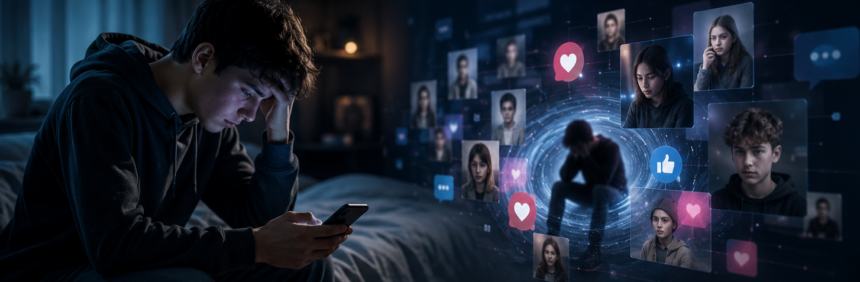
The first EU country to do it. Age verification by 1 September for new accounts — existing users get until 2027. Phones are banned from every French high school. And one legal adviser is already warning this won’t work like an outright ban at all.
France’s under-15 (U15) social media ban passed, when both chambers of the French Parliament voted in favour of a landmark bill — making France the first country in the European Union to approve a blanket ban on the platforms. President Emmanuel Macron called the passage “a major step forward,” posting on X that “France is leading the way in Europe when it comes to protecting our children and teenagers.” The law bans mobile phones from French high schools starting next year, extending an existing prohibition that already covers elementary and middle schools. Under the legislation, responsibility for enforcement is with the platforms themselves — it is up to social media companies to deploy age verification systems capable of filtering out underage users, with exceptions carved out for online encyclopedias and educational digital services.
What’s Happening & Why It Matters
Two Enforcement Timelines: September 2026 and 2027
France’s U15 social media ban carries a specific, staggered implementation schedule. For new accounts, the age-verification requirement is tentatively set to take effect on 1 September 2026. Existing users are expected to be subject to the rule starting in 2027. The exact list of affected platforms is unclear as of the law’s passage, according to French outlet BFM Tech — a gap given the law’s scope.
An earlier version of the bill had proposed allowing U15s to access social media with parental consent. The final law dropped that provision, banning the age group from the platforms outright regardless of parental approval — a stricter outcome than what lawmakers initially considered, and one that emerged after the European Commission flagged a conflict with the EU’s Digital Services Act.
The Law Won’t Ban Anything Yet

France’s U15 social media ban received a specific and important caveat from within the child protection advocacy community itself. Ines Legendre, a legal adviser for the online protection group e-Enfance, said the law will not translate into an outright ban. That caution matters given how the legislation’s own headline: “France bans children under 15 from social media” — implies immediate, comprehensive enforcement that the staggered timeline and unresolved platform list do not yet support.
By contrast, France’s public health watchdog delivered the evidentiary basis driving the law’s political momentum, concluding that social media had harmful effects on teenagers’ mental health, particularly among girls. Macron has cited social media as a contributing factor to youth violence — a connection that gained renewed political urgency following a fatal school stabbing in eastern France in April, which TF’s earlier reporting flagged as a driver of Macron’s quest for EU-wide regulation.
Constitutionality and Enforceability Concerns
France’s U15 social media ban did not pass without political opposition. Lawmakers from the left-wing party France Unbowed opposed the bill, arguing its constitutionality is unclear, that it would end online anonymity, and that it would prove impossible to enforce in practice. Critics writing from a civil-liberties perspective have perceived the law as part of an European upswell — placing gatekeeping authority over children’s internet access with the state rather than with parents or individuals.
Age verification systems capable of distinguishing a 14-year-old from a 15-year-old are technically imperfect across every jurisdiction that has attempted comparable legislation. As TF covered in its UK social media ban mechanics article, Australia’s under-16 (U16) ban has already faced documented circumvention challenges — a precedent France’s own enforcement will need to contend with once its September deadline arrives.
A Fast-Moving, International Movement
France’s U15 social media ban places the country within an accelerating global regulatory wave TF has documented throughout 2026. Australia became the first country to remove children U16 from social media in December 2025, making platforms including TikTok, Facebook, Snapchat, Reddit, X, and Instagram liable for fines of up to 50 million Australian dollars (~$35 million) if they fail to prevent underage account holders. As TF covered in its UK social media ban article and Norway AI ban article, the UK and Norway have each pursued their own versions of youth digital restriction throughout the year.
France’s specific contribution to that pattern is regulatory precedent within the EU itself — as the first member state to pass a blanket social media ban, France’s implementation experience over the coming year will inform how the European Commission and other member states approach comparable legislation across the bloc.
TF Summary: What’s Next
Age verification requirements for new accounts are scheduled to take effect 1 September 2026. Existing users are subject to the rule starting in 2027. The complete list of platforms covered by the law is unconfirmed. The mobile phone ban in French high schools takes effect the same academic year. e-Enfance and other child protection groups continue monitoring the law’s practical implementation ahead of the September deadline.
MY FORECAST: France’s U15 social media ban will produce enforcement gaps during its first year — Legendre’s own caution that the law “will not immediately translate into an outright ban” is the same age-verification and circumvention challenges every comparable jurisdiction has already documented. By contrast, France’s status as the first EU member state to pass the legislation gives it considerable political weight regardless of imperfect enforcement — expect at least two additional EU countries to introduce comparable legislation within 12 months, citing France’s precedent and its resolution of the Digital Services Act conflict as the template to follow. The unresolved platform list is the detail worth noting; how French regulators define “social media” will determine whether this is a meaningful restriction or a largely symbolic one.
Related Stories
- Starmer Confirms Full UK Under-16 Social Media Ban — Here’s the Timeline
- UK Social Media Ban: How It Works, Who Backs It, and Who Doesn’t
- Norway Bans AI in Primary Schools — Effective This August