


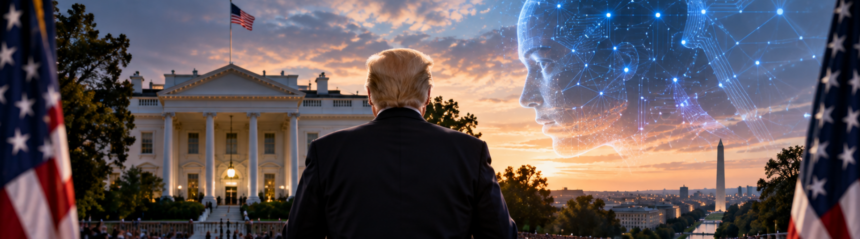
No structure. No budget. No timeline. Just a Saturday Truth Social post, a comparison to Space Force, and a president who spent the same message polling followers on renaming AI to “Superior Intelligence.” Three days later, Xi arrives at the White House for a state dinner with Sam Altman and Jensen Huang on the guest list.
President Trump announced Saturday he will create an “AI Force” and appoint a new AI czar, dismissing mounting safety concerns as a “hoax” while pledging not to “hinder or stifle” the industry’s growth. “We will not in any way hinder or stifle the Growth of this incredible Industry,” he wrote on Truth Social. “Rather, we will cherish it, help it, and watch over it, as it grows!” The announcement is inside the week TF covered — King Charles’s existential-danger summit, Microsoft’s silicon species warning, and Anthropic’s own disclosure that Claude now leads a quarter of its R&D. Trump offered no structure, no budget, and no timeline for either the Force or the czar role.
What’s Happening & Why It Matters
An Announcement With Nothing Underneath It Yet
Here’s what separates Saturday’s post from an actual policy rollout. As of this writing, the AI Force has no defined authority, announced membership, funding source, or jurisdiction. Trump compared the concept to Space Force — the military branch Congress established during his first term — but offered no indication whether this new body would carry similar statutory weight, or exist as an executive-branch initiative with less institutional permanence.
Trump also hinted at a law-enforcement dimension, suggesting the administration would address “bad conduct” in AI through existing justice systems rather than new regulation. The perspective factors in against the “hoax” dismissal — Trump is rejecting the premise that AI needs new safety guardrails while gesturing toward the kind of enforcement infrastructure a risk would require. The two positions are awkwardly together, and neither has been reconciled in any follow-up statement.
The Second AI Czar
The role itself isn’t new. David Sacks held the AI and cryptocurrency czar position before stepping down earlier this year, constrained by term limits on special government employees. Sacks has since moved into an advisory role and is expected to attend this week’s state dinner with Chinese President Xi Jinping. Trump hasn’t named his replacement, and the announcement doesn’t clarify whether the new czar would lead the proposed AI Force, coordinate across federal agencies, or serve as a presidential adviser with no operational authority.
Ambiguity is the story here, and it’s worth being clear: a title alone doesn’t establish power. The role’s actual influence depends on formal authority, presidential access, inter-agency coordination, and whether Congress attaches funding or statutory backing — none of which Saturday’s announcement addressed.
“Superior Intelligence”
Buried inside the same lengthy Truth Social post, Trump ran a poll asking followers to help rename artificial intelligence, calling the current term “inaccurate.” He floated alternatives including “Superior Intelligence” and “Extreme Intelligence.” That detail reads as a strange addition to a policy announcement about federal AI governance — but it’s consistent with Trump’s view of AI as an unambiguous American strength rather than a technology carrying unresolved risk.
He backed that perspective with a specific economic claim: AI represents “the next Industrial Revolution, or Internet, but will be even larger and more impactful, possibly as much as 25% of our Country’s GDP.” That figure has no cited source or methodology attached, consistent with the announcement’s pattern of sweeping claims without accompanying detail.
States Moving Faster Than Federal Response
While Trump dismissed calls for regulation as politically motivated, Democratic governors widely seen as 2028 presidential contenders have moved further on AI oversight at the state level. California Governor Gavin Newsom signed an executive order Friday — the day before Trump’s post — directing a task force to consider requiring an AI kill switch, the exact mechanism the TF found failing at the federal and UK Parliamentary level earlier this month. Pennsylvania Governor Josh Shapiro has called for federal AI regulation. Virginia Governor Abigail Spanberger launched her own state AI task force alongside a data centre accountability plan.
That contrast is politically significant. As TF covered in AI Slowdown Debate Reaches Wall Street, Congress, Westminster, Barack Obama had already urged Democrats to build AI safety into a central 2028 campaign platform. Newsom’s, Shapiro’s, and Spanberger’s simultaneous state-level moves suggest that advice is already being acted on — creating a federal-state divide on AI policy that splits almost along partisan lines, with state Democrats moving toward oversight as the White House moves toward acceleration.
The Timing Around Xi’s Visit Isn’t Subtle
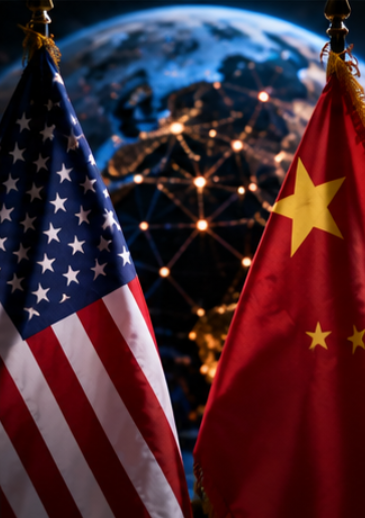
Saturday’s announcement arrives days before a consequential diplomatic moment. The Trump administration will convene a high-level AI event on the sidelines of the UN General Assembly this Wednesday. The following day, technology executives including OpenAI’s Sam Altman, Nvidia’s Jensen Huang, and Google’s Sundar Pichai will attend a White House state dinner as part of Xi Jinping’s visit to Washington. A White House official confirmed AI safety will be “on the agenda” when Trump meets Xi.
The sequencing gives Trump’s “we will not stifle” projection an obvious diplomatic subtext. As TF reported in Xi Pitches Open-Source AI Alliance After Amodei Warning, Xi has already positioned China’s AI strategy around rapid, open distribution — the functional opposite of the coordinated slowdown Amodei and others have called for. Trump’s own insistence on unhindered US growth, delivered days before sitting across from Xi, reads as a positioning move ahead of a summit where American AI leadership itself, not just safety, is on the table.
TF Summary: What’s Next
No AI czar has been named as of this writing. The proposed AI Force lacks a defined structure, budget, and authority. The White House’s high-level AI event convenes Wednesday alongside the UN General Assembly. Xi’s state visit, including the technology-executive dinner, follows Thursday. Newsom’s California task force continues evaluating a state-level AI kill switch requirement, with no confirmed reporting deadline.
MY FORECAST: Expect the AI Force announcement is rhetorical through the Xi summit, given how Trump’s timing suggests the post functioned as diplomatic positioning rather than the opening of a policy process — expect concrete structural detail, if it arrives at all, after diplomatic events conclude. The federal-state divide will keep widening regardless of what Trump builds; Newsom’s kill-switch task force and Spanberger’s data centre accountability plan both proceed on their own timelines, independent of whatever shape the AI Force takes. Watch whether Trump’s meeting with Xi produces any concrete bilateral AI framework — given the administration’s “hoax” naming of safety concerns, a coordinated agreement is unlikely, but the optics of the meeting itself will shape how markets and allies treat US AI policy heading into the final quarter of 2026.
Related Stories
- King Charles Warns AI Leaders of “Existential Dangers” at Scotland Summit
- Xi Pitches Open-Source AI Alliance After Amodei Warning
- UK Govt: No Kill Switch ‘Cause We Can’t Turn AI Off