


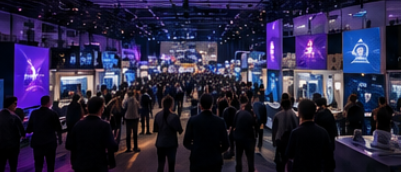
Jeff Bezos told 180,000 people in Paris that the Moon is how we save Earth. France’s intelligence agency fired Palantir and hired a French startup instead. Germany sent its largest-ever delegation. And the Anthropic access ban — four days earlier — made European AI sovereignty the most urgent conversation at the show.
VivaTech 2026 opened in Paris on 17 June — and the timing could not have been more politically charged. Europe’s biggest tech trade fair opened its doors on Wednesday, putting American billionaire Jeff Bezos front and centre on its guest list as enthusiasm for generative AI rubbed shoulders with anxiety about the continent’s technological dependence. The backdrop is specific and fresh. Four days earlier, as TF covered in its Claude Fable 5 suspension article, the US government ordered Anthropic to restrict its most advanced AI models — and Anthropic responded by pulling access for every user globally. France is shifting sensitive data analysis from US firm Palantir to local ChapsVision, amid recent US access restrictions to powerful AI models. The message from every European speaker at VivaTech carries the same undertone. The kill switch is real. Europe needs its own hand on the button.
What’s Happening & Why It Matters
Bezos on Stage: Move Industry to the Moon, Save the Planet

VivaTech 2026‘s most dramatic moment came from Jeff Bezos — co-CEO of Prometheus and executive chairman of Blue Origin. Bezos took the stage at VivaTech in Paris on Wednesday to make the case that humanity must move to the Moon and eventually beyond — not just for the sake of exploration, but to save the planet from the effects of technology and industry. His argument is economic as much as environmental. He argued that shifting heavy industry off Earth is the only scenario in which economic growth and environmental preservation can coexist, saying “our garden planet can be returned to its pre-industrial revolution state.”
According to Bezos, only by moving energy-intensive industries into space will we be able to reduce the burden on the planet without sacrificing improvements in our standard of living. The Moon’s specific advantages are compelling. Lunar water ice could be converted into liquid oxygen — one of the key propellants for deep space travel — and launched into orbit at a fraction of the cost of lifting it from Earth. The Moon’s surface holds virtually every mineral needed to build infrastructure in space. Materials lifted from the lunar surface require 28 times less energy per kilogram than those launched from Earth.
Prometheus — Bezos’s New AI Company
Beyond Blue Origin, Bezos discussed his newest venture. During his speech, Bezos discussed the Prometheus artificial intelligence project, which is being developed to accelerate engineering research and the creation of new technologies. Backers of AMI Labs — where LeCun is building world models as a direct contrast to the large language model approach — include Bezos Expeditions, Cathay Innovation, Greycroft, and NVIDIA. By contrast, Bezos saved his most memorable line for the close. “There has never been a better time to be an entrepreneur,” he said, concluding his speech.

France Fires Palantir — and Hires ChapsVision
The most consequential business announcement at VivaTech 2026 happened the day before the conference opened. On 16 June, French Prime Minister Sébastien Lecornu announced that France’s domestic intelligence agency DGSI ended a decade-long relationship with US data-analytics firm Palantir, with Lecornu announcing that French startup ChapsVision will fully replace Palantir. His reasoning was unambiguous. Lecornu said France cannot “accept new strategic dependencies in technology” and framed the move as building “real autonomy.”
By separating from the American Palantir in favour of the French ChapsVision, Lecornu intends to build “real strategic autonomy.” The timing is directly tied to the Anthropic episode. Both moves accelerate a European trend toward technology sovereignty that intensified after Anthropic restricted access to some of its highest-performing models under US government orders. Sifted cites concerns about a potential “digital kill switch” — the risk that US providers could revoke access to AI and cloud tools used in critical government services. Additionally, alongside the Palantir switch, Lecornu announced that €655 million within France’s €54 billion France 2030 programme will be directed toward AI, covering compute infrastructure, startups, and research.
Germany’s Largest Delegation — and a Joint Sovereignty Statement

Germany is VivaTech’s Country of the Year for 2026, represented by the largest national delegation in the event’s history. The German presence covers 200 startups, 14 Länder, 12 government entities, and two federal ministers on the main stage. Those ministers are Karsten Wildberger (Digital Transformation) and Dorothee Bär (Research, Technology and Space). France and VivaTech’s guest nation Germany issued a joint statement as the fair opened, offering a “shared vision for strengthening Europe’s digital sovereignty.”
The delegation occupies an 800 square metre booth and represents a deliberate statement about the Franco-German innovation partnership and Europe’s shared ambition on AI and deeptech sovereignty. Germany’s military has likewise said it will stop using Palantir products — a parallel national security decision that mirrors France’s DGSI move precisely.
The European AI Sovereignty Debate
Peter Steinberger — known in the developer scene as “steipete,” founder of PSPDFKit and creator of the viral open-source project OpenClaw, who has been part of the Codex team at OpenAI since early 2026 — shares the stage with OpenAI‘s head of Product & Platform Thibault Sottiaux on 18 June. A piquant subtext: Steinberger recently stated publicly that he is moving to the United States — in his view, too much regulation is stifling AI development in Europe. Precisely the debate that hangs over the entire VivaTech anniversary edition. secsec

That tension — between European regulation as protection and European regulation as obstacle — is the defining argument of the conference. Yann LeCun and Mistral AI CEO Arthur Mensch both appear on stage. Both represent different positions within that debate. The discussions are Europe’s broad dilemma: how to preserve strategic autonomy while remaining dependent on American companies that dominate cloud services, chip development, and cutting-edge AI research.
VivaTech’s 10th Anniversary — Scale, Rebrand, and Record Numbers
VivaTech is making a big deal of turning 10, with a free event open to all on Sunday that turned the Champs-Élysées into a walkway of robots, the mobility of the future, and all types of innovation. The scale is impressive. The Porte de Versailles exhibition halls in Paris are the industry’s densest gathering point, with around 15,000 startups, 4,000 investors, more than 450 speakers across four stages, and roughly 180,000 visitors expected in total. Additionally, VivaTech changed its name, which was previously Viva Technology. The organisers say the name change is that, over the past 10 years, the event is “much more than just a gathering: a true ‘VivaTech Generation’ has emerged.”
TF Summary: What’s Next
VivaTech 2026 runs through 20 June — with public days on Saturday and Sunday. The Franco-German joint sovereignty statement will be referenced in upcoming EU Digital Markets Act enforcement proceedings and G7 negotiations in Evian simultaneously. The Palantir transition at DGSI is expected to take several years — given the complexity of unwinding a decade-long intelligence contract. The UK’s NHS and Metropolitan Police Palantir contracts are also under active review, per the Guardian.
MY FORECAST: VivaTech 2026 will be remembered as the conference where European AI sovereignty stopped being a talking point and became procurement policy. France’s DGSI switch from Palantir to ChapsVision — followed by Germany’s parallel military decision — establishes a template that every European intelligence service will study. By contrast, the €655 million from France’s 2030 programme is a real signal but a modest one. Mistral and ChapsVision need capital at Anthropic and Palantir scale to be genuine alternatives — and that capital does not yet exist at the level required. The sovereignty ambition is clear. The financing to match it is the unresolved question that Bezos, LeCun, and every speaker at VivaTech cannot fully answer.