



A football with a 500Hz sensor. Digital twins of all 16 stadiums. 3D body scans of all 1,248 players. Smart vests that nearly benched a Brazilian star — until video review proved the data wrong. The 2026 World Cup is the most data-driven tournament ever played.
The 2026 FIFA World Cup technology stack represents the most extensive sports data infrastructure ever deployed for a single event. The tournament — co-hosted across the United States, Canada, and Mexico — kicked off on 11 June as the largest FIFA World Cup ever staged. Lenovo, the tournament’s Official Technology Partner, is running an Intelligent Command Center that generates AI-powered daily summaries across all 16 stadiums. The official match ball — the Adidas Trionda — contains a 500Hz inertial sensor. Every one of the 1,248 players across 48 teams underwent 3D body scanning to create personal digital avatars for officiating. Meanwhile, Brazil is using sensor-packed smart vests that nearly led coaches to bench a star player — before video proved the data wrong.
What’s Happening & Why It Matters
The Trionda: A Football That Computes 500 Times Per Second

The 2026 FIFA World Cup technology begins with the ball itself. The official match ball — named Trionda, Spanish for “three waves,” celebrating the three co-host nations — moves away from the multi-panel designs of previous tournaments. It features just four thermally bonded panels. By contrast, the real innovation is inside. A compact sensor chip, weighing approximately 14 grams, is suspended within the ball’s structure. That inertial measurement unit (IMU) captures acceleration in three dimensions, rotational spin, trajectory changes, and the precise moment of contact with a player’s foot, head, or body — 500 times per second.
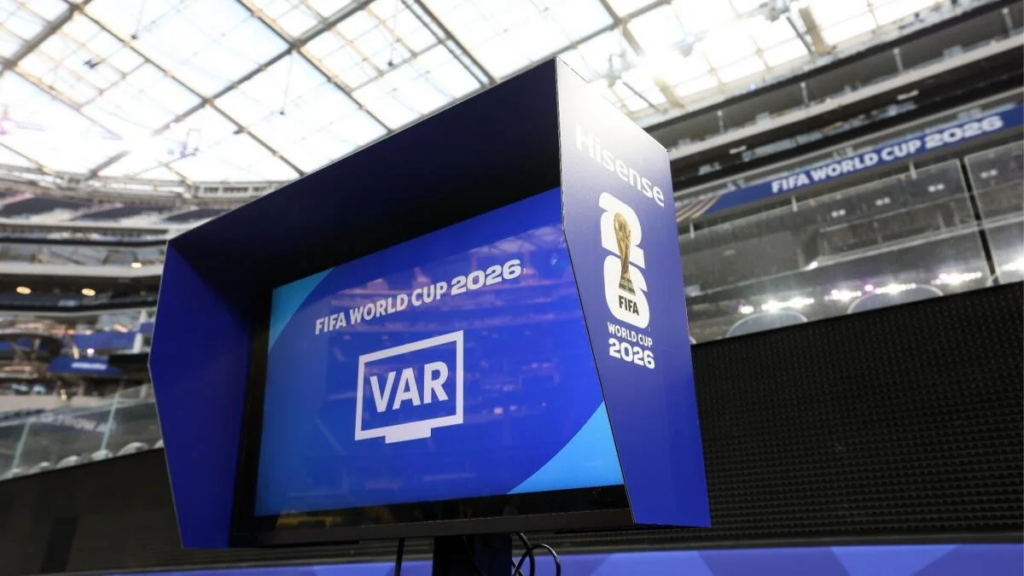
The data is transmitted wirelessly, in real-time, to the Video Assistant Referee (VAR) operations centre. Building on the connected-ball concept introduced in Qatar in 2022, the Trionda represents a substantial leap in measurement precision. Every kick, every touch, and every deflection becomes a data point the instant it happens.
1,248 Digital Avatars — One for Every Player
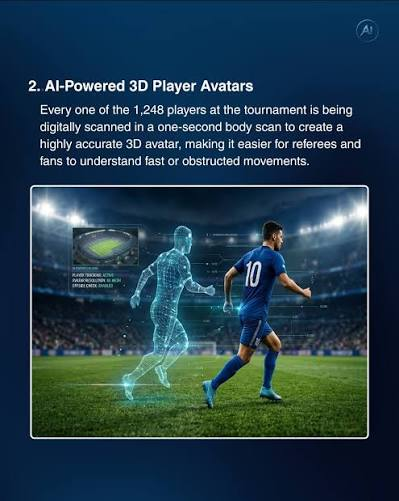
The most striking individual technology element is the player scanning programme. FIFA created a digital avatar of every tournament player — all 1,248 athletes across the 48 qualified teams’ 26-man squads. Each player entered a scanning chamber during their pre-tournament photo shoot. The process takes approximately one second per player and captures highly accurate body-part dimensions.
By contrast, previous offside technology used a generic avatar representing an average player. The system uses a digital figure based on each player’s own body: height, limb length, and body structure. The avatars integrate directly into the semi-automated offside system and television broadcasts — giving viewers a clearer simulation of contested plays. FIFA describes this as one of the first times a “digital twin” of a person is an official component of officiating at a global sports event.
Semi-Automated, Not Automated
The phrase “semi-automated offside technology” is doing important work. The system measures one specific thing objectively: a player’s position at the moment the ball is kicked. By contrast, it is deliberately walled off from judging whether that player interfered with play — a determination that is entirely human. The technology produces evidence and a recommendation. A referee makes the decision.
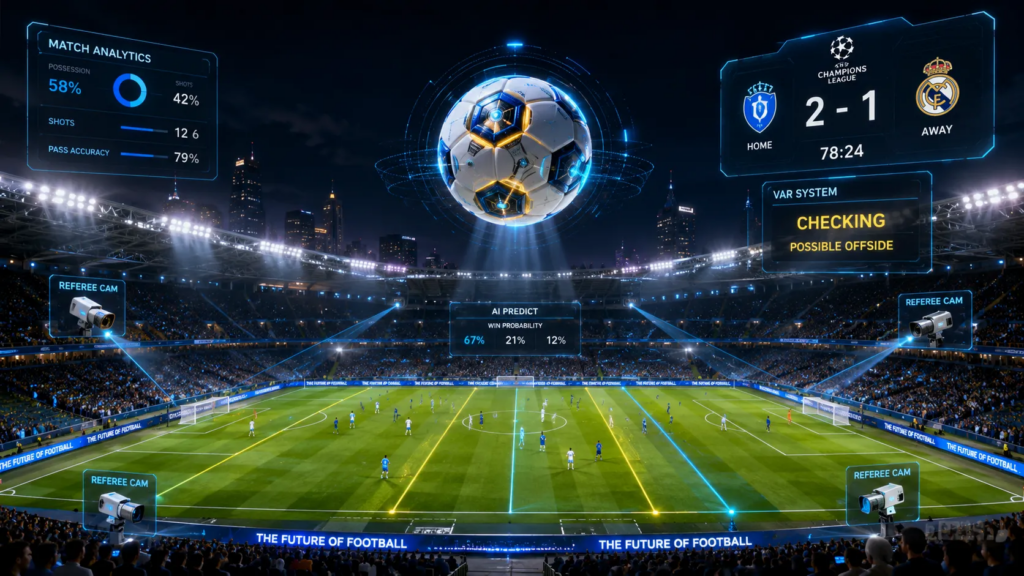
When a disputed call happens — and it will — the accountable party is the referee, working with faster. more precise inputs. That scoping is a considered position on AI’s role in officiating. FIFA has trusted AI with measurement. It has not trusted AI with judgment. The promise to viewers is a referee’s-eye view of close incidents, with — FIFA argues — greater transparency into how each decision was reached.
Digital Twins: All 16 Stadiums, Modelled in Real Time
Beyond the pitch, Lenovo‘s Digital Twin technology creates hyper-accurate virtual maps of all 16 host stadiums. The models let officials track crowd flow, security deployments, and technical systems in real time, across three countries simultaneously. If a bottleneck forms at a specific gate — Lenovo cites Atlanta as an example — officials see it on their digital map before it is a physical problem.
The Intelligent Command Center supports all of FIFA‘s functional areas — generating AI-written daily summaries and monitoring operations across the tournament’s entire footprint in real time. Additionally, Smart Wayfinding connects host cities, fan zones, landmarks, and transportation hubs into a single interactive navigation layer. FIFA President Gianni Infantino and Lenovo Chairman and CEO Yuanqing Yang unveiled the full technology package together at Lenovo Tech World 2026 at Sphere.
Brazil’s Smart Vests
Brazil‘s technology story is the most human in the entire tournament. The five-time champions equip players with sensor-packed smart vests — worn under the jersey like a sports bra — tracking GPS position, heart rate, and a composite metric called “player load.” Guilherme Passos, Brazil’s head of sports science, told the BBC that clubs send tracking data to the national team daily — even when players are not with the squad.

Passos once flagged a player covering only 3.7 miles (6 km) in a match — roughly half what teammates ran. By the data alone, that player looked underperforming. By contrast, video review told a different story. Coaches concluded the player was “always in the right spot” — tactically positioned so well that he simply did not need to cover the same ground as his teammates. The lesson generalises. The smartest player on the pitch can produce the most boring smart vest data. Brazil opens its campaign against Morocco at MetLife Stadium — TF will be watching whether that lesson holds across the group stage.
Security at Three-Nation Scale
The security operation for 2026 is described as equivalent to managing dozens of Super Bowls simultaneously. Counter-unmanned aircraft systems (C-UAS) — combining radar detection, camera tracking, and mitigation — have received substantial investment to address drone threats across all 16 venues. AI-driven platforms aggregate and analyse public data streams in real time, identifying potential risks for rapid multi-agency response. Ticketing systems, communications networks, and broadcast infrastructure all represent targets that security experts describe as an unprecedented challenge — given the tournament’s scale and three-country geographic footprint.
TF Summary: What’s Next
The tournament runs through the group stage and knockout rounds across all three host nations. FIFA Football AI Pro — the generative AI platform built with Lenovo — continues supporting participating federations throughout. The semi-automated offside system, digital avatars, and Trionda sensor data feed every match’s officiating decisions. Brazil’s smart vest data continues informing squad rotation decisions match-by-match.
MY FORECAST: The 2026 FIFA World Cup technology stack will generate its first major controversy within the tournament’s first two weeks — a contested offside call where the semi-automated system’s recommendation conflicts with a referee’s on-field judgment. That controversy will not be a failure of the technology. It will be the system working exactly as designed — producing faster, more precise evidence while leaving the final judgment call to a human referee, who will occasionally disagree with what the data suggests. By contrast, the more durable legacy of the tournament’s technology will be the smart vest data infrastructure. Brazil’s approach — integrating tracking across men’s, women’s, and youth teams continuously, not just during tournaments — will become the template every major football federation adopts within two World Cup cycles. The 2026 tournament will be remembered as the moment football’s data infrastructure became as load-bearing as its broadcast infrastructure.