


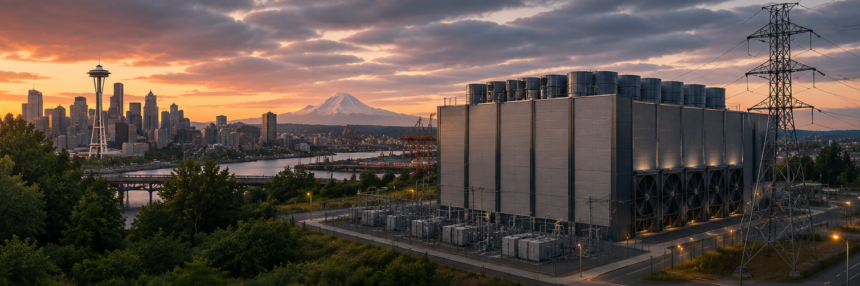
Seattle’s City Council voted unanimously in committee to impose a one-year ban on new large-scale data centres. Five proposed facilities would have consumed electricity equivalent to 300,000 homes. Amazon employees spoke in favour of the ban against their own employer. The full council votes on 9 June.
Seattle’s data centre moratorium moved closer to reality on 3 June 2026 — and the politics of how it got there are as striking as the policy itself. Seattle‘s City Council Land Use and Sustainability Committee voted unanimously to approve a one-year moratorium on new large-scale AI data centres within the city’s limits. The full council is scheduled to vote on 9 June 2026. Mayor Katie Wilson first proposed the ban in April, and not one of the nine council members has broken with her position. Two developers have already withdrawn their proposals in response. The moratorium applies to any data centre using more than 20 megawatts of power. The five facilities originally proposed would have combined for 369 megawatts — approximately one-third of Seattle’s average daily electricity consumption. For context, that is enough power to supply 300,000 homes.
What’s Happening & Why It Matters
The Four Companies That Started This
A specific and quantifiable event triggered Seattle’s data centre moratorium. Four companies approached Seattle City Light — the city’s publicly owned electric utility — about building five large-scale data centres within Seattle’s city limits. The combined demand of those proposals would have required Seattle City Light to provision 369 megawatts of additional power capacity. That represents roughly one-third of the city’s current average daily load. Adding that capacity would require significant grid investment — and would almost certainly increase electricity rates for Seattle’s residential and commercial customers.
Two of the four companies subsequently withdrew their proposals before the committee vote. One was Sabey Data Centres — a Tukwila-based developer. Neither Microsoft nor Amazon were identified as the company that withdrew. Both separately confirmed that they have no current plans to build data centres within Seattle’s city limits, noting that they already operate major facilities in other Washington State locations,, including Quincy and Umatilla, Oregon.
Amazon and Microsoft Employees Testified Against Their Employers
The most politically revealing aspect of Seattle’s hearing was who showed up to testify in favour of the moratorium. Patrick Schloesser, a software engineer at Amazon Web Services, testified at the City Council hearing. His statement was striking. “It’s been reported that this year, Amazon is spending $200 billion on capital, with most of it going to data centres and AI,” he said. Microsoft is spending $190 billion. Meanwhile, the leaders at my company have laid off 30,000 corporate employees in the last eight months. What that tells me is that Big Tech is desperate to build as much compute capacity as it can, as fast as it can.”
That testimony — from a current employee of the world’s largest cloud provider, speaking publicly at a city council hearing — captures the internal tension running through Big Tech in 2026. The companies spending hundreds of billions on AI infrastructure simultaneously cut tens of thousands of workers. As TF covered in its AI Behaving Badly #13 article, Google DeepMind workers voted 98% in favour of unionising over related concerns in May. The Schloesser testimony in Seattle is the same dynamic — workers using every available forum to push back against their employers’ AI-first strategy.
Over 54,000 Resident Emails — The People Spoke First
Schloesser was not alone at the hearing. The council received more than 54,000 emails from residents calling for action before the committee vote. Residents cited rising utility costs, environmental impacts, noise from industrial HVAC infrastructure, and the industrialisation of urban land as their primary concerns. City Council President Joy Hollingsworth addressed the volume of community response directly. “This is not a knee-jerk reaction,” she said. She cited the documented effects of data centre density on communities in Virginia, North Carolina, and Ireland — all regions where power consumption, water use, and noise complaints have generated sustained resident opposition.
City Council Member Eddie Lin — who is sponsoring the moratorium proposal — made the city’s intent clear. “I don’t see us having a permanent ban on all data centres. But I do think we need to have appropriate rules and regulations.” Those rules, he explained, would address data centres’ water and electricity use, noise levels, greenhouse gas emissions, and local employment impacts. The moratorium gives the city time to develop those rules while construction is paused.
Seattle Joins a National Trend — 14 States Are Moving
Seattle’s data centre moratorium is not an isolated civic reaction. It is part of a documented national pattern. According to the National Conference of State Legislatures, 14 US states are currently considering legislation that would pause or restrict new data centre construction. A report from Data Centre Watch found that in 2025, at least $156 billion in data centre projects were blocked or delayed amid local opposition and litigation. St. Charles, Missouri, and a county near Dallas have both recently approved moratoriums. Pennsylvania residents held a town hall on data centre expansion earlier this year — as TF covered in its tech courts article. The pattern is consistent. Power grid strain, water consumption, and community character concerns are generating organised resistance to the AI infrastructure buildout wherever it lands.
The Big Tech Response — and Its Commercial Logic
Amazon‘s response to the moratorium was measured and specific. A spokesperson confirmed that Amazon has no plans to construct data centres within the city limits of Seattle. The company added that it is committed to investing in local economic development and improving water and energy efficiency. Amazon “respects our colleagues’ right to voice their opinions,” the spokesperson said — a corporate acknowledgement that Schloesser’s testimony will not result in his termination. Microsoft separately launched a community initiative in January pledging to be a “good neighbour” in data centre communities. At the same time, Microsoft anticipates $190 billion in capital expenditure in 2026 — largely for AI infrastructure. Those two positions coexist. The community relations initiative does not slow the build.
Why This Matters Beyond Seattle
The commercial stakes of the moratorium trend extend well beyond Seattle’s city limits. Amazon, Microsoft, Google, and Meta are collectively expected to spend approximately $700 billion on capital expenditure in 2026 — most of it for AI infrastructure. The specific facilities that enable frontier AI — the data centres running NVIDIA H100 and H200 clusters, the cooling systems, the transmission infrastructure — need to be built somewhere. As communities across the United States and Europe resist them, the question of where becomes increasingly difficult to answer.
France — as TF covered in its Choose France article — is actively welcoming that investment with SoftBank‘s €45 billion AI data centre commitment and its nuclear-powered electricity grid. By contrast, the communities most familiar with Big Tech — because Big Tech is headquartered there — are the ones most resistant to hosting its infrastructure. The moratorium in Seattle is a symptom of a fundamental tension in the AI buildout that no company can resolve through community relations alone. The power consumption is real. The environmental impact is real. The jobs displaced by the same AI that the data centres enable are real.
TF Summary: What’s Next
The full Seattle City Council votes on the moratorium on 9 June 2026. With committee approval unanimous and Mayor Wilson’s position unchanged, the vote is expected to pass. Once approved, the one-year moratorium takes effect for all new data centre projects requiring more than 20 megawatts of power within Seattle’s city limits. The council will use the moratorium period to develop permanent regulations governing data centre construction. Those regulations are expected to address electricity consumption, water use, noise, emissions, and local employment requirements.
MY FORECAST: Seattle’s data centre moratorium will pass the full council on 9 June and be extended by six months beyond the initial year, resulting in an 18-month pause before any new major data centre construction in the city. The extended timeline will allow Seattle to develop the most comprehensive municipal data centre regulatory framework in the United States. That framework will be adopted as a template by at least five other tech hub cities — including Austin, Denver, and Raleigh — within 18 months. The 14 state-level bills currently in motion will increasingly reference the Seattle regulations as a tested model. By contrast, the actual AI infrastructure buildout will not slow materially. It will relocate to rural communities with lower electricity costs, looser zoning regulations, and populations that welcome the construction employment. That relocation is not a solution to the environmental and energy concerns. It is a geographic redistribution of them.