


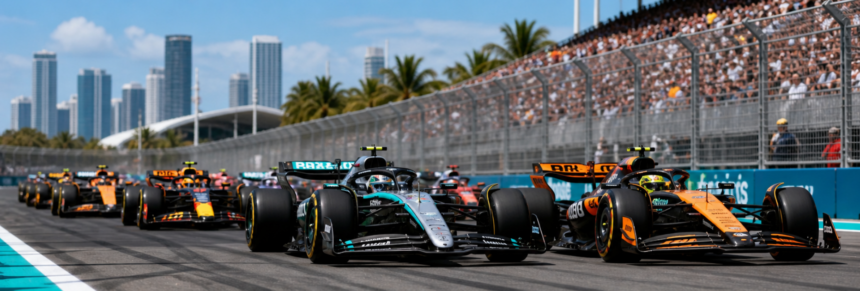
Kimi Antonelli won the 2026 Miami Grand Prix. Almost every team brought a new car. Mercedes barely changed theirs. The five-week F1 break changed the season — not in the way anyone expected.
The 2026 Miami Grand Prix delivered one of the most chaotic and technically compelling races of the year. Formula 1 returned on 3 May 2026 after a five-week break — the longest mid-season gap in recent memory. Teams used that window to overhaul their cars. Seven of ten constructors brought more than five upgrades each to the Miami International Autodrome. Ferrari led the upgrade battle with 11 new parts. Red Bull, McLaren, and Alpine followed closely. Mercedes brought just two changes. Then Kimi Antonelli — in that lightly updated Mercedes — won anyway.
The result fell like a heavyweight’s punch. Six teams spent their five-week break rebuilding cars from the floor up. The dominant team made minor tweaks. The gap that everyone hoped to close? It got smaller… but by much.
What’s Happening & Why It Matters
The 5-Week Break That Changed Everything — Almost
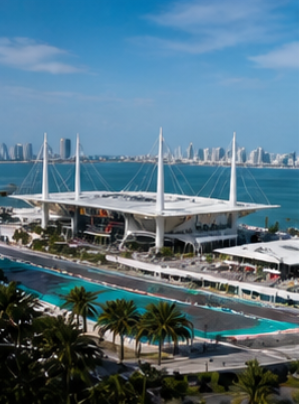
The 2026 F1 Miami Grand Prix was the fourth round of the season. The first three races — in Australia, China, and Japan — all ended the same way. Mercedes won. Kimi Antonelli took pole position and the race win in each one. The championship leader arrived in Miami nine points ahead of teammate George Russell in the standings. Mercedes held a 45-point lead in the Constructors’ Championship.
That context explains why the five-week break factored in so much. Every rival team treated April as a development sprint. Ferrari boss Frédéric Vasseur hinted before Suzuka that the championship picture would look “different” by Miami. Ferrari staff reportedly believed the upgrade package could change the “script” of the entire season. Italian newspaper La Gazzetta dello Sport described aerodynamic evolution across “practically every area” of the SF-26 — front wing, halo, rear wheels, underframe, and a debut of the so-called “Macarena wing.” The expectations inside the paddock were high.
The Upgrade Battle: 11 Parts vs. Two
Ferrari‘s 11-part upgrade package was the largest by any team at the 2026 Miami Grand Prix. The changes targeted aerodynamic load, front-corner flow stability, and rear-wing efficiency. Front wing endplates gained new vanes. Front suspension fairings changed profile. New floor geometry followed alongside sidepod and engine cover revisions. The package amounted to a substantial portion of the cost for a new car.
McLaren brought seven upgrades to the MCL40. The changes covered the front corner, engine cover, sidepods, floor body, rear corner, and rear wing — all targeting increased downforce and improved flow conditioning. Circuit-specific cooling louvres also arrived for Miami’s oppressive heat and humidity.
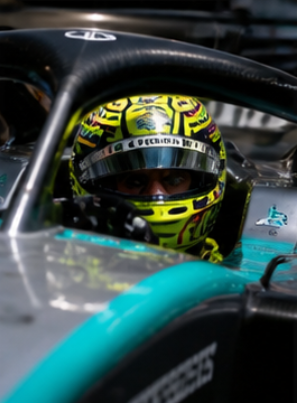
Red Bull overhauled its front wing, sidepods, floor, and rear corner. The changes addressed a known problem — a shifting, unpredictable balance that both Max Verstappen and Isack Hadjar had criticised all season. Red Bull also debuted its own version of the Macarena wing concept. Cadillac brought nine upgrades. Alpine introduced a new chassis for Franco Colapinto, along with a new rear wing.
Mercedes brought a revised front corner and a new tailpipe. That is it. Two changes while every rival was rebuilding.
Practice: Ferrari Flies, Mercedes Stutters
Free Practice 1 at the 2026 Miami Grand Prix ran for 90 minutes — extended from the standard 60 to account for it being the only practice session of a Sprint weekend. Charles Leclerc topped the session immediately in the upgraded SF-26, posting a 1:29.855 lap time. Max Verstappen finished second, 0.297 seconds back. Oscar Piastri was third in the McLaren.
Mercedes had a difficult hour. Antonelli suffered a power unit issue that prevented a soft-tyre run, leaving him fifth. George Russell reported unusual turbo noises — described as sounding like a “steam engine” — and finished sixth after a series of scrappy moments, including a lock-up and a wide run on a push lap. Sky Sports F1’s Karun Chandhok captured the mood: “What have Mercedes got in their pocket? Has George Russell been sandbagging? That’s the question mark coming out of this session as, otherwise, we’ve suddenly got three other teams in that fight.”
Qualifying and Sprint: Antonelli Responds
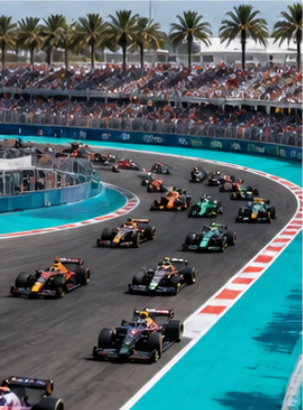
Antonelli claimed pole position for Sunday’s race — his third consecutive pole of the season. That achievement made him the first driver in F1 history to secure three poles from three race starts in 2026. Leclerc qualified strongly but admitted the straights at Miami cost Ferrari time. “On our side, we struggled with the tyres,” he told F1 TV. “The mediums were working very well, while with the softs we didn’t have good feelings.” The Saturday Sprint also delivered action. Verstappen won the Sprint race — providing Red Bull its first Sprint victory of the season and evidence that the upgrade package had worked.
Race Day: Chaos, Strategy, and History
The Miami Grand Prix race start moved three hours earlier due to a forecast of heavy thunderstorms. Organisers pushed the five-lights-out moment forward to ensure completion before the storms arrived. Rain had already fallen that morning, but the track was dry at the new start time, with clouds lingering overhead.
The opening lap produced immediate chaos. Antonelli launched from pole with Verstappen and Leclerc on either side. All three locked up in Turn 1. Verstappen made contact with Leclerc and spun 360 degrees, narrowly avoiding the rest of the field. Leclerc inherited the lead. Behind them, Lewis Hamilton collided with Colapinto at Turn 11, sending bodywork across the track. Separate incidents for Isack Hadjar and Pierre Gasly triggered the Safety Car in the opening laps.
Antonelli’s Masterclass: Undercut, Pace, and a Third Straight Win
From that chaotic start, the 2026 Miami Grand Prix settled into a tactical battle. The lead changed hands multiple times. Antonelli, Leclerc, Lando Norris, Piastri, and Verstappen all led at different points. Mercedes executed a decisive undercut strategy that vaulted Antonelli back to the front. From there, the Italian managed the gap to Norris over the remaining laps to seal victory.
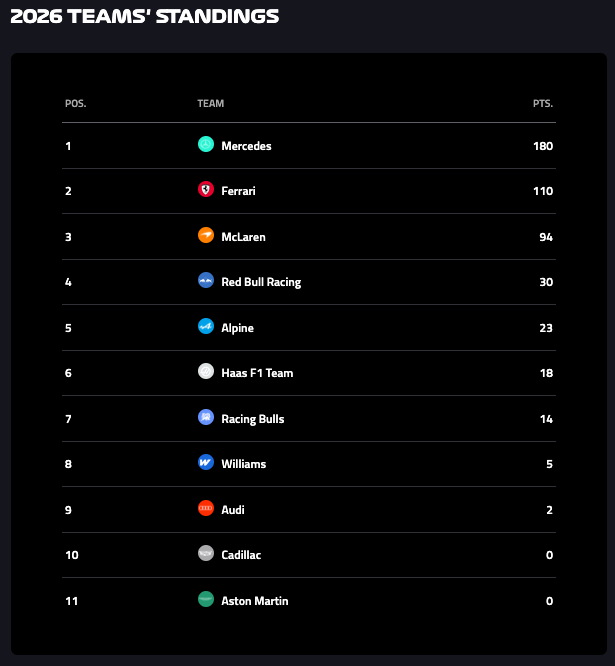
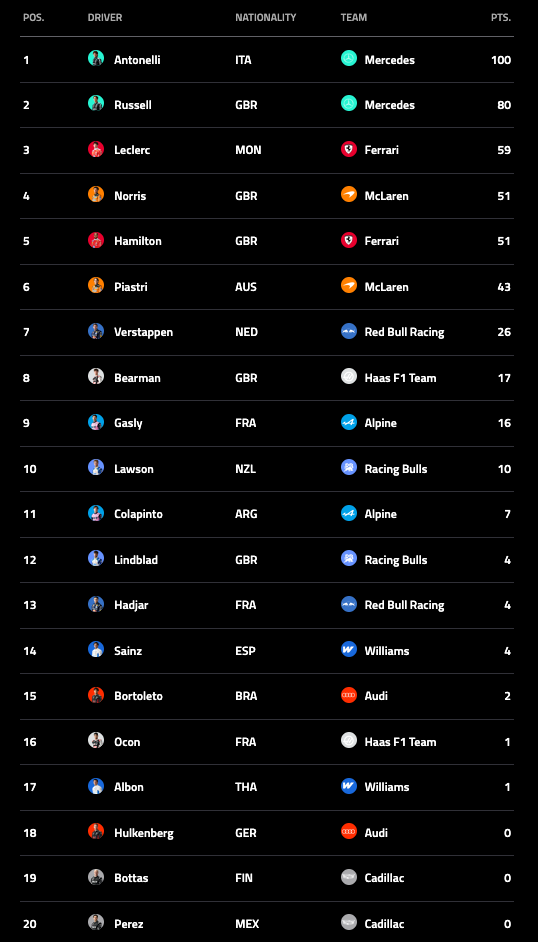
“The start was not as bad as yesterday — it was a little bit better,” Antonelli said after the race. “I didn’t expect Charles to brake that early, so to avoid him I locked up. I was a bit lucky with what happened in Turn 2.” He stated, “I did a little mistake with the energy management, trying to overtake Charles, then I lost a place to Lando. But then the pace was strong, I was able to stay close, and then the team did a great strategy. We did a massive undercut, and we managed to bring it home.”
The win made Antonelli the first driver to win three consecutive F1 Miami Grand Prix races from three consecutive pole positions — a record in the young history of the event. Norris finished second. Piastri took third. McLaren filled the podium’s two supporting slots, leaving Norris to lament: “How did we not win this?”
Did the Upgrades Work?
Leclerc finished fourth. His teammate Hamilton crossed the line sixth — recovering after the Turn 11 collision. On the upgrade verdict, Leclerc was measured: “The upgrades worked well, it’s just that everyone brought them, so we more or less expected the kind of situation where Mercedes probably still has the car to beat.” Hamilton was less satisfied: “I hoped it would be better. The car didn’t give me great sensations, honestly.”
The honest assessment from Miami is that the 2026 Miami Grand Prix upgrades closed the gap — but not enough. Ferrari is genuinely quicker than before. McLaren is quicker too. Red Bull took the Sprint win. But Mercedes won the race with a minimal upgrade, a great strategy, and a driver at the height of his form.
TF Summary: What’s Next
Formula 1 heads to Montreal for the Canadian Grand Prix on 22–24 May 2026. Mercedes has signalled a larger upgrade package is coming for Canada — holding back some development specifically for the Circuit Gilles Villeneuve. That announcement alone tells a story. If Mercedes dominated the first four races with a conservative development pace, the Canadian Grand Prix upgrade could extend its advantage rather than reduce it.
For Ferrari, McLaren, and Red Bull, the Miami upgrades are a foundation — not a ceiling. All three teams leave Florida with genuine evidence of pace improvement. Norris‘ question after the podium — “How did we not win this?” — reflects real frustration from a team that knows it had the tools to beat Mercedes on Sunday. The 2026 F1 season is still Antonelli‘s and Mercedes‘ — but the gap is closing, one upgrade package at a time.