


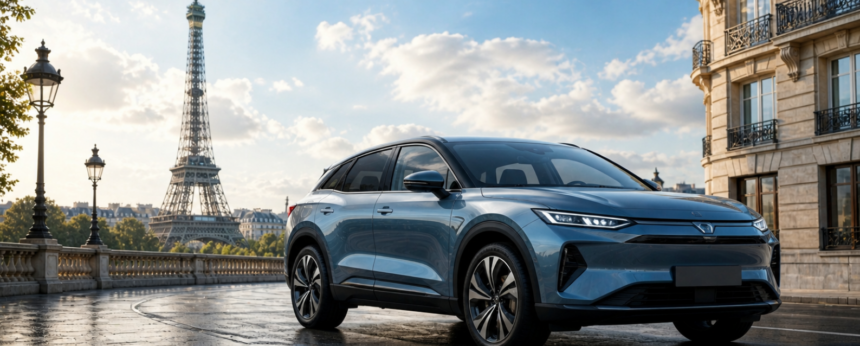
A Chinese car just topped the UK’s best-seller chart. Another Chinese brand is hiring BMW engineers in Munich for a 2027 launch. Europe’s auto industry is facing a reckoning.
In March 2026, a car that almost no one in Europe had heard of two years ago climbed to the top of the UK’s new vehicle sales chart. The Jaecoo 7 — a plug-in hybrid SUV built by Chery Automobile, China’s largest vehicle exporter — sold 17,951 units in the UK in a single month. That figure beat the Nissan Qashqai, the Kia Sportage, and every other SUV that British consumers have relied on for years. The Jaecoo 7 is priced at approximately £28,995 ($36,380 / €33,545) — thousands of pounds cheaper than comparable European alternatives — and it comes with a seven-year, 100,000-mile warranty that only Toyota and Lexus can rival.
Meanwhile, in Munich, Germany, Xiaomi Auto is quietly building something more disruptive. The Chinese tech giant — best known globally for smartphones — opened an EV R&D and Design Centre in Munich in 2025. The centre is led by former BMW executive Rudolf Dittrich and staffed by engineers recruited from BMW, Porsche, Mercedes-Benz, and Lamborghini. Xiaomi plans an official European launch in 2027. The two stories — one already underway, the other accelerating toward a deadline — together describe a structural shift in the European automotive industry that is no longer speculative.
What’s Happening & Why It Matters
The Jaecoo 7: Priced Like Temu, Styled Like a Range Rover
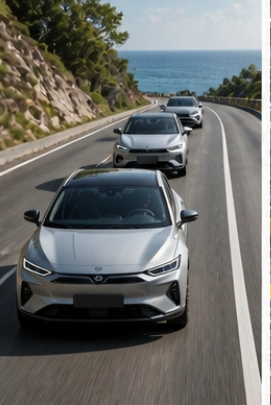
The Jaecoo 7’s rapid UK ascent is unusual by almost any measure in automotive history. Chery launched the Jaecoo brand specifically for international markets in 2023. The Jaecoo 7 went on sale in the UK in early 2025. Less than two years later, it is at the top of the monthly sales chart. Automotive observers have described the car’s styling as “more than a hint of Range Rover Velar” — with a ruler-straight shoulder line, a broad grille, and a rear light bar that reads as genuinely premium. Critics nicknamed it the “Temu Range Rover” — a comparison that captures both its visual ambition and its aggressive price positioning.
The pricing mathematics tell the real story. Chery Chair Yin Tongyue shared his own cost analysis with Reuters. A plug-in hybrid Jaecoo 7 costs Chery approximately $25,000 (€23,050) to manufacture and bring to market. The equivalent European-made SUV costs approximately $33,000 (€30,426). Materials costs in China run 40% lower than in Europe. Labour costs are four times lower. At the scale Chery operates — 2.8 million vehicles sold in 2025, of which 1.3 million were exported — parts procurement advantages compound those cost advantages further.
What the Jaecoo 7 Actually Offers Buyers
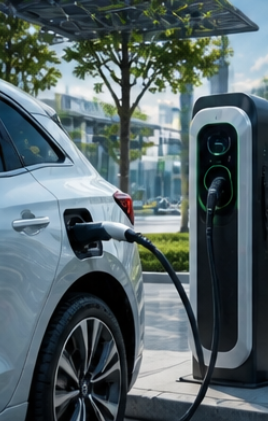
The Jaecoo 7 PHEV delivers 90 kilometres (56 miles) of pure electric range and a total combined range of 1,200 kilometres (746 miles). The system produces a combined 205 kW (275 hp) from a 1.5-litre turbocharged petrol engine and a 150 kW electric motor. The entry model includes a 13.2-inch infotainment screen, LED lights, heated front seats, and a full-length panoramic sunroof. The PHEV Luxury variant adds cooled front seats, a heated steering wheel, a 14.8-inch display, heated rear seats, and a Sony sound system. The car holds a five-star Euro NCAP safety rating from 2025 tests.
Automotive critics have not been uniformly enthusiastic. What Car? magazine gave the Jaecoo 7 a two-star review, citing a “fidgety ride, wayward handling and oversensitive safety systems.” The lane-keep assist is described as jerky and intrusive. Carwow concluded it “excels in some ways, but overall needs more time and effort to create a well-rounded package.” That assessment is alongside a different consumer verdict: the UK’s highest monthly car sales figure in March 2026. British buyer Ginny Buckley, founder of EV-buying website Electrifying.com, explained the disconnect directly. “While it’s not one of the best in its class to drive, it proves that many buyers care more about the in-car tech and extras such as heated seats and steering wheels.”
The EU Tariff Workaround That Chery Mastered
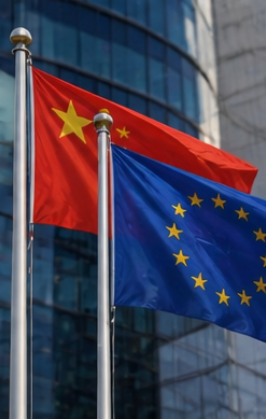
Europe introduced additional tariffs on Chinese-made battery-electric vehicles (BEVs) in October 2024. Those tariffs — reaching up to 45.3% for some manufacturers — have significantly slowed Chinese pure EV exports to the EU. Chinese hybrid vehicle exports responded differently. Plug-in hybrid exports to the EU surged 155% in 2025. Pure EV exports to the EU grew just 12% over the same period. The pattern is clear. Chinese manufacturers capable of supplying PHEV powertrains alongside or instead of pure EVs can reach European consumers while sidestepping the tariff burden. Chery launched the Jaecoo 7 PHEV in Germany at €36,900 — directly positioned within the EU tariff structure rather than above it. That is deliberate product strategy, not a coincidence.
Xiaomi: Made in China, Engineered in Germany
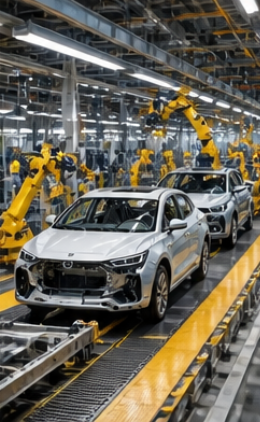
Xiaomi Auto represents a different category of Chinese EV challenger entirely. Where Chery competed on price, Xiaomi competes on performance, technology integration, and brand cachet. The company entered the EV market in March 2024 with the launch of its SU7 electric sedan. Since then, the pace of its automotive operation has been remarkable. Xiaomi delivered 411,800 vehicles in 2025 — its first full year of production. The company targets 550,000 deliveries in 2026. Its Beijing factory produces a new vehicle every 76 seconds. Over 90% of key production processes are automated, with more than 700 robots involved in manufacturing.
The SU7 Ultra — Xiaomi’s performance flagship — holds the Nürburgring production electric car lap record at 7 minutes and 4.957 seconds. That time beats the Porsche Taycan Turbo GT Weissach by over 2.5 seconds. It accelerates from 0 to 100 km/h (0 to 62 mph) in under two seconds and reaches a top speed of 350 km/h (217 mph). Ford CEO Jim Farley spent six months testing Xiaomi vehicles and commented: “Xiaomi’s software integration is well above what we offer today.” That assessment from the CEO of one of the companies Xiaomi plans to compete with is one of the more striking endorsements in recent automotive history.
The Munich R&D Centre: Poaching Europe’s Best Engineers
Xiaomi‘s Munich R&D and Design Centre is not a small satellite office. It is a deliberate infrastructure investment in European engineering credibility. Rudolf Dittrich — the centre’s director and a BMW veteran — described the approach at Auto China 2026. “Xiaomi is approaching that very methodologically, looking at data. We’re trying to get customer insights as much as we can.” The team includes engineers who developed the BMW M4 GT3, BMW 3 Series, Z4, X5, and X6. Former designers from Porsche, Lamborghini, and Mercedes-Benz also work at the centre. Xiaomi has hired former Tesla China executives alongside European automotive veterans.
The first vehicle to carry significant input from the Munich team is the YU7 GT — a performance SUV variant scheduled to debut in China in late May 2026. The YU7 GT is already undergoing undisguised testing at the Nürburgring. After the Chinese launch, the Munich team’s work will feed directly into the models Xiaomi plans to launch in Europe from 2027.
The EU Tariff Challenge Xiaomi Faces
Xiaomi manufactures exclusively in China. Under current EU rules, the company falls into the “other cooperating manufacturers” category — facing an additional duty of 20.7% on top of the standard 10% customs tariff. That gives a combined surcharge of approximately 30.7% before any minimum price agreement takes effect. The European Commission published new guidelines in January 2026 for a minimum price system negotiated with Beijing. Those guidelines could mitigate — but not eliminate — the tariff burden. Xiaomi has not announced plans for local production in Europe, unlike competitors BYD and XPENG. Starting prices in China range from approximately €27,000 for the standard SU7 to €64,000 for the SU7 Ultra. After tariffs, European pricing will shift materially. Parallel imports already price the SU7 in Germany between €73,000 and €98,000 — illustrating the gap that official tariff arrangements must close before Xiaomi‘s European value proposition can follow as intended.
What European Automakers Are Doing About It
The competitive pressure is visible in European automakers’ responses. Volkswagen is accelerating its own EV model refresh cycle. Renault has built a dedicated budget EV brand — Dacia Spring — specifically designed to compete on affordability. Stellantis formed partnerships with Chinese manufacturer Leapmotor to co-produce affordable EVs using Chinese platforms. BMW has deepened its manufacturing partnerships in China to offset cost disadvantages. These responses acknowledge the competitive reality — the cost advantage that Chinese manufacturers hold is structural, not cyclical.
TF Summary: What’s Next

Chery plans to maintain the Jaecoo 7 at the top of the UK chart through new model introductions and continued price competitiveness. The Jaecoo brand is expanding to Germany and France in 2026. Omoda — Chery’s urban-focused sister brand — is entering France this year with a 100-dealer network. A European expansion, covering additional powertrain variants and new segments, is targeted for 2027. The company’s stated goal is 1.4 million annual sales across Omoda and Jaecoo combined by 2030, excluding China.
Xiaomi targets auto division profitability in the second half of 2026 — a prerequisite for launching the European expansion from a position of financial strength. The company is targeting Germany as its first official European market, with the UK and Australia following in 2028 for right-hand-drive deployments. The SU7 Ultra is already approved for use on European roads. The YU7 GT — the Munich team’s first major project — launches in China by the end of May 2026. The European trajectory is set. The only remaining questions are pricing after tariffs and the pace at which Xiaomi‘s production can scale from 550,000 vehicles in 2026 to match European ambitions. By 2028, the European new car market will look materially different from today. Both stories above explain why.