


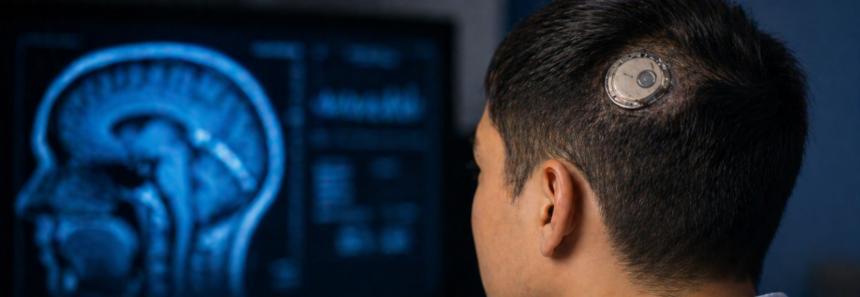
The size of a blueberry. Resting in the skull above the brain. It delivers electrical pulses wirelessly — no leads, battery, or brain tissue contact. The FDA said, “Let’s test it.”
On 27 April 2026, the US Food and Drug Administration (FDA) granted Motif Neurotech an Investigational Device Exemption — the regulatory green light needed to begin the first US clinical trial of a wireless brain implant specifically designed to treat treatment-resistant depression (TRD). The implant is called the DOT — short for Digitally programmable Over-brain Therapeutic. The clinical trial is called RESONATE. The population it targets is enormous: approximately 3 million Americans whose depression has not responded to at least two courses of standard medication or therapy.
The FDA approval makes Motif Neurotech the fastest implantable brain-computer interface company to move from founding to investigational device approval with a novel device — achieving the milestone just four years after the company’s establishment. That pace puts it ahead of every comparable neurotech startup in clinical development history.
What’s Happening & Why It Matters
What the DOT Implant Is — and What Makes It Different
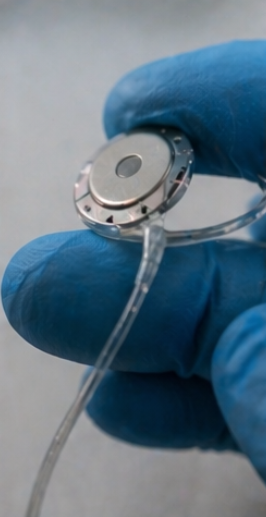
The DOT device is approximately the size of a blueberry. Surgeons place it directly into the bone of the skull — not into brain tissue. That placement is the key engineering distinction. The device sits above the dura mater — the protective membrane covering the brain — and delivers targeted electrical stimulation downward into the brain regions clinically linked to depression symptoms. Because no part of the device penetrates brain tissue, the surgical risks associated with traditional deep-brain stimulation (DBS) are significantly reduced.

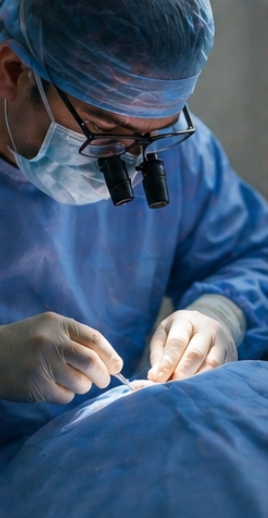
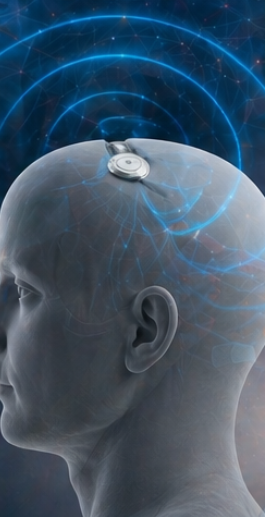
The entire implantation procedure takes approximately 20 minutes. It is performed on an outpatient basis — meaning patients go home the same day. There are no implanted batteries. No wires are running under the skin. The system operates on wireless power delivery using an external charging and activation device. Motif is developing a version of the system capable of monitoring brain signals in real time — allowing both patients and clinicians to build objective data on how the brain responds to stimulation and adjust therapy accordingly.
The “Continuous Glucose Monitor” Vision
Motif Neurotech CEO and co-founder Jacob Robinson — also a professor at Rice University in Houston — described the long-term vision with a medical analogy that makes the ambition clear. “The goal for this technology is that it would be the mental health equivalent of a continuous glucose monitor for diabetes,” he said. “What has been really special for me personally on this journey is to be able to work all the way from a concept through the process of research and development funded by the federal government at Rice, and take that into a product that is going to affect people’s lives for the better.”
That analogy is instructive. A continuous glucose monitor tracks blood sugar in real time. It does not replace insulin — but it makes insulin dosing far more precise and personalised. A brain stimulation device that monitors neural signals in real time could do the same for depression treatment — replacing fixed, one-size-fits-all stimulation protocols with adaptive, data-driven therapy that adjusts to each patient’s brain activity. That kind of closed-loop neurostimulation does not yet exist for depression at scale. The RESONATE trial is the first step toward making it real.
RESONATE Trial: Who, Where, and How
The RESONATE early feasibility study will enrol patients across eight leading US institutions. Trial sites include Baylor College of Medicine, Mass General Brigham, and NYU Langone Health. Each participant must have failed at least two courses of standard antidepressant treatment before qualifying for the study. Participants will be monitored for 12 months after implantation.
The trial’s primary goals are to validate safety and confirm feasibility. At this stage, Motif needs to demonstrate that the DOT can be implanted safely, that it delivers reliable stimulation to the intended brain region, and that the overall system functions as designed in human subjects. Efficacy data — clinical evidence that patients’ depression improves — will be reported as a secondary endpoint. Larger efficacy trials will follow if the RESONATE results support proceeding. Patient enrolment begins in 2026.
Why 3 Million Americans Are Waiting
Treatment-resistant depression is not a niche condition. It is one of the leading causes of disability and suicide in the United States. Approximately one in three people diagnosed with major depressive disorder does not respond adequately to antidepressant medications. Some face debilitating side effects — weight gain, sexual dysfunction, emotional blunting — that make sustained treatment impossible. Others try medication after medication without meaningful relief.
Existing options for treatment-resistant cases are limited and imperfect. Electroconvulsive therapy (ECT) is effective but carries stigma and requires general anaesthesia. Transcranial magnetic stimulation (TMS) is non-invasive but requires frequent clinic visits and produces inconsistent results across patients. Ketamine infusions offer rapid relief but are expensive and short-acting. Traditional deep-brain stimulation is surgically invasive. The DOT device is between TMS and DBS — more targeted than the former, far less invasive than the latter.
The Brain Stimulation Sector
The DOT approval does not arrive in isolation. It is part of an accelerating wave of neuromodulation approvals and trials reshaping the mental health treatment market.
In December 2025, the FDA approved Flow Neuroscience’s FL-100 — the first prescription at-home brain stimulation device for major depressive disorder. The FL-100 is a transcranial direct-current stimulation (tDCS) system priced between $500 and $800 (€461–€737). It uses a wearable headset rather than an implant. In Phase 2 clinical data, 58% of patients achieved remission after 10 weeks of use. Among global users, 77% reported symptom improvement within three weeks. The device launches in the US in Q2 2026.
At a different scale, Neuralink — Elon Musk‘s brain-computer interface company — raised an additional $650 million (€599 million) in 2025. Neuralink is already conducting human trials of a chip that allows people with severe paralysis to control devices using their thoughts. Five patients currently use the technology. In May 2025, the FDA granted Neuralink’s speech-restoration implant “breakthrough device” designation — the same status it had previously given the company’s vision implant, Blindsight. Neuralink’s target applications are motor and sensory restoration rather than depression treatment — but the category is the same: therapeutic brain-computer interfaces moving from research to clinical reality.
What Makes DOT Technically Distinctive
The DOT’s engineering represents a specific departure from the established approach to implantable neurostimulators. Traditional DBS devices require large implanted pulse generators — essentially an internal battery pack placed under the collarbone — connected to stimulating electrodes by wires threading through the body. Those batteries need surgical replacement every three to five years. The systems occupy significant internal volume and introduce infection risk along wire paths.
DOT eliminates all of that. No implanted battery or internal wires. No subcutaneous hardware beyond the skull-mounted device itself. Wireless power delivery means the energy source stays external. The programmable stimulation parameters mean a clinician can adjust therapy without additional surgery. Over time, if the signal monitoring capability reaches full development, the system could detect when stimulation is most needed — and deliver it automatically in response to real brain activity rather than on a fixed schedule. That is the closed-loop future that makes the glucose monitor analogy compelling.
TF Summary: What’s Next
Motif Neurotech begins enrolling patients in the RESONATE trial in 2026 across its eight partner institutions. The 12-month follow-up period means the first meaningful safety and feasibility data will not be publicly available before late 2027 at the earliest. If RESONATE supports proceeding to a larger pivotal trial, that second study would enrol hundreds of patients and generate the efficacy data needed to support a full FDA approval for commercial use. The commercial timeline for a cleared DOT device — if the science supports it — is most likely 2029 to 2031.
In the near term, the FDA approval is a genuine shift in how brain stimulation for mental health is being approached in the United States. The combination of the DOT trial for treatment-resistant cases, the Flow FL-100 at-home device for moderate-to-severe depression, and Neuralink’s parallel work on motor and sensory restoration together signals that therapeutic brain-computer interfaces are transitioning from academic research to regulated clinical products. The 3 million Americans with treatment-resistant depression who have exhausted standard options are at the front of that queue. The RESONATE trial does not promise them a solution. It promises them a serious attempt at one — which, for many, is more than they have had in years.
If you or someone you know is struggling with depression, support is available. The 988 Suicide and Crisis Lifeline can be reached by calling or texting 988 in the United States.