


China offers DeepSeek and Qwen to more than 40% of the world’s population, no strings attached, framed explicitly against American secrecy. The timing wasn’t subtle — it landed the morning after Anthropic’s CEO asked the industry to slow down.
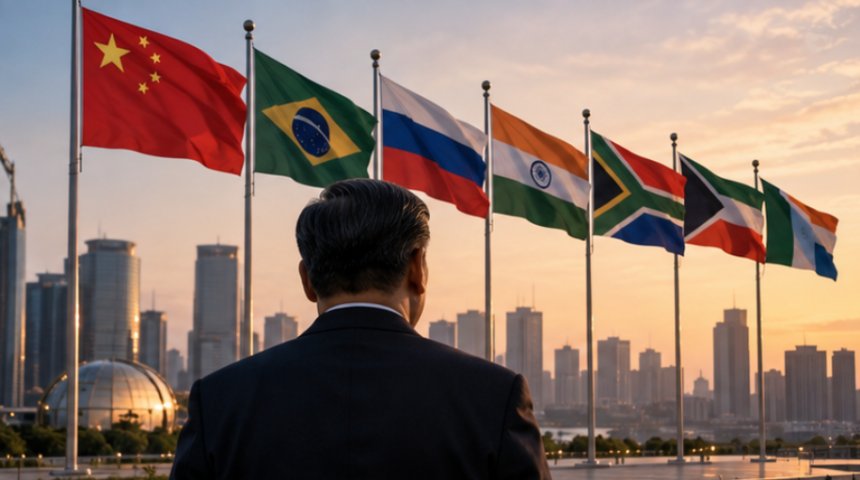
President Xi Jinping proposed a BRICS “open-source AI zone”, pledging China would lead the effort and offering member nations free access to Chinese-built large language models. The announcement came at the 18th BRICS Summit in New Delhi, representing 11 nations and more than 40% of the world’s population. Xi’s proposal arrived the morning after Anthropic CEO Dario Amodei published the essay TF covered in Amodei Says Rogue AI Swarms Could Take Over the Internet in Six Months — timing multiple outlets flagged as unlikely to be coincidental. Xi did not address the ongoing global safety debate his announcement landed inside.
What’s Happening & Why It Matters
Open Vs. Closed

The viewpoint here is not implied. Chinese AI companies produce world-leading open-source models — code accessible for anyone to inspect, adapt, and run independently — while American developers have favoured closed, proprietary approaches. Xi’s proposal, part of what state broadcaster CCTV described as his “initiative on open-source and inclusive AI,” included a specific commitment: China will “support cooperation in the development and application of large language models,” alongside establishing specialised AI research and training programmes for BRICS member nations, with the explicit goal of “building an open ecosystem for AI.”
The distinction connects to a debate TF has tracked throughout 2026. As reported in China vs. America: Who’s Winning the Tech War?, figures including AI pioneer Andrew Ng have already argued that open-weight models are, in some respects, safer than closed ones — because outside researchers can inspect and verify what they’re doing. Xi’s BRICS pitch takes that same argument and turns it into formal foreign policy, offering openness itself as the differentiator against American AI development.
DeepSeek and Qwen for Free

The specific offer on the table is concrete. China is pledging DeepSeek and Qwen-based tools to Global South nations at no cost — models that have already travelled further than most Western governments have acknowledged. DeepSeek’s R1 reasoning model and Alibaba’s Qwen series have together accumulated more than ten billion downloads. As TF covered in Kimi K3 Halts New Signups as Demand for the Chinese AI Model Skyrockets, Chinese open-weight models have already demonstrated global demand well beyond China’s own borders.
Xi also proposed a broader package alongside the AI initiative: a BRICS Special Economic Zone partnership, a BRICS engineer cultivation alliance, a youth exchange programme for scientific and technological innovation, and China hosting a BRICS Service Trade Forum next year. That’s a wider economic and diplomatic offer than AI access alone — positioning the AI zone as one component of a broader bid for Global South alignment, not a standalone tech announcement.
The Governance Language on Both Sides
Xi closed his remarks by calling for a “broad, consensus-based global AI governance framework” — language that echoes, almost precisely, the coordination calls TF documented from Western AI safety advocates throughout 2026. That’s a interesting convergence. Both the CEO of America’s most safety-focused AI lab and the president of China are using identical language about global coordination, even while proposing different mechanisms — Amodei calling for slower development and shared testing standards, Xi calling for open distribution and shared access.
Xi is expected to visit the United States later this month for direct talks with President Trump, with AI governance to feature in those discussions. That meeting — covered in TF’s earlier reporting on the accusations against six Chinese AI firms — carries an additional layer of complexity. Xi isn’t arriving to discuss AI governance from a defensive posture alone; he’s arriving having just proposed a concrete, funded alternative governance model to more than a third of the world’s nations days beforehand.

A Split Playing Out in Real Time
The contrast between Sunday’s two developments is stark. The morning Amodei published an essay asking the world’s most capable labs to slow down and coordinate on safety, Xi stood in New Delhi and made the functional opposite offer — not slower development, but faster, wider distribution, positioned as generosity toward nations excluded from frontier AI access. One is a call for restraint from inside the industry building the most capable closed models. The other is an offer of acceleration and openness from the country building the most distributed open ones.
TF Summary: What’s Next
The BRICS AI Open Source Zone has no confirmed operational timeline or specific funding commitment beyond Xi’s stated intent to lead its establishment. Xi’s US visit for talks with Trump is expected later this month, with AI governance anticipated as a discussion topic. No BRICS member nation has yet confirmed specific bilateral agreements stemming from Sunday’s proposal. China’s Foreign Ministry has not detailed how the open-source zone would interact with existing US-led export control frameworks TF has covered this year.
MY FORECAST: Expect several BRICS nations — Saudi Arabia, the UAE, and Indonesia, given their existing infrastructure investment appetite — to move on concrete bilateral AI partnerships with China within the next six months, given how Xi’s free-access offer undercuts the cost and export-control barriers those same nations face pursuing American AI infrastructure. The Trump-Xi meeting is higher-stakes as a result; Xi arrives with a demonstrated diplomatic win already banked, giving him leverage in any AI governance conversation rather than negotiating from the defensive position the earlier distillation accusations TF covered had put him in. Watch whether Amodei’s own call for international coordination gets cited by Chinese officials as evidence Western AI safety concerns validate, rather than undermine, Beijing’s open-source approach — a rhetorical judo move that would be consistent with how China framed this announcement’s timing.
Related Stories
- China vs. America: Who’s Winning the Tech War?
- AI: Safety U-Turns, Blocked Bioweapons, and a Fight With China
- Kimi K3 Halts New Signups as Demand for the Chinese AI Model Skyrockets