



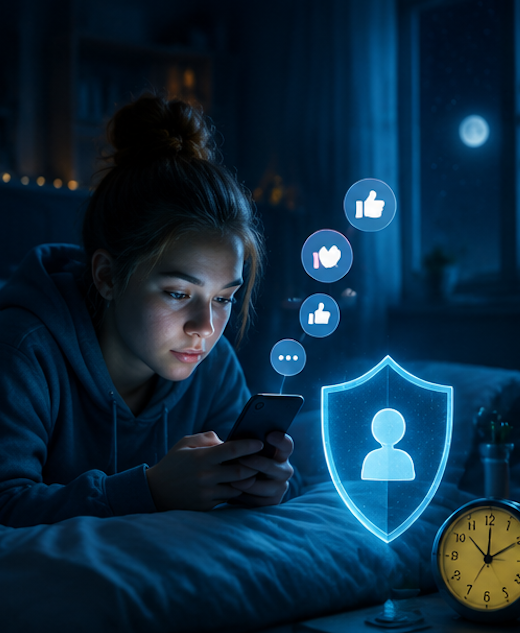
Instagram, TikTok, and YouTube would switch off by default between midnight and 6am for older teens. Autoplay and infinite scroll would deactivate too. But it’s opt-out, not enforced — a few taps and any teenager can switch it back on. The NSPCC calls it a “sticking plaster.” The Shadow Education Secretary calls it pointless.
The UK’s midnight social media curfew proposal was announced — expanding a youth online safety crackdown that began with the under-16 ban TF covered in June. The Labour administration outlined a six-hour default lockout from midnight to 6am for 16- and 17-year-olds on platforms including Instagram, TikTok, and YouTube. Under the proposal, highly engaging features — autoplay videos and infinite scrolling — would deactivate by default for the age group, aiming to encourage better sleep and focus. Online Safety Minister Kanishka Narayan confirmed the government has decided not to restrict VPN access as part of the oversight, despite earlier suggesting it might. Crucially, the curfew comes with a built-in escape hatch: older teens can switch it off with a few taps in their account settings.
What’s Happening & Why It Matters
A Softer Mechanism for an Older Age Group
The UK’s midnight social media curfew proposal deliberately targets a different age bracket with a different regulatory tool than June’s under-16 ban. As TF covered in its UK social media ban article, that earlier policy imposes a hard prohibition on under-16s. By contrast, ministers chose a considerably softer approach for 16- and 17-year-olds — a default setting rather than an enforced restriction. Narayan defended that distinction directly to Sky News: the government wanted to avoid outright bans for older teenagers, aiming instead for “a smooth slope into adulthood.”
Additionally, the proposals must still be formally legislated. The government plans to present the new rules before Parliament by the end of 2026, targeting implementation alongside the under-16 ban next spring — currently expected around spring 2027.
“Curfews They Can Simply Switch Off Won’t Achieve Anything”
The UK’s midnight social media curfew proposal faces direct criticism over its opt-out design from politicians on both sides. Shadow Education Secretary Laura Trott argued a curfew teens can switch off “fails to offer meaningful protection.” “Either they think 16- and 17-year-olds should be on social media or they don’t, but curfews they can simply switch off won’t achieve anything,” Trott said, according to the Associated Press.
The National Society for the Prevention of Cruelty to Children (NSPCC) welcomed the development while offering a similarly pointed caution. Chief executive Chris Sherwood warned that unless the government implements “further, stronger measures,” the policy will act only as a “sticking plaster” that fails to address the deeply addictive algorithms driving excessive screen time. By contrast, that critique mirrors almost exactly the language TF documented in the EU’s separate ruling against Meta — as covered in its EU Meta addictive design article, regulators globally are converging on the same diagnosis: engagement-maximising design, not just access timing, is the underlying problem.
Platforms Respond Citing Existing Safeguards
The UK’s midnight social media curfew proposal drew immediate pushback from the platforms it targets. A YouTube spokesperson argued that “blanket bans push kids out of curated, supervised, beneficial experiences and towards anonymous, less safe services.” TikTok‘s director of public policy for Northern Europe, Ali Law, told CNBC the platform already offers more than 50 preset safety settings for under-16 users, including a one-hour screen time limit and a 10pm prompt encouraging users to take a break.
Additionally, safety software providers say platforms will need to build new verification systems to segment users into three distinct compliance categories: under-16s facing a total ban, 16- and 17-year-olds subject to the default curfew, and unrestricted adults. That three-tier age verification requirement is a substantial technical build for every affected platform — considerably more complex than a single binary age check.
The Political Backdrop — a Government in Transition
The UK’s midnight social media curfew proposal arrives during a period of significant domestic political change. The policy’s implementation falls to incoming Prime Minister Andy Burnham, adding genuine political uncertainty to a framework that already faces criticism from both directions — child safety advocates calling the opt-out too permissive, and tech companies warning of unintended consequences for vulnerable teens. As TF has covered throughout 2026, the original under-16 ban was Keir Starmer’s signature child safety policy; its handover to a new premier introduces implementation risk that did not exist when the policy was first announced in June.
The UK’s layered approach — a full ban for under-16s, a default curfew for 16- and 17-year-olds, and looming AI chatbot restrictions — represents one of the most comprehensive youth social media regulatory frameworks attempted by any major Western democracy. It tests directly whether opt-out default settings can achieve meaningful behavioural change compared to Australia’s outright ban model, which TF has covered separately and which is already facing its own bypass challenges.
TF Summary: What’s Next
The government targets presenting the curfew proposal before Parliament by the end of 2026. Implementation is expected alongside the under-16 ban around spring 2027, pending consultation. Platforms must build the three-tier age verification infrastructure the proposal requires before either policy can take effect. The government has confirmed it will not restrict VPN access as part of the crackdown.
MY FORECAST: The UK’s midnight social media curfew proposal will pass Parliament largely unchanged — the political consensus behind youth online safety measures is strong across party lines, even where critics dispute the mechanism’s effectiveness. By contrast, the opt-out design will produce measurably weak compliance among the exact demographic most motivated to bypass it — 16- and 17-year-olds are considerably more technically capable of disabling default settings than younger children subject to the under-16 ban. Expect Australia’s under-16 ban bypass data, which TF has covered showing widespread circumvention, to primary evidence child safety advocates cite when asking for a mandatory rather than opt-out curfew within 12 to 18 months of the policy’s launch.
Related Stories
- Starmer Confirms Full UK Under-16 Social Media Ban — Here’s the Timeline
- EU Tells Meta: Disable Auto-Play and Infinite Scroll or Face Massive Fines
- UK Social Media Ban: How It Works, Who Backs It, and Who Doesn’t